Hypertensive Crisis Risk Checker
Check Your Medication Risks
This tool identifies potentially dangerous combinations that could cause severe hypertensive crisis. Always consult with your healthcare provider before making any medication changes.
When your blood pressure spikes to 220 over 130 in minutes-your head pounding, vision blurring, chest tight-you’re not having a bad day. You’re in a hypertensive crisis, and it could kill you before you reach the hospital. Most people think high blood pressure is a slow-burning problem, something you manage with pills and salt restrictions. But for thousands each year, it explodes suddenly-not from stress or poor diet-but from a simple, overlooked drug interaction. A common painkiller mixed with an antidepressant. Cheese with an old antidepressant. A cold medicine taken with a weight-loss pill. These aren’t rare accidents. They’re predictable, preventable, and happening right now.
What Exactly Is a Hypertensive Crisis?
A hypertensive crisis isn’t just high blood pressure. It’s when your systolic pressure hits 180 mmHg or higher, or your diastolic climbs past 120 mmHg, and your body starts shutting down. This isn’t a slow creep. It’s a storm. Blood vessels rupture. Kidneys fail. The brain swells. The heart strains until it can’t keep up. The difference between life and death often comes down to whether this spike is causing immediate organ damage. That’s called a hypertensive emergency. If there’s no damage yet, it’s a hypertensive urgency-but even then, you’re one step away from disaster. Most doctors focus on long-term control. But in emergency rooms across the U.S. and Europe, 1 in 5 of these sudden spikes aren’t from untreated hypertension. They’re from drugs. Not overdoses. Not abuse. Normal prescriptions, over-the-counter meds, even candy, interacting in ways no one warned you about.Drugs That Can Trigger a Crisis
Some medications are known risks. Others sneak in quietly. Here’s what actually causes these crises:- MAOIs (Monoamine Oxidase Inhibitors) like phenelzine or selegiline. These are antidepressants, often prescribed for treatment-resistant depression. They block an enzyme that breaks down norepinephrine. When you eat tyramine-rich foods-aged cheese, cured meats, draft beer, soy sauce-the norepinephrine surges. Blood pressure can spike 50 to 100 mmHg in under two hours. There are documented cases of patients waking up at 220/130 after eating cheddar. One Reddit user described three days in the ICU after a simple cheese sandwich.
- Venlafaxine (Effexor). This SNRI antidepressant is widely prescribed. At doses above 300 mg/day, it can cause diastolic pressure to climb past 90 mmHg. At 450 mg, the risk jumps dramatically. Yet many doctors don’t monitor BP in patients on venlafaxine unless symptoms appear. Patients report headaches and blurred vision for weeks before being told, “It’s just stress.”
- Cocaine and propranolol. Cocaine causes vasoconstriction. Propranolol blocks beta receptors, leaving alpha receptors unopposed. The result? Extreme, uncontrolled tightening of arteries. Systolic pressure can hit 220 mmHg within an hour. This combo is deadly even in small amounts.
- Cyclosporine. Used after organ transplants to prevent rejection. Up to half of transplant patients develop high blood pressure on this drug. The mechanism? Reduced sodium excretion and increased prostaglandins. But many doctors mistake it for organ rejection and increase the dose-making the hypertension worse.
- Licorice candy. Yes, candy. Glycyrrhizin in black licorice blocks an enzyme that normally protects your body from cortisol acting like a mineralocorticoid. This leads to sodium retention, potassium loss, and fluid overload. Blood pressure rises slowly-over weeks-but can become severe. One patient’s pressure dropped 30 points within two weeks after stopping daily licorice snacks.
- Decongestants like pseudoephedrine and phenylephrine. Found in cold and allergy meds. They’re stimulants. They tighten blood vessels. For someone on an antidepressant, blood pressure medication, or even just over 65, this can be enough to trigger a crisis.
- Sibutramine. A weight-loss drug banned in the U.S. since 2010 but still available online or in unregulated markets. It raises systolic and diastolic pressure by 7 mmHg in people already hypertensive. Even small doses can be dangerous.
Why Do These Interactions Fly Under the Radar?
Doctors aren’t ignoring you. They’re just not looking in the right places. A 2022 study found that 65% of emergency doctors don’t routinely ask about medication interactions when someone shows up with a sudden BP spike. Patients don’t think to mention their licorice habit or their nightly cold pill. They don’t know that “natural” doesn’t mean safe. They don’t realize their antidepressant and their sinus spray are a time bomb. FDA labeling has improved. Black box warnings now appear on MAOIs. But 78% of high-risk medications still lack clear warnings about hypertensive crisis potential-especially for off-label uses. Over-the-counter drugs? Only 12% of decongestant labels mention hypertension risk. That’s not negligence. It’s systemic failure. And it’s getting worse. Antidepressant prescriptions are rising 13% a year. Weight-loss drugs like phentermine are more accessible than ever. Older adults are taking more pills than ever before. The average 70-year-old takes six medications. Each one is a potential spark.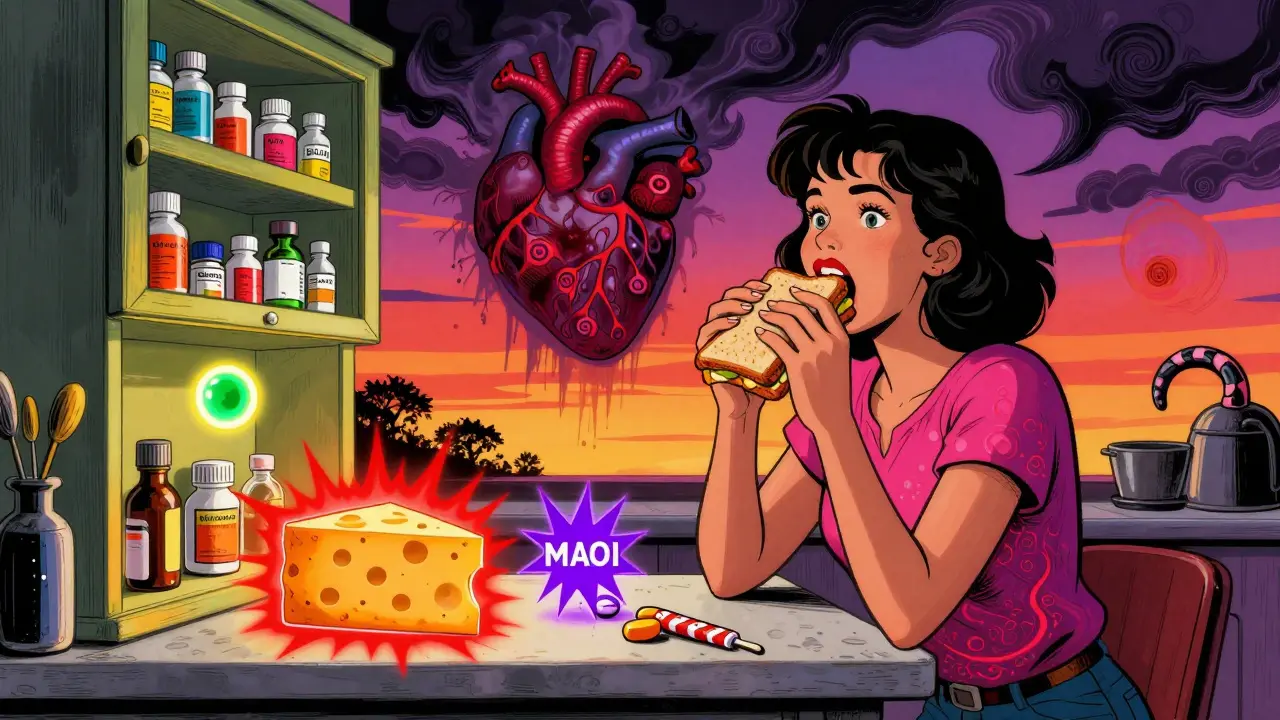
How Fast Does It Happen? The Timeline Matters
Not all crises unfold the same way.- MAOI-tyramine: 30 to 120 minutes after eating. Sudden, violent, deadly.
- Cocaine + beta-blocker: 30 to 60 minutes. Explosive. Often fatal if not treated immediately.
- Venlafaxine (high dose): Days to weeks. Gradual, ignored, then sudden.
- Cyclosporine: Weeks to months. Mistaken for rejection.
- Licorice: Weeks to months. Slow, silent, reversible.
What Happens If You Don’t Act?
A hypertensive emergency isn’t just “really high BP.” It’s:- Brain hemorrhage or stroke
- Heart attack or heart failure
- Acute kidney injury
- Retinal damage leading to blindness
- Aortic dissection-the tearing of the main artery
How to Prevent It
Prevention isn’t complicated. It’s just rarely done.- If you’re on an MAOI: Avoid aged cheese, cured meats, tap beer, soy sauce, fermented foods, and red wine. Use the “MAOI Diet Helper” app-it improved adherence by 78% in a Mayo Clinic trial.
- If you’re on venlafaxine: Ask your doctor to check your BP monthly if you’re on more than 225 mg/day. The 2024 ACC guidelines now classify this as “high risk.”
- Always check with your pharmacist before taking any new OTC medicine, supplement, or herb. Even “natural” stimulants like ephedra or guarana can trigger a crisis.
- Know your meds. If you’re on cyclosporine, get your BP checked every two weeks for the first three months. If your pressure rises, don’t assume it’s rejection-ask about the drug.
- Report it. If you experience unexplained high BP after starting a new drug, report it to MedWatch (FDA). One patient’s report led to the discovery that licorice candy was causing severe hypertension in multiple users.
What to Do in an Emergency
If your BP is above 180/120 and you have symptoms-severe headache, chest pain, blurred vision, nausea, confusion-call 911. Don’t wait. Don’t try to “wait it out.” Emergency treatment depends on the cause:- MAOI-tyramine: IV phentolamine (5-15 mg). Works in under 20 minutes. 92% effective.
- Cocaine-induced: Benzodiazepines first (lorazepam), then labetalol or nitroprusside. Avoid beta-blockers alone-they make it worse.
- Cyclosporine: Calcium channel blockers like amlodipine. 78% effective.
- Mineralocorticoid excess (licorice, steroids): Stop the drug. Potassium replacement. Spironolactone may help.
The Future: Technology Is Finally Catching Up
The FDA approved its first AI-powered decision-support tool in January 2023. It scans a patient’s entire medication list and flags dangerous combinations in real time. In trials, it cut MAOI-related emergencies by 40%. New genetic tests can now identify people with CYP2D6 polymorphisms-those who metabolize antidepressants slowly and are 3.2 times more likely to have a severe reaction. The NIH is testing a system called the “Hypertension Interaction Alert System,” which predicts severe events with 92% accuracy by analyzing 15,000+ drug interactions. But tech won’t help if doctors don’t use it. If patients don’t speak up. If we keep treating high blood pressure like a numbers game instead of a life-or-death signal.Final Warning
You don’t need to be a drug addict or a medical outlier to have a hypertensive crisis. You just need to be taking two things that shouldn’t be taken together. One is a prescription. One is a candy bar. One is a cold pill you bought without a thought. Ask your doctor: “Could any of my meds, even the OTC ones, cause my blood pressure to spike?” Ask your pharmacist: “Is this safe with what I’m already taking?” And if you’re on an MAOI? Don’t eat the cheese. Not even a little. Your life might depend on it.Can over-the-counter cold medicine cause a hypertensive crisis?
Yes. Decongestants like pseudoephedrine and phenylephrine are stimulants that constrict blood vessels. When taken with MAOIs, antidepressants like venlafaxine, or even certain blood pressure medications, they can cause sudden, dangerous spikes in blood pressure. Many people don’t realize these are active drugs, not harmless remedies. Always check with a pharmacist before taking any OTC product if you’re on multiple medications.
How long should I wait after stopping an MAOI before taking another antidepressant?
The American Heart Association recommends a 2-week washout period for most MAOIs. But for irreversible MAOIs like phenelzine, the European Society of Hypertension advises 4 to 5 weeks. This is critical because MAOIs linger in your system. Taking an SSRI or SNRI too soon can cause serotonin syndrome or a hypertensive crisis. Never rush this transition.
Is licorice candy really dangerous for blood pressure?
Yes, especially black licorice. It contains glycyrrhizin, which blocks an enzyme that protects your body from cortisol acting like a mineralocorticoid. This causes sodium retention, potassium loss, and fluid buildup-leading to high blood pressure. Even a few pieces a day for a few weeks can cause measurable increases. Blood pressure often normalizes within two weeks of stopping, but damage can occur before you realize it.
Why do doctors miss drug-induced hypertensive crises?
Because they’re trained to look for primary hypertension, not drug interactions. A 2022 study found that 65% of emergency physicians don’t routinely screen for medication interactions in patients with sudden high BP. Patients often don’t mention OTC drugs, supplements, or diet habits. Even when they do, the connection isn’t made. It’s a gap in training, not carelessness.
Can I still take venlafaxine if I have high blood pressure?
It depends. At doses under 225 mg/day, venlafaxine is generally safe with monitoring. Above that, it’s classified as high risk. If you have existing hypertension, your doctor should check your BP monthly and consider alternatives like bupropion or SSRIs with lower hypertensive potential. Never increase your dose without discussing blood pressure risks.
What’s the most dangerous drug interaction for hypertensive crisis?
The most dangerous is MAOI combined with tyramine-rich foods or stimulants like cocaine or amphetamines. This combination can cause systolic pressure to exceed 250 mmHg within minutes. Mortality rates reach 30% if untreated. It’s preventable-but only if you know the risk. Many patients don’t realize their antidepressant and their favorite snack are a lethal mix.
Are there any apps or tools to help avoid these interactions?
Yes. The “MAOI Diet Helper” app, developed by Mayo Clinic, helps users track tyramine-rich foods and alerts them to dangerous combinations. The FDA’s new AI-powered decision-support tool, now used in major hospitals, scans medication lists and flags high-risk interactions in real time. Pharmacists also use tools like Lexicomp and Micromedex. Ask your pharmacist if they use one.
Luke Crump
January 7, 2026 AT 21:23So let me get this straight-you’re telling me my cheddar on crackers is a silent assassin? And my doctor never warned me? I mean, I get it, but also… this is what happens when medicine becomes a spreadsheet and not a human conversation. We’re not talking about nuclear codes here, we’re talking about cheese. Cheese, people. The thing we put on burgers. The thing toddlers lick off their fingers. And now it’s got a 30% kill rate? That’s not a medical alert. That’s a horror movie trailer.
Molly Silvernale
January 8, 2026 AT 14:01It’s not the drugs… it’s the silence. The quiet, unspoken assumption that if it’s sold over the counter, it’s safe. If it’s natural, it’s harmless. If it’s prescribed, it’s sacred. We’ve turned healthcare into a game of Russian roulette with pill bottles and snack aisles. And no one’s asking who’s loading the gun. The real tragedy isn’t the spike-it’s that we’ve normalized the risk. We’ve made ‘I didn’t know’ the default excuse. But knowledge isn’t a luxury-it’s the only thing standing between a Tuesday and a funeral.
Annette Robinson
January 10, 2026 AT 07:06I’m a nurse, and I’ve seen this happen. A sweet elderly lady came in with a BP of 230/140-she’d been eating licorice every day for three weeks because she thought it was ‘just candy.’ She didn’t think it was a drug. She didn’t think her doctor needed to know. We had to pull her off it, give her potassium, and monitor her for days. She cried because she thought she’d ruined her life. But she didn’t. She just needed someone to ask. Please, if you’re on meds-tell your pharmacist everything. Even the ‘harmless’ stuff. They’re trained to care. They just need you to talk.
Aubrey Mallory
January 11, 2026 AT 09:30Let’s be real-this isn’t about education. It’s about profit. Pharma doesn’t want you to know that your OTC cold medicine could kill you. They don’t want you to know that your antidepressant and your cheese sandwich are a death combo. They make billions selling the pills. The warnings are buried because transparency kills margins. And until we treat Big Pharma like the industry it is-not a savior-we’ll keep burying people under labels they never read.
Dave Old-Wolf
January 13, 2026 AT 08:08Wait, so if I take a cold pill and I’m on an antidepressant, I could have a stroke? That’s wild. I had a cold last winter and took Sudafed. I didn’t think anything of it. I’m on Zoloft. Should I be worried? I mean, I’m fine now, right? But what if I didn’t know? This is scary. I’m gonna call my doc tomorrow.
Prakash Sharma
January 14, 2026 AT 08:41This is why the West is weak. You people treat medicine like a grocery list. In India, we know a pill is a weapon. We ask our elders, our doctors, our priests. We don’t just pop things because they’re ‘available.’ You think cheese is safe? In my village, we know every herb, every spice, every root has power. You don’t mix things blindly. You learn. You respect. This isn’t a crisis of medicine-it’s a crisis of ignorance. Stop treating your body like a toy.
Donny Airlangga
January 15, 2026 AT 15:37My mom had a hypertensive crisis last year. They found out it was because she was taking melatonin and a blood pressure med she didn’t tell anyone about. She thought melatonin was ‘just a sleep aid.’ No one told her it could interact. She’s fine now, but she’s terrified to take anything. I think this needs to be on every prescription label. Like, a big red stamp. Not fine print. Not a footnote. A red stamp.
Kristina Felixita
January 15, 2026 AT 21:00okay so i just found out my favorite black licorice candy is basically a slow poison?? like… i eat like 3 pieces a day?? and i’m on an ssri?? this is a whole vibe shift. i just deleted the app that tells me how many calories are in it and downloaded the MAOI diet helper. i’m not even mad. i’m just… grateful. thank you for this post. i feel like i just got a second chance. 🫂
Joanna Brancewicz
January 17, 2026 AT 14:32MAOI-tyramine interaction: Class I risk. SNS overstimulation → catecholamine surge → vasoconstriction → end-organ damage. Clinical presentation: HTN emergency with neurologic or cardiac compromise. Diagnostic clue: recent dietary exposure + MAOI use. Treatment: phentolamine IV. Prognosis: 92% survival with prompt intervention. Prevention: patient education + AI-driven CDS integration. Mandatory pharmacist counseling. Not optional.
Evan Smith
January 19, 2026 AT 00:56So… if I eat cheese and take Effexor, I’m basically playing Jenga with my brain? And the doctor’s like, ‘Nah, you’re fine’? I mean, I get it-doctors are overworked. But this isn’t just a ‘oops’-this is a system failure. Someone needs to make a TikTok about this. Like, ‘Don’t eat cheese if you’re on antidepressants’ with a dramatic zoom-in on a cheddar slice. It’d go viral. And maybe-just maybe-someone would live because of it.
Lois Li
January 20, 2026 AT 05:09I’ve been on an MAOI for two years. I’ve never eaten cheese. I’ve never had a sip of red wine. I’ve never taken a cold pill without checking with my pharmacist. I don’t do it because I’m scared. I do it because I’m alive. And I want to be here for my kid’s graduation. For my sister’s wedding. For Sunday pancakes. This isn’t about restrictions. It’s about freedom. The freedom to live without a bomb ticking in your body. Thank you for writing this. I’m not alone.
christy lianto
January 21, 2026 AT 07:28My husband’s on venlafaxine. He’s been getting headaches for months. He thought it was stress. I thought it was him being ‘overworked.’ We didn’t connect it. Until last week-he woke up with blurred vision. We rushed to the ER. His BP was 210/128. They found out it was the dose. They lowered it. He’s better now. But if we’d waited another week… I don’t want to think about it. If you’re on any antidepressant and you feel off-don’t wait. Don’t ignore it. Ask. Demand. Push. Your life isn’t a footnote.