Side Effect Tracker
Track Your Side Effects
3
1 = Mild, 5 = Severe
When to Report to Your Doctor
Report immediately if:
- Severity 4 or 5
- Severe or worsening symptoms
- Symptoms affecting daily life
- Unusual reactions
Track consistently for:
- Patterns emerging over time
- Linking symptoms to specific activities
- Informing your next doctor visit
Your Tracking History
No entries yet. Start tracking your side effects below.
When you take a new medication, the side effects listed on the label aren’t the whole story. What you see in the package insert comes from clinical trial data-a tightly controlled snapshot of how the drug performed in a small group of carefully selected patients. But what happens when millions of people start using it in the real world? That’s where real-world side effects come in, and they often tell a very different story.
Why Clinical Trials Don’t Show the Full Picture
Clinical trials are designed to answer one question: Does this drug work under ideal conditions? To do that, researchers control everything-age, health status, other medications, even how often patients show up for check-ups. Participants are carefully screened to exclude people with other illnesses, pregnant women, older adults with multiple conditions, or those taking other drugs that might interfere. This creates a clean, predictable environment-but it’s nothing like the messy reality of everyday life. For example, a phase 3 cancer trial might include only 381 patients. That’s enough to spot common side effects like nausea or fatigue, but not rare ones. If a side effect affects just 1 in 500 people, it’s statistically invisible in a trial that size. Yet when a drug hits the market and millions start taking it, those rare reactions show up. That’s how rosiglitazone, a diabetes drug approved in 1999, ended up being linked to a 43% higher risk of heart attacks-something clinical trials never caught. The data collection process itself is rigid. Side effects are recorded only during scheduled visits, using a standardized scale called CTCAE v5.0, which lists 790 specific symptoms with severity levels from 1 (mild) to 5 (death). But patients don’t live in clinics. They feel side effects at home, at night, while working, or while caring for kids. A patient might not mention mild dizziness during a 15-minute doctor’s visit, but they’ll log it in a health app every evening. That’s why 63% of patients report side effects not listed in their FDA-approved labeling-many of them moderate to severe.What Real-World Data Reveals That Trials Miss
Real-world data comes from places clinical trials can’t reach: emergency rooms, pharmacy records, insurance claims, electronic health records from 9,500 U.S. hospitals, and even social media. The FDA’s Adverse Event Reporting System (FAERS) alone received over 2.1 million reports in 2022-up from 1.4 million in 2018. That’s not just numbers. It’s real people describing what happened. Real-world evidence exposed the heart failure risk linked to pioglitazone after 10 years of use, based on data from over 190,000 patients. It flagged disabling side effects from fluoroquinolone antibiotics-like tendon ruptures and nerve damage-after analyzing 1.2 million patient records in Europe. These weren’t surprises in labs. They were patterns emerging from actual use. Digital tools are accelerating this. The MyTherapy app, used by 1.2 million people, found a 27% higher rate of fatigue with immunotherapy drugs than clinical trials reported. Why? Because patients tracked symptoms daily, not just during clinic visits. One user wrote: “The trial only asked about fatigue during office visits, but I experienced it worst at home in the evenings.” That kind of detail never makes it into a trial report.The Flip Side: Real-World Data Isn’t Perfect Either
Real-world data isn’t magic. It’s noisy. A 2019 study found only 2-5% of actual side effects are ever reported to FAERS. Most patients don’t know how to report them. Doctors are overwhelmed-only 12% consistently file reports because it takes an average of 22 minutes per case. And not all signals are real. In 2018, real-world studies suggested anticholinergic drugs caused dementia. But deeper analysis showed the real culprit was the underlying conditions-like depression or urinary incontinence-that led people to take those drugs in the first place. The medication wasn’t the cause; it was a marker for something else. Data quality is another issue. Only 34% of adverse events recorded in electronic health records have enough detail for regulators to act on. One doctor might write “patient felt tired,” another might note “fatigue, grade 3, worsening after 3 weeks, associated with nausea.” Without standardization, it’s hard to compare or trust the data.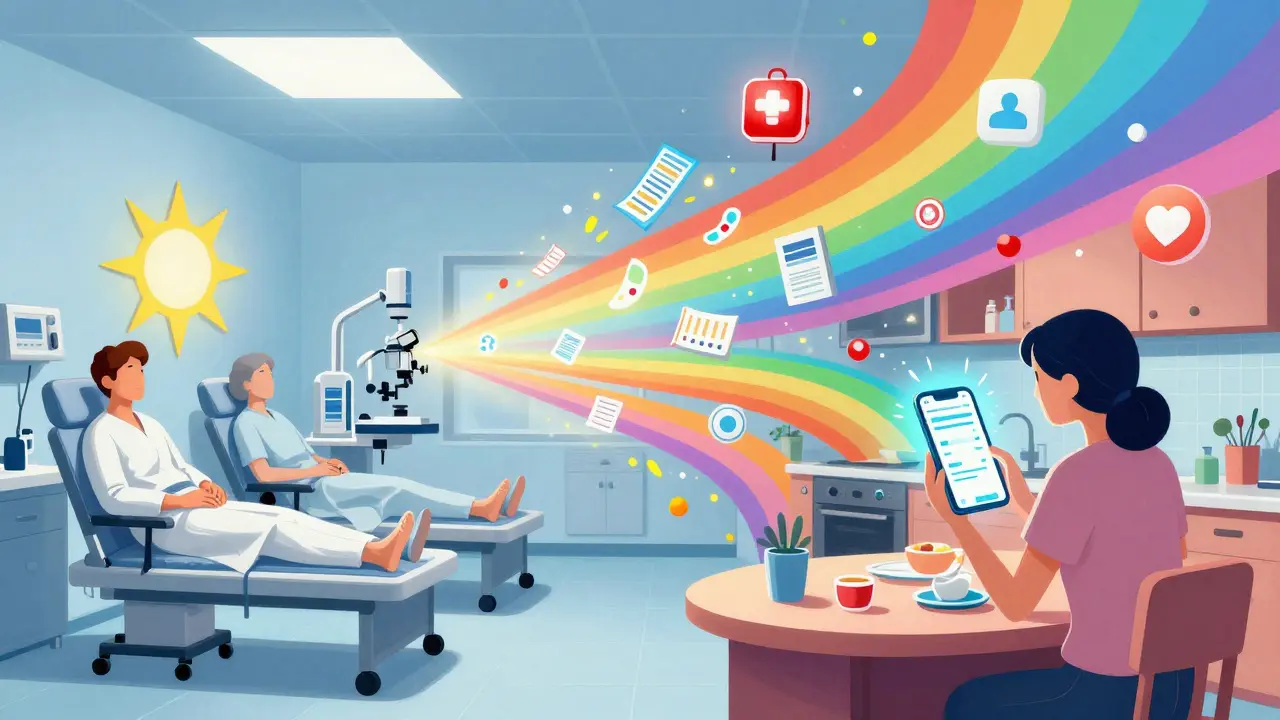
How the FDA Uses Both Types of Data
The FDA doesn’t pick one over the other. It uses them together. Clinical trials give the first safety seal of approval. Real-world data watches what happens after that seal is broken. Since the 21st Century Cures Act in 2016, the FDA has been required to use real-world evidence in regulatory decisions. Between 2019 and 2021, 87% of new drug approvals included real-world data in their post-marketing safety plans. In 2022, 67% of approvals did-up from just 29% in 2017. The FDA’s Sentinel Initiative monitors 300 million patient records in near real-time. It uses 17 different statistical methods to spot unusual patterns. When a signal shows up-like a spike in liver injury after a new drug launch-it triggers an investigation. That’s how the agency caught the heart failure risk with pioglitazone years before clinical trials could have seen it. But there’s a catch: real-world data can’t prove cause like a trial can. It can only suggest. That’s why the FDA still requires clinical trials for initial approval. Real-world evidence doesn’t replace trials-it completes them.What This Means for Patients and Doctors
If you’re a patient, understand that the side effect list on your prescription isn’t final. New ones can appear months or years later. If you notice something unusual-especially if it’s persistent or worsening-track it. Use a journal, an app, or even a simple note on your phone. Report it to your doctor. And if they don’t know how to file a report, ask them to contact the FDA’s MedWatch program. For doctors, interpreting both data types is becoming essential. A 2023 study found only 38% of physicians could correctly read real-world evidence without special training. That’s a problem. If you see a pattern in your practice-say, three patients on the same drug all developing severe dizziness-you’re not imagining it. You’re seeing early real-world evidence. Document it. Share it. It might save someone else.

Wendy Claughton
January 18, 2026 AT 21:37Wow, this is so important. I’ve been tracking my fatigue with MyTherapy since starting immunotherapy, and the app flagged something my doctor dismissed as ‘just stress.’ Turns out, it was a known but unlisted side effect. Thank you for highlighting this. We need more people sharing real experiences.
Aysha Siera
January 20, 2026 AT 19:58Big Pharma hides the truth. They know these drugs kill slowly. The FDA is just a puppet. Watch what happens when they approve the next one.
Andrew McLarren
January 21, 2026 AT 20:58Thank you for this comprehensive and nuanced overview. The integration of real-world evidence into regulatory frameworks represents a critical evolution in pharmacovigilance. While clinical trials remain the gold standard for establishing causal efficacy and safety, the longitudinal, population-level insights derived from real-world data are indispensable for identifying rare, delayed, or context-dependent adverse effects. The synergy between these paradigms is not merely complementary-it is foundational to patient-centered medicine.
Andrew Short
January 23, 2026 AT 14:09Of course the trials don’t show the real risks. They’re designed to lie. The FDA approves drugs to protect shareholders, not patients. You think they want to know about the 1 in 500 heart attacks? They’d rather bury it until the patent expires.
Danny Gray
January 25, 2026 AT 09:32Isn’t it funny how we treat medicine like a perfect machine? We build these clinical trials like cathedral rituals-clean, silent, holy-and then act shocked when the real world, with its messy bodies and chaotic lives, breaks the glass. Maybe the problem isn’t the data. Maybe it’s our delusion that control = truth. The body doesn’t care about your inclusion criteria. It just reacts. And it remembers.
Stacey Marsengill
January 26, 2026 AT 04:29I’ve been on three different meds in the last five years. Two had side effects that weren’t listed. One made me cry uncontrollably at 3 a.m. I told my doctor. He shrugged. So I posted it on Reddit. Two weeks later, another woman said the same thing. That’s not a fluke. That’s a warning sign they’re too lazy to see.
Ryan Otto
January 26, 2026 AT 11:54Let us be precise: the statistical power of Phase III trials is deliberately underpowered to expedite approval. The 1 in 500 adverse event? That’s not an oversight-it’s a calculated risk. Regulatory bodies operate under economic imperatives, not epistemic ones. The FAERS system, with its 2-5% reporting rate, is a statistical black hole. And yet, we treat this as science. This is not science. This is risk arbitrage disguised as public health.
Andrew Qu
January 27, 2026 AT 11:29If you’re on a new medication, keep a simple log: date, symptom, time of day, what you ate, sleep quality. Even just 3 lines a day gives your doctor way more than ‘I feel tired.’ I’ve helped patients spot patterns that led to dose changes-no ER visits, no hospitalizations. It’s not magic. It’s just paying attention.
Tyler Myers
January 28, 2026 AT 09:22They don’t want you to know this. The whole system is rigged. You think they’d let you see the raw data? Nah. They bury it. And then they charge you $500 for a pill that gives you nerve damage. Wake up. This isn’t healthcare. It’s a profit pipeline.
Emma #########
January 29, 2026 AT 18:02Thank you for writing this. My mom had a reaction to a drug no one could explain until she started tracking it. Now she uses an app. It’s changed everything. We need more people like you speaking up.
Nishant Sonuley
January 30, 2026 AT 23:54Look, I get it-clinical trials are clean, controlled, and boring. But real-world data? It’s chaotic, biased, and full of noise. A guy says he got dizzy after taking the pill… but he also drank three energy drinks and pulled an all-nighter. Is it the drug? Or is it his life? We can’t just trust anecdotes. We need better systems-standardized symptom logging, AI-assisted pattern detection, patient-reported outcome tools built into EHRs. Not just ‘post it on Reddit’ and call it science.
Robert Cassidy
January 31, 2026 AT 23:33Real-world data is just woke medicine. They’re letting social media decide what’s safe. Next thing you know, we’ll ban aspirin because some influencer said it made her ‘feel emotionally drained.’ This isn’t progress. It’s mob rule disguised as science.
Jodi Harding
February 2, 2026 AT 17:48They missed the fatigue. Again. Just like with the antidepressants. Just like with the statins. We keep seeing the same pattern. The system isn’t broken. It’s designed this way.
Naomi Keyes
February 4, 2026 AT 13:18And yet… you still take the pill. You still click ‘accept’ on the terms. You still trust the system. Why? Because you have no choice. And that’s the real tragedy-not that the data is flawed, but that we’ve been trained to accept flawed systems as inevitable. You’re not powerless. You’re just comfortable pretending you are.