Medication Food Timing Checker
Check Your Medication Food Timing
Enter your medication name to see if it should be taken with food or on an empty stomach. This tool is based on FDA guidelines and clinical research.
Have you ever taken a pill with your morning coffee, only to wonder if it even worked? You’re not alone. Around 65% of people ignore food timing instructions for their meds - and many don’t even realize it matters. But skipping this simple step can cut drug effectiveness by half or turn a mild side effect into a hospital visit. The difference between taking your medicine with food or on an empty stomach isn’t just a suggestion - it’s science.
Why Food Changes How Your Meds Work
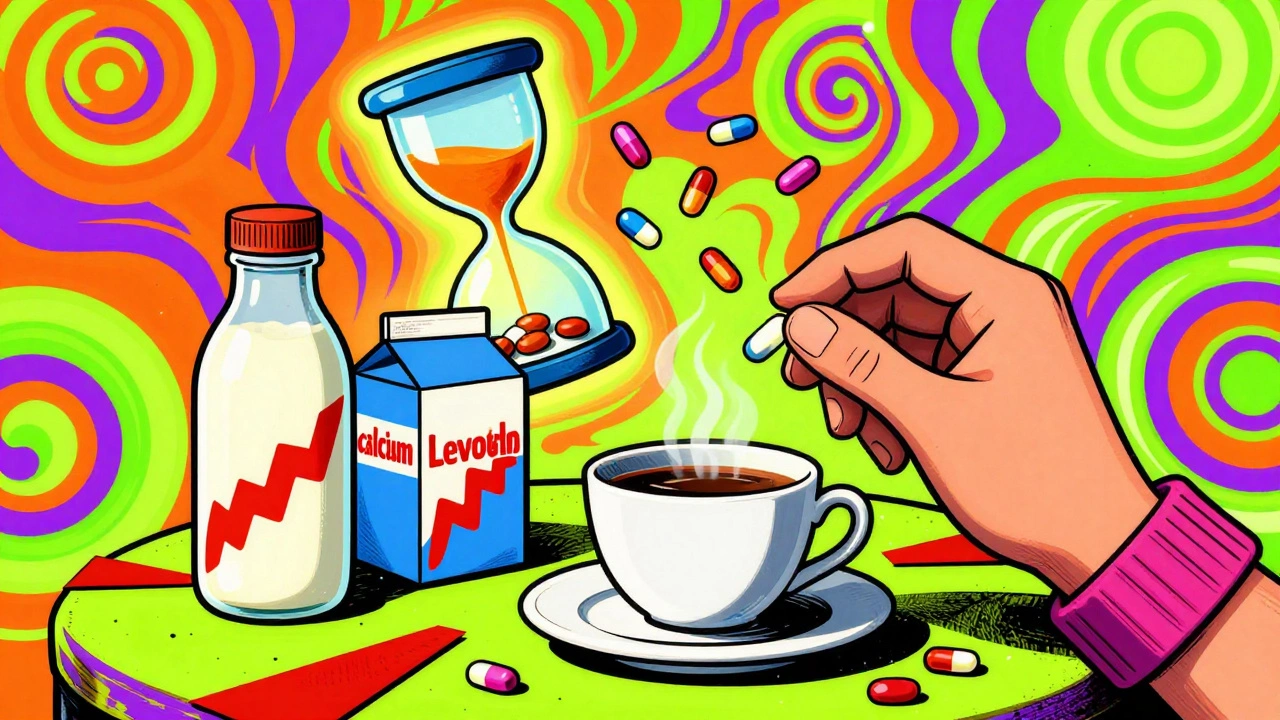
Your stomach isn’t just a passive container. When you eat, your body goes into digestion mode: acid levels rise, bile flows, enzymes activate, and food slows down how fast everything moves through your gut. All of that affects how drugs get absorbed. Some drugs need acid to dissolve. Others get destroyed by it. Some need fat to be absorbed. Others bind to calcium in milk or iron in your multivitamin. Even the caffeine in your coffee can interfere. A 2022 study from the University of California found that penicillin V breaks down 40% faster when stomach pH rises after eating. That means less drug reaches your bloodstream - and less protection against infection. Food also changes how fast your stomach empties. A high-fat meal can delay it by two hours or more. For a drug like levothyroxine - which needs to be absorbed quickly on an empty stomach - that delay can drop absorption by 20% to 50%. That’s not just inconvenient. It’s dangerous. Your thyroid hormone levels can swing wildly, making you tired, gaining weight, or feeling anxious - even if you’re taking the right dose.Medications That Must Be Taken on an Empty Stomach
These are the ones you can’t afford to ignore:- Levothyroxine (Synthroid): Taken first thing in the morning, at least 30 to 60 minutes before breakfast. Food, coffee, soy, calcium, and iron can all block absorption. One patient on Reddit reported two years of erratic TSH levels - until they realized their morning latte was the culprit. Now they take it at 4 a.m. and wait 90 minutes.
- Alendronate (Fosamax): This osteoporosis drug must be taken with a full glass of water, 30 minutes before eating. If you take it with food, absorption drops by 60%. That means your bones don’t get the protection they need.
- Sucralfate (Carafate): Used for ulcers, this drug forms a protective coating over damaged tissue. But it only works if your stomach is empty. Take it 1 hour before meals - not during.
- Ampicillin: This antibiotic’s absorption drops 35% with food. Peak levels fall, and total exposure (AUC) drops 28%. That’s enough to make treatment fail.
- Zafirlukast (Accolate): A 40% drop in absorption with food. Take it at least 1 hour before or 2 hours after eating.
- Omeprazole (Prilosec) and Esomeprazole (Nexium): These proton pump inhibitors block acid production. But they only work if taken before food triggers acid release. Nexium specifically needs to be taken at least 1 hour before breakfast. Take it after eating? Healing rates for esophagitis drop from 93% to 67%.
For these, the rule is simple: 1 hour before or 2 hours after eating. That’s the standard definition of "empty stomach" used by pharmacists and the FDA. No snacks. No gum. No water with lemon. Just plain water - and patience.
Medications That Need Food to Work Right
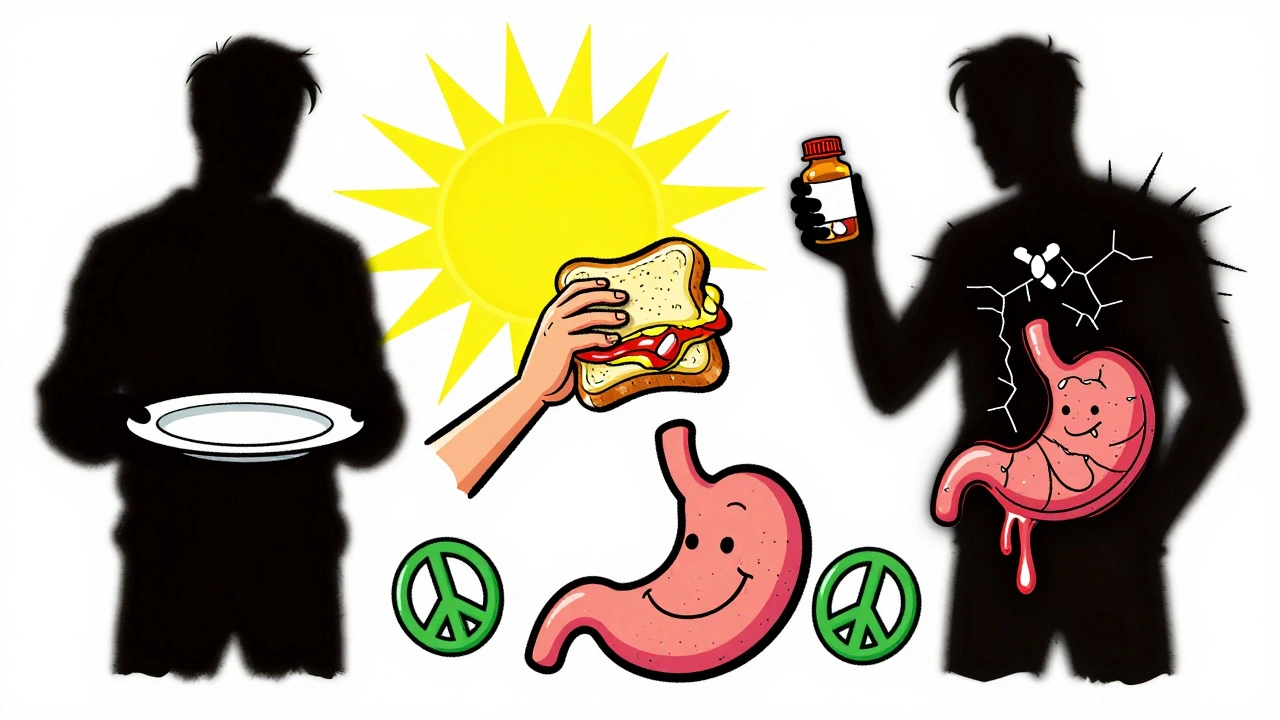
Not all meds hate food. Some actually need it to do their job - or to keep you from getting sick.- NSAIDs (Ibuprofen, Naproxen): These painkillers irritate your stomach lining. Taking them without food raises your risk of ulcers by 50-70%. The American College of Gastroenterology says 10,000 to 20,000 hospitalizations a year from NSAID damage could be avoided if people just ate first. One patient on HealthUnlocked said taking naproxen with food cut their stomach pain from daily to once a month.
- Aspirin (high dose): For pain relief, take it with food. It cuts gastric irritation from 25% down to 8%.
- Duloxetine (Cymbalta): This antidepressant causes nausea in many people. Taking it with food lowers nausea by 30%.
- Statins (Atorvastatin, Simvastatin): Food helps your body absorb these cholesterol drugs better. But here’s the catch: grapefruit juice is deadly with them. It can spike blood levels by 300-500%, raising your risk of muscle damage (rhabdomyolysis) by 15 times. Avoid it completely.
- Griseofulvin: This antifungal needs fat to dissolve. Take it with a meal that has some oil or butter - otherwise, you’re wasting your money.
For these, the rule is: take with a meal of 500-800 calories. That’s about a sandwich with cheese, a bowl of cereal with milk, or a small stir-fry. A handful of crackers won’t cut it.
What Happens When You Get It Wrong
Ignoring food timing isn’t just a habit - it’s a health risk. A 2023 Drugs.com analysis of over 12,000 patient reviews found that 37% of complaints about PPIs were because people took them after meals. They thought they were helping their heartburn - but they were making it worse. Thyroid patients are the most affected. The Institute for Safe Medication Practices reports that 22% of all medication errors involving food timing involve levothyroxine. One woman in a 2022 Express Scripts survey took her Synthroid with her breakfast smoothie - and didn’t realize her TSH levels were off until her doctor told her she needed a 30% higher dose. That’s the equivalent of missing a quarter of your doses every day. NSAIDs are the second most common mistake. In the same survey, 58% of people took ibuprofen or naproxen without food. Of those, 73% ended up with stomach pain. That’s not just discomfort - it’s bleeding, perforation, emergency care. And the cost? It’s huge. The American Pharmacists Association says 30% of medication non-adherence comes from confusion over food timing - costing the U.S. healthcare system $290 billion a year.How to Get It Right - Simple Rules
You don’t need a pharmacy degree to get this right. Just follow these three steps:- Check the label. Look for "take on empty stomach" or "take with food." If it’s unclear, ask your pharmacist - not your doctor. Pharmacists are trained specifically for this and are 92% more likely to give you clear instructions than physicians.
- Use the 2-1-2 Rule. For empty stomach meds: take them 2 hours after eating, or 1 hour before your next meal. For food-requiring meds: take them during or within 30 minutes of a meal.
- Use tools. Pill organizers labeled "Before Food" and "With Food" improve adherence by 35%. Apps like Medisafe send reminders with food cues. CVS and Walgreens now put color-coded stickers on bottles: red for empty stomach, green for with food. In one pilot, that simple change boosted correct use from 52% to 89%.
For complex regimens - say, you take levothyroxine, a statin, and an NSAID - stagger them. Take levothyroxine at 7 a.m. on an empty stomach. Eat breakfast at 8 a.m. with your statin and NSAID. That way, everything works as it should.
What’s Changing - And What’s Coming
Pharma companies are finally catching on. Johnson & Johnson’s new version of Xarelto uses a special coating that works the same whether you eat or not - a breakthrough. University of Michigan researchers are testing nanoparticle levothyroxine that ignores food entirely. These could eliminate food timing for some drugs in the next few years. But here’s the truth: 75% of today’s medications still need careful timing. Even if new drugs come out, you’ll still be taking older ones - and they’re not going away. The FDA now requires food-effect testing for 92% of new drugs, up from 65% in 2015. That means more labels will tell you exactly when to take them. But you still have to read them.Final Tip: Ask Your Pharmacist
Your doctor prescribes the drug. Your pharmacist makes sure it works. They see hundreds of patients every week. They know which meds are tricky. They’ve seen the mistakes. They’ve helped people fix their TSH levels, stop stomach bleeding, and get their pain under control - all by changing when they took their pills. Next time you pick up a prescription, ask: "Should I take this with food or on an empty stomach?" Don’t assume. Don’t guess. Don’t wait until you feel worse. Because sometimes, the difference between feeling fine and feeling awful isn’t the medicine - it’s the timing.Can I take my medication with just a sip of water?
Yes - as long as it’s plain water. Avoid coffee, juice, milk, or anything with calcium, iron, or fat unless your medication specifically says it’s okay. For empty stomach meds, even a glass of orange juice can interfere. Stick to water to be safe.
What if I forget and take my pill with food?
Don’t panic. Don’t double up. If you took a food-requiring med without food, wait until your next meal and take it then. If you took an empty stomach med with food, wait at least 2 hours after eating, then take your next dose as scheduled. Never take two doses close together - it’s unsafe. Just get back on track.
Why does grapefruit juice interact with statins?
Grapefruit juice blocks an enzyme in your gut (CYP3A4) that normally breaks down statins. That means more of the drug enters your bloodstream - sometimes 3 to 5 times more. That raises your risk of muscle damage, kidney failure, and rhabdomyolysis. Even one glass can cause this effect for 24 hours. Avoid grapefruit and Seville oranges completely if you’re on atorvastatin, simvastatin, or lovastatin.
Do I need to avoid food for all antibiotics?
No. Only certain ones. Ampicillin, tetracycline, and doxycycline are affected by food - especially dairy and calcium. But others like amoxicillin, azithromycin, and ciprofloxacin are fine with food. Always check the label or ask your pharmacist. Don’t assume all antibiotics work the same way.
Can I take my thyroid med at night instead of in the morning?
Yes - if you can keep it consistent. A 2022 study in the Journal of Clinical Endocrinology & Metabolism found that taking levothyroxine at bedtime, at least 3 hours after your last meal, works just as well as morning dosing - and some patients even prefer it. The key is consistency: same time, same conditions, every day. Don’t switch back and forth.
Are over-the-counter meds affected by food too?
Absolutely. Ibuprofen, naproxen, and aspirin all need food to protect your stomach. Even some supplements - like iron or zinc - absorb better with food. And calcium supplements can interfere with thyroid meds and antibiotics. Always read the label on OTC drugs - they’re not harmless just because they’re available without a prescription.

Gilbert Lacasandile
December 10, 2025 AT 04:33Man, I had no idea my morning coffee was messing with my thyroid med. I’ve been taking Synthroid with my latte for years and wondering why I’m always tired. Switched to water and waiting 90 minutes - felt like a new person in two weeks. Thanks for the clarity.
Also, I started using those color-coded stickers from CVS. Game changer. My pill organizer finally makes sense now.
Guylaine Lapointe
December 11, 2025 AT 01:03Let’s be clear: this article is technically accurate but dangerously oversimplified. The FDA doesn’t define ‘empty stomach’ as ‘one hour before’ universally - that’s a pharmacokinetic approximation, not a regulatory standard. Many drugs have food-effect studies with complex curves, not binary rules.
Also, ‘take with food’ doesn’t mean ‘any snack.’ A single cracker won’t do anything for statins. You need 500+ calories with lipids. And why no mention of grapefruit’s effect on calcium channel blockers? This reads like a BuzzFeed list dressed up as clinical guidance.
Maria Elisha
December 12, 2025 AT 14:18So basically, if I don’t want to die, I have to become a pharmacist? I take 7 pills a day. I can’t keep a spreadsheet on when to eat around each one.
Also, I’m pretty sure my pharmacist just says ‘take it however works for you’ and moves on. Why do they even give us labels if no one follows them?
Angela R. Cartes
December 13, 2025 AT 17:51OMG I’m so relieved I’m not the only one who forgot to take my levothyroxine before coffee 😭
Now I just take it at 11pm after dinner. No more 5am alarms. My TSH is stable, my energy’s better, and I’m not sobbing over oatmeal anymore. 🙌
PS: Grapefruit juice is the devil. I used to drink it daily. Now I just stare at it like it owes me money. 🍊❌
Anna Roh
December 15, 2025 AT 10:57My doctor told me to take my ibuprofen with food. I thought that meant ‘as long as you’ve eaten today.’ So I took it after a bag of chips at 2 a.m.
Turns out, that’s not food. That’s a crime against your stomach.
Now I eat a banana with it. It’s not glamorous. But I’m not in the ER anymore. Sometimes the simplest fix is the one you ignore the longest.
om guru
December 16, 2025 AT 11:43Adherence to pharmaceutical instructions is a matter of discipline and respect for the science of pharmacokinetics. The human body is not a machine to be manipulated by convenience. Consistency in timing, dietary context, and hydration determines therapeutic efficacy.
It is not the fault of the medication if the patient fails to honor the protocol. The responsibility lies with the individual to align behavior with biological reality.
Education is the cure. Not labels. Not apps. Not stickers. Discipline.
Katherine Chan
December 17, 2025 AT 00:33I used to stress so much about getting everything perfect - until I realized most people just need to get 80% right.
If you take your statin with a sandwich instead of a full meal? Still better than on an empty stomach.
If you forget your thyroid med once and eat breakfast? Just take it 2 hours later. You’re not failing. You’re learning.
Progress > perfection. And yes - ask your pharmacist. They’re the real MVPs.
Also - you’re doing better than you think. 💪
Tiffany Sowby
December 17, 2025 AT 23:23Why is this even a thing? In my country, people just take their pills when they remember. No one cares about ‘food timing.’ We don’t have time for this nonsense.
And now you’re telling me grapefruit juice is dangerous? I’ve been drinking it since I was 12. My body knows what it’s doing.
Also, why do Americans make everything so complicated? Just take the pill. End of story.
Asset Finance Komrade
December 18, 2025 AT 15:42One might argue that the entire paradigm of food-mediated drug absorption is a construct of industrial pharmacology - a mechanism designed to enforce behavioral compliance, thereby increasing patient dependence on institutional authority.
Is it not curious that the very substances meant to restore balance require such rigid temporal discipline? Are we not, in essence, being trained to submit to the clock?
Perhaps the future lies not in nanoparticle levothyroxine... but in the dissolution of the medical-industrial complex itself. 🌱
Just a thought.