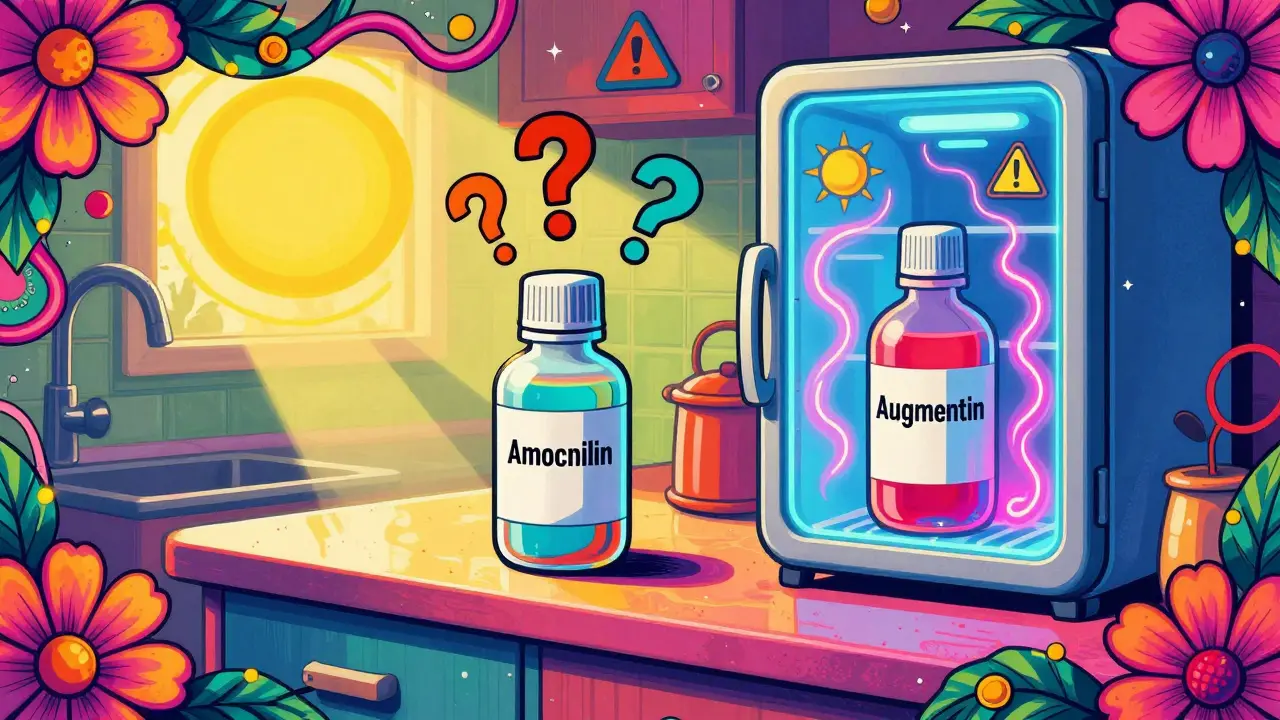
Storing liquid antibiotics the right way isn’t just a suggestion-it can mean the difference between an infection clearing up and turning into something worse. Many parents, caregivers, and even some adults don’t realize that once you mix a powder with water, the clock starts ticking. And not all liquid antibiotics need the fridge. Some actually break down faster if you chill them. If you’ve ever thrown out half a bottle because you weren’t sure if it was still good, or left it on the counter and worried it lost its power, you’re not alone. Here’s exactly how to handle them-no guesswork, no myths, just clear, practical rules based on real medical guidance.
Not All Liquid Antibiotics Need the Fridge
A lot of people assume: liquid medicine = must be refrigerated. That’s not true. Refrigerating certain antibiotics can make them less effective. For example, some formulations of amoxicillin clavulanate (like Augmentin) are designed to stay stable at room temperature. The key is checking the label or asking your pharmacist. The Cleveland Clinic says amoxicillin suspension can be stored at room temperature between 20-25°C (68-77°F) if you don’t have fridge space. But if you do have a fridge, it’s still fine to use it-just don’t assume it’s required.
On the flip side, some antibiotics like certain penicillin-based suspensions do need refrigeration between 2-8°C (36-46°F) to stay potent. The FDA requires manufacturers to test each drug’s stability under different conditions, so the instructions on the bottle aren’t random-they’re based on lab data. If the label says "refrigerate," do it. If it doesn’t, don’t chill it unless your pharmacist says so.
How Long Do Reconstituted Antibiotics Last?
Once you mix the powder with water, the expiration date changes. The original bottle might say "expires in 2027," but that’s for the dry powder. After mixing, the clock resets. Here’s what you need to know:
- Amoxicillin (alone): Lasts up to 14 days at room temperature or in the fridge. The Cleveland Clinic recommends discarding after 14 days regardless of storage.
- Amoxicillin/clavulanate (Augmentin): Lasts 10 days if refrigerated, but some studies show it’s still stable for 5 days at room temperature (27-29°C). Still, most pharmacists recommend 10 days max to be safe.
- Cephalexin suspension: Usually lasts 14 days in the fridge or at room temperature.
- Azithromycin suspension: Lasts 5 days at room temperature. Do not refrigerate-cold can make it clump and taste worse.
Why the difference? Some antibiotics break down faster than others. The JAPSONLINE study (2013) found that in combination drugs like co-amoxiclav, the amoxicillin part stays stable longer than the clavulanate part. That means even if the medicine still looks fine, the clavulanate might have lost strength, leaving you with an antibiotic that won’t fully fight the infection.
What Happens If You Store Them Wrong?
Improper storage doesn’t make antibiotics toxic-it makes them weak. And weak antibiotics don’t kill bacteria. They just train them to survive.
According to Baystate Health (2023), when antibiotics lose potency because of heat, sunlight, or time, infections don’t clear up. That means your child might keep coughing, your ear infection might come back, or a simple skin infection could spread. Worse, this contributes to antibiotic resistance-a global health threat the FDA and WHO are fighting hard to slow down.
Heat and sunlight are the biggest enemies. Never leave antibiotics on a windowsill, in a car, or near the stove. Even a hot bathroom cabinet can degrade them. The FDA says temperature and humidity accelerate deterioration-not just during shipping, but in homes too. One study found that in areas with unreliable power, up to 40% of reconstituted antibiotics were stored improperly, leading to treatment failure.

How to Store Them Right
Follow these simple rules:
- Check the label-it’s your best guide. Look for "Store at room temperature," "Refrigerate," or "Do not freeze."
- Keep it in the original bottle-it’s designed to block light and moisture. Don’t transfer it to a different container.
- Use a marked syringe or dosing cup-not a kitchen spoon. Household spoons vary too much in size. A teaspoon might hold 3ml or 7ml. That’s a huge difference in dose.
- Shake well before each use-suspensions settle. If you don’t shake, you might give half the dose.
- Keep it out of reach of children-many look like juice. A child drinking a whole bottle can have serious side effects.
- Don’t freeze-freezing can damage the structure of the drug. This applies to insulin, vaccines, and antibiotics alike.
- Traveling? Use a small cooler with a cold pack if you need refrigeration. For room-temp meds, keep them in your bag, not the car’s glove compartment.
What to Do When It’s Gone Bad
You can’t tell if an antibiotic has lost potency just by looking at it. It might still look clear and smell fine. But if it’s past the discard date, throw it out. Don’t take chances.
Don’t flush it down the toilet or toss it in the trash where kids or pets can get to it. The FDA recommends taking unused medicines to a drug take-back program. Many pharmacies, hospitals, and police stations have drop-off boxes. If that’s not available, mix the liquid with something unappetizing-like cat litter, coffee grounds, or dirt-pour it into a sealed container, and throw it in the trash.

When in Doubt, Ask Your Pharmacist
Pharmacists are trained to know the exact storage rules for every antibiotic they dispense. If you’re unsure whether your child’s amoxicillin needs the fridge, or if the 10-day mark has passed, call them. They’ll tell you what to do. Don’t rely on internet advice or old habits. Every brand, every batch, every formulation is different.
Also, always finish the full course-even if your child feels better after two days. Stopping early lets surviving bacteria multiply and become resistant. Proper storage ensures the full dose stays effective until the last sip.
Special Cases and Newer Formulations
Some newer antibiotics are being designed to last longer at room temperature. For example, newer versions of cefdinir and cefuroxime suspensions are more stable without refrigeration. But even these have limits. Always follow the manufacturer’s instructions.
For families without reliable refrigeration-especially in rural areas or during power outages-the JAPSONLINE study (2013) found that storing suspensions in cool, dark places (like a basement or shaded cupboard) can help extend stability. But this is a last-resort option. It’s not ideal, and it doesn’t replace proper storage.
Manufacturers are working on better formulations, but until then, the rules are simple: Read the label. Follow the clock. When in doubt, throw it out.
Can I refrigerate amoxicillin even if the label doesn’t say to?
Yes, you can refrigerate amoxicillin even if it’s not required-it won’t hurt it. But don’t freeze it. If the label says "store at room temperature," refrigerating is fine, but not necessary. Some people prefer it cold because it tastes better. Just make sure it doesn’t get too cold.
What if I left my child’s antibiotic in the car for a few hours?
If it was above 30°C (86°F) for more than a few hours, throw it out. Heat breaks down antibiotics fast. Even if it looks normal, it may have lost potency. Don’t risk it-antibiotic failure can lead to worse infections.
Do I need to refrigerate azithromycin suspension?
No. Azithromycin suspension should be stored at room temperature. Refrigerating it can cause it to thicken and become harder to dose accurately. It also tastes worse when cold. Keep it in a cool, dry place like a cupboard.
Can I mix a new batch if the old one expires?
No. You should never mix a new batch at home. Reconstituting antibiotics requires sterile equipment and precise measurements. Only a pharmacist should do this. If your supply runs out, call your doctor for a new prescription.
Why do some antibiotics last longer than others?
It depends on the chemical structure. Some antibiotics, like amoxicillin, are more stable in water. Others, like clavulanate, break down faster. Formulations also include preservatives and stabilizers that affect shelf life. That’s why each drug has its own rules-there’s no one-size-fits-all answer.
Is it safe to use leftover antibiotics for a future illness?
No. Antibiotics are prescribed for specific infections and specific bacteria. Using leftover medicine for a new illness can be ineffective or even dangerous. It might not treat the right bug, and it could lead to antibiotic resistance. Always get a new prescription.
Final Takeaway
Storing liquid antibiotics isn’t about being perfect-it’s about being smart. You don’t need to memorize every rule. Just remember three things: check the label, know the clock, and never guess. If you’re unsure, call your pharmacist. They’ve seen this before. And when in doubt-throw it out. Your child’s health depends on every drop working as it should.



Janette Martens
December 31, 2025 AT 09:15Marie-Pierre Gonzalez
December 31, 2025 AT 09:59Duncan Careless
December 31, 2025 AT 19:06Samar Khan
January 1, 2026 AT 07:23Russell Thomas
January 2, 2026 AT 22:58Joe Kwon
January 3, 2026 AT 11:02Nicole K.
January 5, 2026 AT 05:31Amy Cannon
January 5, 2026 AT 18:31Himanshu Singh
January 6, 2026 AT 17:57Lisa Dore
January 7, 2026 AT 04:03Sharleen Luciano
January 8, 2026 AT 20:46Jim Rice
January 10, 2026 AT 17:42Henriette Barrows
January 10, 2026 AT 20:16Alex Ronald
January 12, 2026 AT 13:11