QT Risk Calculator
This tool estimates your risk of developing dangerous heart rhythm problems when taking macrolide antibiotics based on the American Heart Association guidelines and University of Arizona QT Risk Score system.
When you get a bad chest infection, your doctor might reach for azithromycin or clarithromycin. They work fast, have fewer stomach issues than some other antibiotics, and are often the go-to for pneumonia or bronchitis. But what if you’re over 65, on a diuretic, or have a history of heart rhythm problems? That’s when these common drugs can quietly raise your risk of a dangerous heart rhythm called Torsades de Pointes - a type of arrhythmia that can lead to sudden cardiac arrest.
How Macrolides Mess With Your Heart’s Electrical System
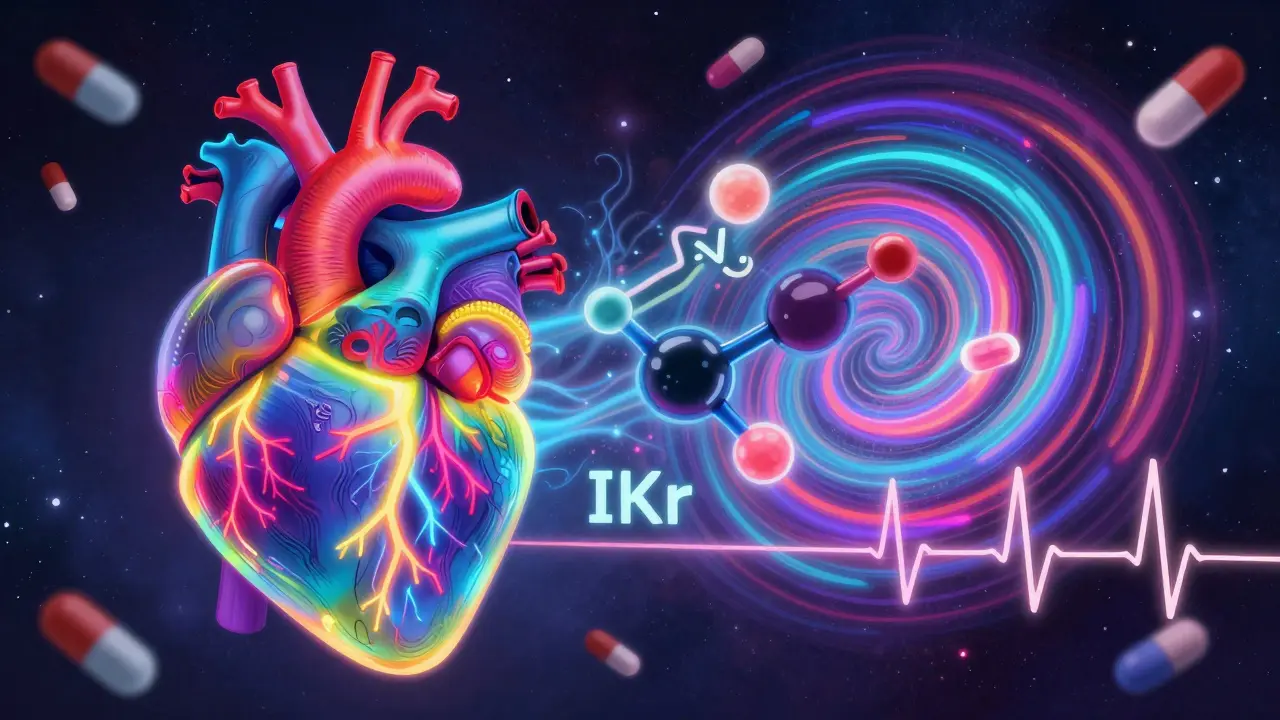
Macrolide antibiotics like azithromycin, clarithromycin, and erythromycin don’t just kill bacteria. They also interfere with a tiny ion channel in your heart cells called IKr. This channel, controlled by the HERG gene, is responsible for letting potassium out of heart cells during the recovery phase after each heartbeat. When potassium leaves properly, the heart resets quickly and stays in rhythm. But when macrolides block this channel, the heart takes longer to recharge - and that delay shows up on an ECG as a longer QT interval.
This isn’t theoretical. In controlled studies, clarithromycin stretches the QT interval by 10 to 20 milliseconds. Azithromycin adds 5 to 10 ms. Sounds small? It’s not. For most people, it’s harmless. But in someone with existing heart conditions, low potassium, or on other QT-prolonging drugs, that extra delay can trigger early afterdepolarizations - abnormal electrical sparks that start chaotic heart rhythms. The result? Torsades de Pointes. It looks like a spiral on an ECG and can turn into ventricular fibrillation - a killer.
Not All Macrolides Are Created Equal
Many assume azithromycin is the safest because it’s widely used and often marketed as "gentler." But the data tells a more complex story. Clarithromycin is the most dangerous. It blocks IKr more strongly than azithromycin and also inhibits the CYP3A4 liver enzyme, which slows down the breakdown of other QT-prolonging drugs. This means if you’re taking clarithromycin and a statin, an antiarrhythmic, or even some antidepressants, your risk doesn’t just add up - it multiplies.
Clarithromycin accounts for 58% of all macrolide-related TdP cases reported to the FDA, even though it’s only prescribed about 15% of the time. Why? Because it’s often given to older patients with multiple health issues - exactly the people most vulnerable.
Azithromycin, on the other hand, doesn’t interfere much with liver enzymes, so drug interactions are less common. But its risk isn’t zero. A landmark 2012 study in the New England Journal of Medicine found that azithromycin was linked to a 2.88 times higher risk of cardiovascular death compared to amoxicillin. The catch? That study didn’t fully adjust for why people were getting azithromycin in the first place. Were they sicker? Did they have more heart disease? Later studies that controlled for 108 variables - including age, diabetes, kidney function, and prior heart events - found the risk dropped to nearly nothing. Still, the FDA kept the warning because even a small absolute risk can mean lives lost when millions are prescribed.
The Real Danger: When Drugs Stack Up
Most macrolide-related cardiac events don’t happen in isolation. They happen because of stacking.
Think of it like this: You take azithromycin for bronchitis. You’re also on amiodarone for atrial fibrillation. You have low potassium from your water pill. You’re 72. You have a history of heart failure. Suddenly, you’re not just one risk factor - you’re four. And each one multiplies the danger.
The American Heart Association lists seven major risk factors that turn a minor QT prolongation into a life-threatening event:
- Female sex (2 to 3.5 times higher risk)
- Age over 65 (1.8 times higher risk)
- Structural heart disease (2.2 times higher risk)
- Low potassium or magnesium (3.1 times higher risk)
- Concurrent use of other QT-prolonging drugs (2.5 to 5 times higher risk)
- Kidney impairment (1.7 times higher risk)
- Genetic long QT syndrome (5 to 10 times higher risk)
One 2022 study in JAMA Internal Medicine found that 42% of macrolide prescriptions in cardiac patients involved at least one other QT-prolonging drug. That’s not a coincidence - it’s a recipe for disaster.

What Doctors Should Do - And What They Often Don’t
Guidelines are clear. The AHA’s 2020 statement recommends a three-step approach:
- Screen - Check for those seven risk factors before prescribing.
- Switch - If someone has two or more risk factors, pick a non-macrolide alternative like doxycycline or a non-quinolone antibiotic.
- Monitor - For moderate-risk patients, check electrolytes and consider a baseline ECG.
But in real-world clinics? It rarely happens. A 2023 survey of physicians on the American College of Physicians forum showed that only 62% check potassium levels before prescribing macrolides to high-risk patients. Nearly 40% wait until symptoms appear - by then, it might be too late.
Electronic health records rarely flag these risks. Most don’t auto-calculate QT risk scores. Some systems, like Kaiser Permanente’s, started adding alerts in 2017 - and cut high-risk prescriptions by 28%. But that’s still the exception, not the rule.
There’s a tool called the QT Risk Score, developed by the University of Arizona. It gives you 10 points based on age, gender, heart disease, electrolytes, and other meds. A score of 7 or higher means high risk - and you shouldn’t use a macrolide. But how many doctors know about it? Not enough.
What About Newer Drugs?
One drug, solithromycin, was designed to fix this problem. It’s a next-generation ketolide antibiotic - structurally tweaked so it doesn’t block IKr. Clinical trials showed no QT prolongation. The FDA even considered approval. But in 2016, they rejected it because of liver toxicity. The lesson? You can’t solve one safety problem without creating another.
For now, we’re stuck with the old ones. And while clarithromycin use has dropped 34% since 2013 - especially in cardiac patients - azithromycin prescriptions have stayed steady. Why? Because it’s convenient. It’s a five-day course. It’s cheap. It’s often given as a single dose. But convenience shouldn’t override caution.

What Should You Do?
If you’re prescribed a macrolide and you’re over 65, have heart disease, take diuretics, or are on any other heart or psychiatric medication - ask these questions:
- Is there a non-macrolide alternative? (Doxycycline, amoxicillin, or even a cephalosporin might work.)
- Have my potassium and magnesium levels been checked recently?
- Am I on any other drugs that can prolong the QT interval? (List them: antiarrhythmics, antifungals, antidepressants, antipsychotics, or even some antacids.)
- Should I get an ECG before starting this?
If you’re on a macrolide and suddenly feel dizzy, lightheaded, or have palpitations - stop the drug and get help. Those symptoms could be the warning signs of TdP.
The Bottom Line
Macrolides aren’t inherently dangerous. For most healthy people under 65 with no heart issues, they’re safe. But for the growing number of older adults on multiple medications - especially those with heart disease or electrolyte imbalances - they’re a ticking time bomb.
The data doesn’t lie. Clarithromycin is the riskiest. Azithromycin is less risky, but not risk-free. And when combined with other QT-prolonging drugs, the danger skyrockets. The medical community knows this. But until EHRs start warning doctors automatically, and until patients start asking the right questions, these deaths will keep happening - quietly, preventably, and far too often.




Chiruvella Pardha Krishna
February 15, 2026 AT 07:27The heart isn't just a pump. It's a symphony of ions, and macrolides? They're the guy who shows up with a trombone at a chamber music recital. No one asked for it. No one needs it. But there it is, drowning out the delicate rhythm of potassium efflux.
We treat antibiotics like candy. A quick fix. A silver bullet. But biology doesn't care about convenience. It cares about balance. And when you disrupt the fine-tuned dance of ion channels, you don't just get a longer QT interval-you invite chaos.
The real tragedy isn't the drug. It's the system that lets this happen. A 72-year-old with heart failure, on three QT-prolonging meds, gets azithromycin because the EHR didn't blink. The doctor didn't know. The patient didn't ask. And now? We're just waiting for the next cardiac arrest to make headlines.
We've turned medicine into a checklist. Screen? Check. Prescribe? Check. Move on. But life isn't a checklist. It's a cascade. One risk factor doesn't kill. Ten do. And we're blind to the cascade.
Clarithromycin isn't evil. Azithromycin isn't safe. The problem is the illusion of safety. The myth that 'it's just one pill.' It's never just one pill. It's one pill on top of five others, in a body that's already fraying at the edges.
And yet, we keep prescribing. Because it's easy. Because it's cheap. Because we're tired. Because the system rewards speed over scrutiny.
It's not malpractice. It's systemic neglect dressed up as efficiency.
Michael Page
February 16, 2026 AT 06:33There's a quiet horror in how routine this is. A patient walks in with bronchitis. Doctor writes azithromycin. No ECG. No labs. No pause. Just a script. And we call this medicine.
The data says risk is low. But low doesn't mean zero. And when you're talking about sudden death in someone who's already fragile, 'low risk' is a luxury we can't afford.
It's not that doctors are negligent. It's that the tools aren't there. No automated QT score. No alert. No nudge. Just a blank field and a default choice.
We need systems that force us to think-not just rely on habit.
Sarah Barrett
February 17, 2026 AT 20:47It’s astonishing how often we mistake familiarity for safety. Azithromycin is the antibiotic equivalent of a well-worn sweater-comfortable, trusted, and seemingly harmless. But comfort doesn’t equate to safety, especially when the body is already frayed at the seams.
What struck me most was the statistic: 42% of macrolide prescriptions in cardiac patients involve another QT-prolonging agent. That’s not negligence. That’s a systemic blind spot. We’ve created a medical culture where polypharmacy is normalized, not interrogated.
The FDA’s warning remains because even a 0.1% increase in risk, multiplied across millions of prescriptions, translates into hundreds of preventable deaths. We’ve forgotten that medicine is not about percentages-it’s about people.
And yet, we continue to optimize for convenience, not caution.
Erica Banatao Darilag
February 19, 2026 AT 00:40i just read this and i’m shaking. not because i’m scared, but because this is happening all the time and no one is talking about it.
i work in a clinic. we have a 78-year-old man on amiodarone, lisinopril, and furosemide. he got azithromycin last month for a cold. no ekg. no labs. just a script.
he’s fine now. but what if he wasn’t? what if he’d been one of the ones who didn’t make it?
we need better tools. we need to stop treating antibiotics like over-the-counter meds.
and we need to listen to the patients who ask questions.
Charlotte Dacre
February 19, 2026 AT 19:38Oh wow. So the medical community has finally figured out that giving a 70-year-old with three heart conditions a drug known to cause sudden death is… risky?
My god, what a revelation. Next you’ll tell us that smoking causes lung cancer.
And yet, here we are. Still prescribing. Still ignoring. Still pretending this isn’t a dumpster fire wrapped in a white coat.
Clarithromycin: 58% of TdP cases. Azithromycin: ‘safer.’ Yeah. Like a chainsaw is ‘safer’ than a grenade.
Esha Pathak
February 20, 2026 AT 03:52Every time I hear someone say 'it's just one pill,' I think of my grandmother. She took azithromycin for bronchitis. She had diabetes, kidney issues, and was on a diuretic. She didn't die from the infection. She died from the 'safe' antibiotic.
They told us it was 'low risk.' But risk doesn't care about your age, your history, or your meds. It just waits.
Why do we keep doing this? Why do we let convenience override caution?
It's not about the drug. It's about the system that lets this happen.
Betty Kirby
February 21, 2026 AT 01:30Let’s be real: if you’re over 65, on diuretics, and have a history of heart issues, you shouldn’t be getting ANY antibiotic without a cardiology consult. Full stop.
Azithromycin isn’t ‘less risky’-it’s just the drug that got lucky because it’s cheaper and has a five-day course. That’s not safety. That’s market dominance.
And don’t get me started on doctors who say, ‘But the study showed no risk!’ Oh, so now we’re trusting a 2012 NEJM paper that didn’t control for 108 variables? Please. That’s not science. That’s confirmation bias with a stethoscope.
Real doctors don’t prescribe based on convenience. They prescribe based on risk stratification. And if you’re not doing that? You’re not a doctor. You’re a script machine.
Josiah Demara
February 21, 2026 AT 14:50Someone’s got to say it: this entire discussion is performative.
You think the FDA warning changed anything? It didn’t. Doctors still prescribe. Pharmacies still fill. Patients still take it. Why? Because no one’s held accountable.
There’s no malpractice lawsuit because the death is ‘unavoidable.’ There’s no audit because the EHR doesn’t flag it. There’s no training because it’s ‘too complicated.’
So we write papers. We post long threads. We nod solemnly. And then we go right back to the same routine.
This isn’t a medical issue. It’s a moral failure dressed in clinical language.
If you’re prescribing macrolides to a high-risk patient without a QT score, an ECG, and a second opinion-you’re not a healer. You’re a liability.
Kaye Alcaraz
February 22, 2026 AT 15:11Thank you for this detailed breakdown. It’s rare to see such clarity on a topic that’s so often oversimplified.
I’ve seen firsthand how easy it is to fall into the trap of ‘standard protocol.’ But when you pause-even for five minutes-to check electrolytes, review meds, and consider alternatives, you don’t just prevent death. You restore dignity to the care you provide.
It’s not about being perfect. It’s about being intentional.
Start with the ECG. Ask about the other meds. Listen to the patient. These aren’t extra steps. They’re the foundation.
Small actions. Big impact.
Daniel Dover
February 24, 2026 AT 03:23Clarithromycin = bad. Azithromycin = less bad. But still bad in the right combo.
Stop prescribing it like it’s aspirin.
Joe Grushkin
February 25, 2026 AT 13:17Of course macrolides are dangerous. But let’s be honest-this whole article is just fearmongering dressed up as science.
People die from heart attacks every day. We don’t ban all antibiotics because of rare events.
And let’s not forget: azithromycin saves lives. Millions of them. You think pneumonia doesn’t kill? It does. And it kills faster than QT prolongation ever will.
Stop pathologizing common treatments. The real danger is overmedicalization. You’re turning a simple infection into a cardiac emergency.
Maybe the problem isn’t the drug. Maybe it’s the panic.