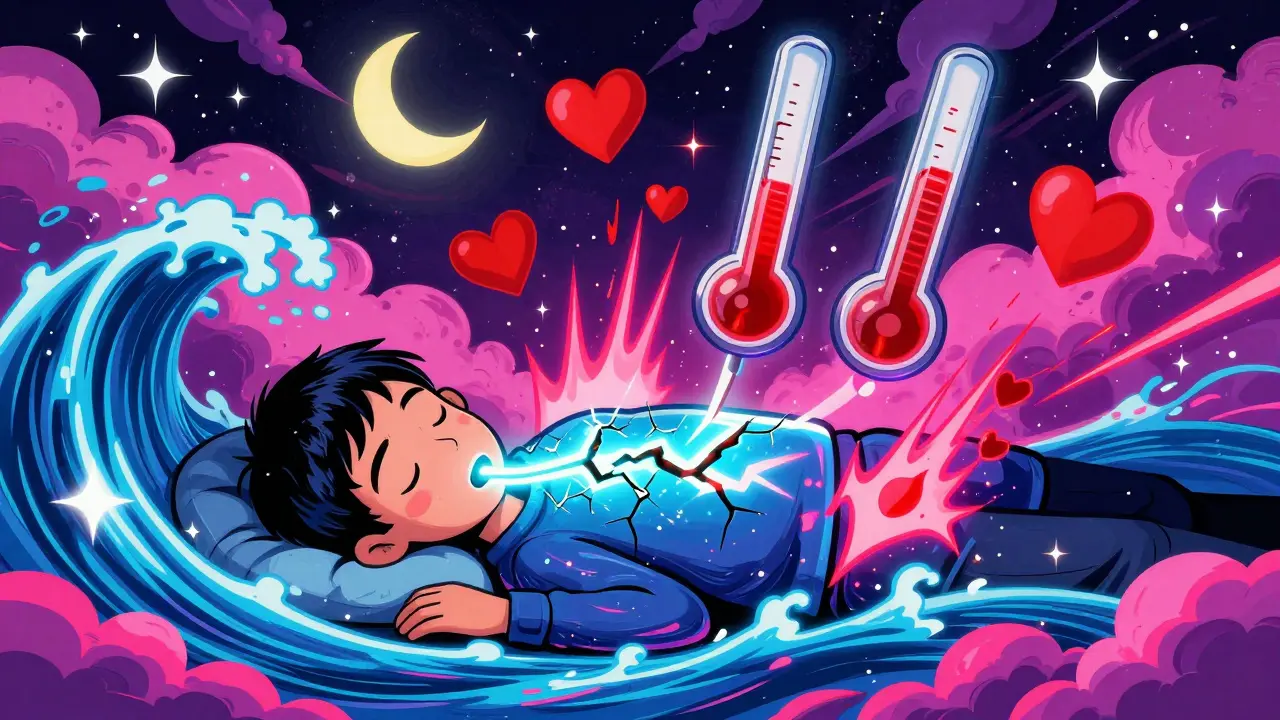
When you stop breathing in your sleep - even for just 10 seconds - your body doesn’t just wake up. It panics. Your heart races. Your blood pressure spikes. And if this happens 30 times an hour, every night, for years, your heart pays the price. Sleep apnea isn’t just about snoring or feeling tired. It’s a silent driver behind high blood pressure, heart attacks, and strokes - especially in people who don’t even know they have it.
What Sleep Apnea Really Does to Your Body
Obstructive sleep apnea (OSA) happens when the muscles in your throat relax too much during sleep, blocking your airway. Each time this happens, your oxygen levels drop. Your brain jolts you awake - just enough to breathe, but not enough for real rest. This cycle repeats dozens or even hundreds of times a night. You might not remember it. But your heart does.
These repeated drops in oxygen trigger a cascade of stress responses. Your body releases adrenaline and other stress hormones at levels two to four times higher than normal during sleep. Your blood vessels constrict. Your heart works harder. Your blood pressure doesn’t drop at night like it should. Instead, it stays high - or even rises. This is called non-dipping, and it’s found in 70-80% of people with moderate to severe sleep apnea. In healthy people, blood pressure naturally falls by 10-20% during sleep. In those with untreated OSA, that drop vanishes.
The Link to High Blood Pressure
One in every five adults has moderate to severe sleep apnea. And up to 80% of people with resistant hypertension - high blood pressure that won’t go down even after taking three different medications - also have undiagnosed sleep apnea. That’s not a coincidence. It’s a cause.
The Wisconsin Sleep Cohort Study followed over 1,000 adults for years and found that people with untreated OSA were two to three times more likely to develop high blood pressure within just four to five years. Even more alarming: younger adults (ages 20-40) with sleep apnea are 45% more likely to have high blood pressure than their peers without it. That’s a bigger jump than in older adults. Sleep apnea isn’t just an aging problem - it’s accelerating heart disease in people decades before they’d normally expect it.
Heart Disease, Heart Attacks, and the Midnight Danger
If your blood pressure stays elevated all night, your heart muscle thickens. Your arteries stiffen. Plaque builds up faster. People with moderate to severe sleep apnea have a 30% higher risk of developing coronary artery disease. Their chance of having a heart attack goes up by 30%, and the risk of a fatal heart event jumps by 60%.
Here’s something most people don’t know: heart attacks don’t just happen randomly. In people with untreated sleep apnea, nearly 27% of heart attacks occur between midnight and 6 a.m. - the exact time when breathing pauses are most frequent. In people without sleep apnea, that number is only 16.5%. The body is under maximum stress during those early hours, and sleep apnea turns that stress into a cardiac emergency.
Stroke Risk Skyrockets
Stroke is another major threat. Sleep apnea doesn’t just raise your risk of having a first stroke - it makes a second one far more likely. People with OSA are 2.5 times more likely to have a stroke than those without it. And if you’ve already had one, your chance of having another triples. The worse the oxygen drops during sleep - especially if your blood oxygen falls below 90% for more than 12% of the night - the higher your risk of dying from a stroke. One study showed that this level of nighttime hypoxia was linked to 4.3 times higher stroke mortality.
Heart Failure and Irregular Heartbeats
Heart failure and sleep apnea feed off each other. About half of all heart failure patients also have sleep apnea. And if you have OSA, your risk of developing heart failure jumps by 140%. The constant strain on your heart weakens it over time. Fluid builds up. Your lungs fill. Breathing gets harder - even when you’re awake.
Then there’s atrial fibrillation (AFib), the most common type of irregular heartbeat. People with sleep apnea are two to four times more likely to develop AFib. In one study, 49% of patients with paroxysmal AFib - episodes that come and go - had sleep apnea. Only 21% of those without AFib did. And here’s the kicker: if you have AFib and untreated sleep apnea, your chances of successful catheter ablation drop by 30%. Sleep apnea doesn’t just cause heart rhythm problems - it makes them harder to fix.
Why CPAP Isn’t a Magic Bullet
Continuous Positive Airway Pressure (CPAP) is the most common treatment. It uses a mask to blow gentle air into your throat, keeping your airway open. It works - but not always the way people expect.
CPAP doesn’t dramatically lower blood pressure in most people. On average, it reduces systolic pressure by just 2-3 mmHg. That’s not enough to make headlines. But here’s what it does do: it cuts stroke recurrence by 37%. It improves heart failure outcomes. It makes AFib treatments more effective. And it reduces the overnight surges in adrenaline that damage your arteries.
The problem? Only 46% of people who start CPAP stick with it long-term. Most use it less than four hours a night, fewer than seven nights a week. If you’re not using it consistently, you’re not getting the protection. And if you’re not getting protection, your heart keeps paying the cost.
Who Should Be Screened - And When
The American Heart Association says this clearly: if you have high blood pressure, atrial fibrillation, heart failure, a stroke, or coronary artery disease - especially if treatment isn’t working - you should be tested for sleep apnea.
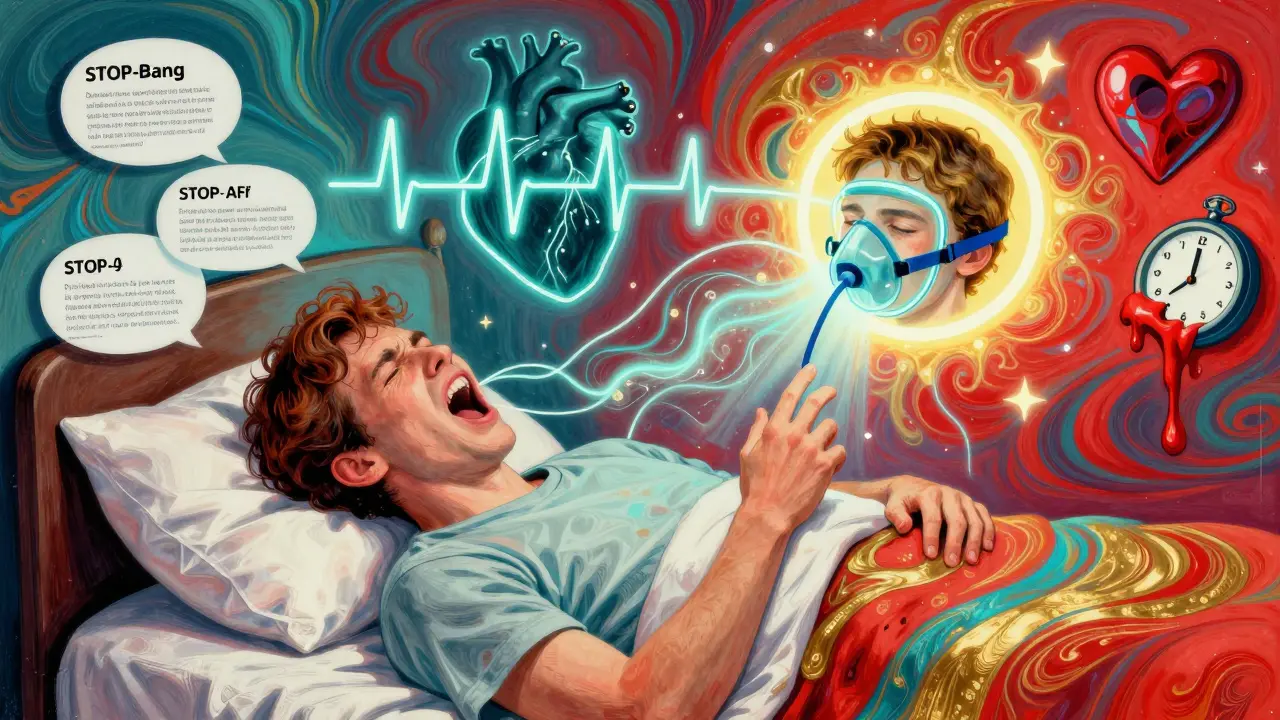
Doctors in Europe are already using a simple five-question tool called STOP-Bang to screen patients in cardiology clinics. It asks about snoring, tiredness, observed breathing pauses, high blood pressure, BMI, age, neck size, and gender. It catches 84% of moderate to severe cases. No sleep lab needed. Just a quick chat.
And it’s not just for older people. If you’re under 40, overweight, and have high blood pressure or unexplained fatigue, don’t wait. Sleep apnea might be the missing piece. The data shows it’s accelerating heart disease in younger adults faster than we thought.
What You Can Do Now
If you snore loudly, wake up gasping, feel exhausted even after eight hours of sleep, or have high blood pressure that won’t budge - talk to your doctor. Ask for a sleep apnea screening. A home sleep test is often all it takes. It’s simple, non-invasive, and covered by most insurance plans.
If you’re diagnosed, don’t give up on CPAP. It’s not perfect. But it’s the most proven tool we have. Try different masks. Adjust the pressure. Use it with a humidifier. Find a support group. The goal isn’t perfection - it’s consistency. Even four hours a night, five nights a week, makes a difference.
And if you’re not diagnosed but have risk factors - obesity, a large neck, daytime sleepiness - don’t wait for a crisis. Your heart doesn’t wait. Sleep apnea doesn’t announce itself with a siren. It whispers. And if you ignore it long enough, it shouts - with a heart attack, a stroke, or a failing heart.
Cardiologists Are Starting to Listen
For years, sleep apnea was seen as a pulmonology problem. Now, cardiologists are the ones pushing for change. They see it every day: patients with advanced heart disease who respond poorly to treatment - until you find and treat their sleep apnea. Then, suddenly, things improve. Blood pressure drops. Heart rhythm stabilizes. Recovery speeds up.
The message is clear: sleep apnea isn’t a side issue. It’s a core cardiovascular risk factor - just like smoking, diabetes, or high cholesterol. And it’s one of the few that’s treatable. But only if you know it’s there.
Tiffany Adjei - Opong
January 5, 2026 AT 12:10Okay but have you ever actually looked at the CPAP compliance data from Medicare? It’s not 46%-it’s closer to 28% after one year, and most of those are using it under two hours. The studies cherry-pick the compliant 20% to make CPAP look good. Meanwhile, the real-world failure rate is catastrophic. You think your heart’s saved? Nah. It’s just quietly failing while you’re scrolling TikTok at 2 a.m. with a mask on your face like a cyborg refugee.
Cam Jane
January 5, 2026 AT 23:10Hey, if you’re snoring so loud your partner leaves the room, or you wake up gasping like a fish on a dock-please, just get tested. It’s a home test, takes one night, and if you have it? You can literally reverse some of the damage. I had AFib and high BP for years. Started CPAP. Six months later, my doc said, ‘Wait, did you lose weight?’ No-I just slept. My heart finally got a break. You don’t need to be perfect. Just show up. Even 4 hours, 4 nights a week? That’s a win.
Isaac Jules
January 6, 2026 AT 04:20LOL. So now sleep apnea is the new villain? Next they’ll say bad breath causes heart attacks. CPAP is a $1000 scam. The real problem? You’re fat, lazy, and drink soda before bed. Stop blaming your biology and get off the couch. Also, 46% compliance? That’s still too high. Should be 100% or no treatment. If you can’t breathe while sleeping, maybe you shouldn’t be allowed to sleep at all. #WakeUp
Stuart Shield
January 6, 2026 AT 15:09It’s wild how something so quiet-like the way your breath catches in the dark-can scream so loudly through your arteries. I used to think snoring was just annoying. Then my sister had a stroke at 41. Turns out, she’d been gasping all night for years. No one noticed. No one asked. She didn’t even know she was dying slowly in her sleep. This isn’t just medical data-it’s a whisper that turns into a scream if you ignore it long enough. Please, if you’re tired all the time, just get checked. It’s not weakness. It’s wisdom.
Lily Lilyy
January 8, 2026 AT 05:20Thank you for sharing this important information. It is truly vital that we all become aware of the connection between sleep and heart health. I encourage everyone to speak with their physician and consider a sleep study if they experience fatigue or high blood pressure. Prevention is always better than cure. Let us take care of ourselves and each other with kindness and responsibility.
Gabrielle Panchev
January 8, 2026 AT 23:23Wait-so you’re telling me that if I stop breathing 30 times an hour, my heart doesn’t just ‘pay the price’-it’s literally being tortured by adrenaline spikes and non-dipping BP? And CPAP only lowers systolic by 2-3 mmHg? So… it’s not fixing the problem, it’s just… reducing the damage? But then you say it cuts stroke recurrence by 37%? So it’s not a cure, but it’s a bandage that actually works? And yet 54% of people quit? So… we’re just letting people die because they find a mask uncomfortable? And we call this a healthcare system?!!??
Katelyn Slack
January 9, 2026 AT 04:27i had no idea this was a thing. i snore so loud my dog sleeps in the other room. and i’m always tired. i thought it was just stress. i’m gonna ask my dr. for a test. thanks for the post. i didn’t know i needed to hear this.
Melanie Clark
January 9, 2026 AT 13:15They don't want you to know this but sleep apnea is a government conspiracy to make you buy CPAP machines so Big Pharma can profit. The real cause is 5G radiation from your phone charging next to your bed. The drops in oxygen? That's just your body trying to detox from microchips implanted during your last flu shot. And CPAP? It's a distraction. What you really need is a crystal skull under your pillow and a lemon juice cleanse. Your heart doesn't need air-it needs spiritual alignment. And if you're still breathing at night? That's not apnea. That's surveillance.
Harshit Kansal
January 11, 2026 AT 09:22Bro I used to think I was just lazy but after I got diagnosed with sleep apnea I realized I was basically running a marathon every night just to breathe. My wife started recording me and I sounded like a dying walrus. CPAP was awkward at first but now I feel like a new person. No more 3 p.m. naps. No more yelling at my kids for no reason. Just peace. And yes, I still hate the mask. But I’d rather hate a mask than hate my own heartbeat.
Venkataramanan Viswanathan
January 11, 2026 AT 14:53In India, we often dismiss snoring as normal, even a sign of deep sleep. But this article has opened my eyes. My father had a stroke at 58, and we never considered sleep apnea. Now I screen all my patients over 40 with hypertension using STOP-Bang. Simple. Fast. Life-saving. We must change the narrative: sleep is not idle time-it is the body’s most critical repair cycle. Ignoring it is not negligence. It is a choice.
Ryan Barr
January 12, 2026 AT 03:12CPAP compliance rates are statistically irrelevant. The real issue is that you’re all too lazy to die elegantly.
Dana Termini
January 13, 2026 AT 03:15I think this is so important. I used to think sleep apnea was just for older men who snore. But my cousin, 32, female, athletic, got diagnosed last year. She didn’t even realize she was stopping breathing. It’s not about stereotypes. It’s about listening to your body. If you’re exhausted, don’t just drink more coffee. Ask the question. You might save your heart.