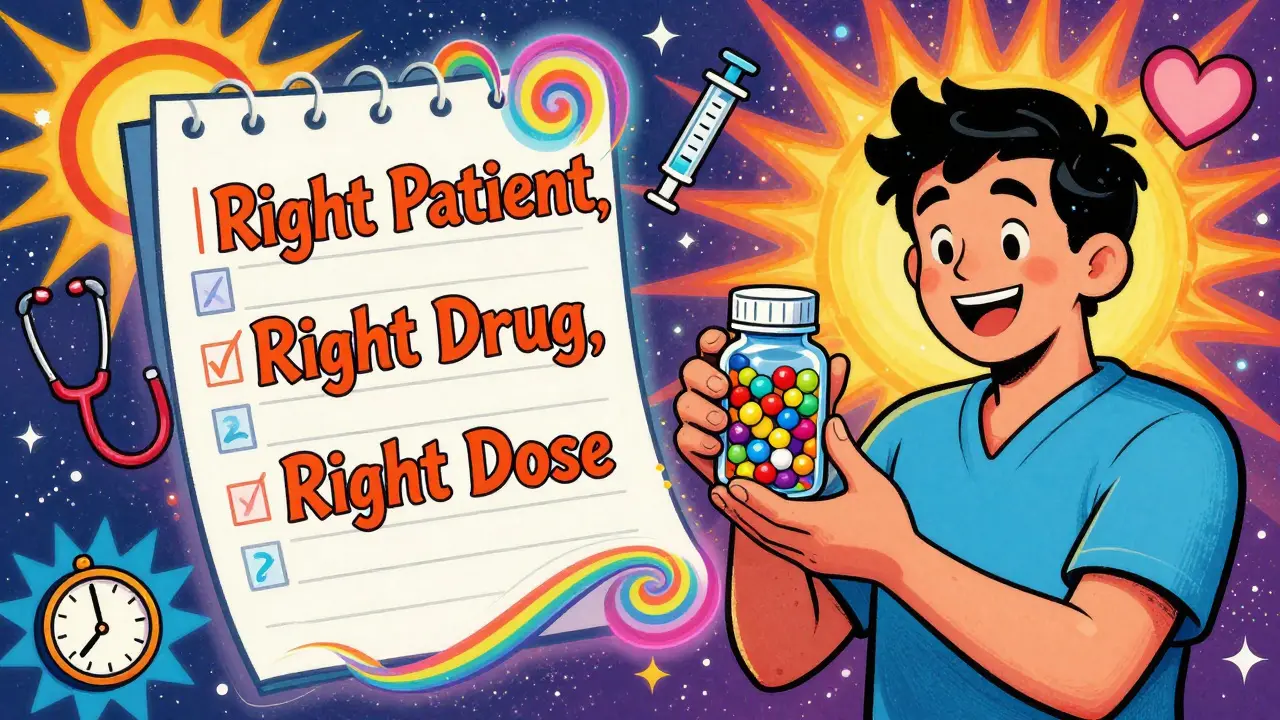
Every year, more than 1.5 million people in the U.S. end up in the emergency room because of medication mistakes. Many of these cases are preventable. The problem isn’t always that doctors or pharmacists make errors-it’s often that patients don’t know what to ask, what to watch for, or how to speak up. Knowing a few simple medication safety terms can cut your risk of harm in half. You don’t need to be a doctor. You just need to understand these key ideas and use them when you’re handed a new prescription.
What Are the Eight Rights of Medication Safety?
The foundation of medication safety isn’t complicated. It’s built on a set of checks called the "Eight Rights." These aren’t just for nurses or pharmacists-they’re tools you can use every time you take a pill, get an injection, or refill a prescription.
- Right patient: Are you sure the medicine is meant for you? Always confirm your name and date of birth are checked before you get any medication. Hospitals use two identifiers for this reason. Don’t assume they got it right-ask.
- Right medication: Does the name on the bottle match what your doctor prescribed? Many drugs sound alike. For example, Hydralazine and Hydroxyzine are completely different. One lowers blood pressure. The other treats allergies. Ask for both the brand and generic name.
- Right dose: How much should you take? A pill, a teaspoon, a full syringe? For children, 15% of medication errors happen because of wrong dosing. Even adults can misread labels. If it’s a liquid, ask how many milliliters equal one dose. Write it down.
- Right route: How is it supposed to be given? Oral? Injection? Patch? Cream? A 2019 study found that 12% of serious errors happened because a drug meant for IV use was swallowed instead. Never guess. Ask: "Is this taken by mouth, or does it go into the vein?"
- Right time: When should you take it? Before meals? At bedtime? Every 8 hours? Skipping doses or doubling up can be dangerous. Use a phone alarm or a pill box with labeled slots. Studies show this cuts errors by 31%.
- Right reason: Why are you taking this? Too often, people take meds because "the doctor said so," without knowing why. If you’re on a blood thinner, ask if it’s for atrial fibrillation, a recent surgery, or a clotting disorder. Knowing the reason reduces inappropriate use by 28%.
- Right documentation: Was it recorded? When a nurse gives you a shot or you pick up a new prescription, make sure it’s written in your chart. If you’re discharged from the hospital, ask for a written list of all your meds and why you’re taking each one.
- Right response: What should you feel-or not feel? Medications should help, not hurt. If you start feeling dizzy, nauseous, or have a rash, write it down. These could be signs of an adverse reaction. Tracking your response cuts severe events by 35%.
These aren’t just buzzwords. They’re your checklist. Use them every time you get a new prescription or refill one.
What Is an Adverse Drug Event (ADE)?
An adverse drug event (ADE) is any harm caused by a medicine. It’s not just an allergic reaction. It includes taking too much, taking the wrong one, or even the side effects you didn’t expect. The CDC says ADEs are a leading cause of preventable hospital visits. Some are mild-like a headache from a new blood pressure pill. Others are life-threatening, like internal bleeding from a blood thinner.
Here’s the difference you need to know:
- Side effect: A known, expected reaction. For example, drowsiness from allergy meds.
- Adverse drug event: Harm you didn’t expect or that wasn’t supposed to happen. Like a rash from a drug you’ve taken for years.
When you notice something unusual, don’t wait. Call your doctor. Keep a log: date, time, symptom, dose. This helps your provider decide if it’s the medication or something else.
What Are High-Alert Medications?
Not all medicines are created equal when it comes to risk. Some are called high-alert medications because even a small mistake can cause serious injury or death. The Institute for Safe Medication Practices (ISMP) lists these as the most dangerous:
- Insulin
- Blood thinners (like warfarin or apixaban)
- Opioids (like oxycodone or fentanyl)
- IV potassium chloride
- Chemotherapy drugs
These account for 67% of fatal medication errors, according to ISMP’s 2021 report. If you’re prescribed one of these, double-check everything. Ask: "Is this a high-alert drug?" Then, ask your pharmacist to explain the dose again. Don’t be shy. Your life could depend on it.
What Is a Close Call?
A close call is when something almost went wrong-but didn’t. Maybe the nurse caught a wrong dose before giving it. Maybe the pharmacist spotted a mix-up in the label. These moments matter. They’re not just "luck." They’re signs that safety systems are working.
But here’s the catch: if patients don’t speak up, close calls stay hidden. If you notice something doesn’t look right-like a pill color changed or the label says "take twice daily" but your old bottle said "once daily"-say something. You’re not causing trouble. You’re preventing it.
What Are Sentinel Events?
A sentence event is a serious, unexpected event that results in death or major injury. The Joint Commission, which sets hospital safety standards, defines medication errors that cause death as sentinel events. These are rare-but they happen. And they’re almost always preventable.
For example: a patient gets the wrong drug because their name was confused with someone else’s. Or a diabetic receives a full syringe of insulin instead of 10 units. These aren’t accidents. They’re system failures. But when patients know the terms and ask questions, they become part of the solution.
How to Use These Terms in Real Life
Knowing these terms is useless unless you use them. Here’s how to make them part of your routine:
- When your doctor writes a new prescription, ask: "What is the right reason for this?" Write it down.
- At the pharmacy, compare the label to your old prescription. Does the name, dose, and instructions match? If not, ask why.
- When you get home, set a phone reminder for the right time. Use a pill organizer.
- Before taking any new medicine, ask: "Is this a high-alert medication?"
- Keep a simple log: date, medicine, dose, how you felt. Share it with your doctor at your next visit.
- If you’re hospitalized, ask the nurse: "Can you confirm I’m the right patient?" Use your name and birthdate.
Studies show patients who do this reduce their risk of harm by up to 50%. You don’t need to be a medical expert. You just need to be curious and persistent.
Why This Matters Now More Than Ever
In 2024, the Joint Commission made it mandatory for hospitals to teach patients the Eight Rights before discharge. Medication apps like Medisafe now include these terms as built-in verification steps. And by 2030, the CDC and FDA aim for 90% of patients to recognize at least five of these terms.
But progress isn’t automatic. Only 12% of U.S. adults have strong health literacy. That means most people struggle to understand instructions on a pill bottle. That’s why you need to speak up-not just for yourself, but for others too. If you understand these terms, you can help a family member, friend, or neighbor avoid a mistake.
Medication safety isn’t about blaming doctors or pharmacists. It’s about building a team. And you’re a key member.
What should I do if I think I got the wrong medicine?
Stop taking it immediately. Call your pharmacist or doctor. Don’t wait for symptoms. Bring the bottle and the prescription with you. Ask: "Is this the right drug, dose, and route?" Use the Eight Rights as your checklist. If you’re unsure, get a second opinion. It’s better to be safe than sorry.
Do I really need to know the difference between side effects and adverse events?
Yes. Side effects are common and often mild-like dry mouth or dizziness. Adverse events are unexpected and potentially dangerous. If you’ve never had a rash before and you get one after starting a new drug, that’s an adverse event. Document it. Report it. Don’t assume it’s "just a side effect." That’s how serious problems get missed.
Can I ask my pharmacist to explain the Eight Rights?
Absolutely. Pharmacists are trained to explain medications. Ask: "Can you walk me through the right patient, right drug, right dose?" Most will be happy to help. If they seem rushed, ask to speak with a clinical pharmacist. This is part of their job.
Why do some medicines have similar names?
It’s a common problem. Drug companies sometimes pick names that sound alike by accident. The FDA tries to prevent this, but mistakes happen. That’s why you must confirm both brand and generic names. For example, Fluoxetine (an antidepressant) and Flunisolide (a nasal spray) are easily confused. Always double-check.
Is it okay to use a pill organizer for high-alert medications?
Yes-but with caution. For high-alert drugs like insulin or blood thinners, never pre-fill a pill organizer unless your doctor or pharmacist approves it. Some meds can’t be stored in containers. Always ask first. When in doubt, keep the original bottle and use a daily log instead.

Srividhya Srinivasan
March 19, 2026 AT 13:52Oh, thank GOD someone finally wrote this. I’ve been screaming into the void for years-people just swallow pills like candy and then wonder why they’re hallucinating. I once saw a woman take her husband’s blood thinner because the bottles looked "similar enough." BRUH. The Eight Rights? That’s not a checklist-it’s a survival manual. Write it on your bathroom mirror. Tattoo it on your forearm. Do NOT trust the system. Trust YOURSELF.
Prathamesh Ghodke
March 20, 2026 AT 22:08Love this breakdown. As a pharmacist, I see this every day. People don’t realize how often "I thought it was for my back pain" turns into an ER trip. I always tell folks: if you’re unsure, ask twice. And yes-ask for the generic AND brand name. I’ve had patients thank me for catching a mix-up between hydroxyzine and hydralazine. One was for anxiety. The other? For hypertension. Big difference. You’re not being annoying. You’re being smart.
Stephen Habegger
March 20, 2026 AT 23:31This is exactly what we need more of. Simple, clear, actionable. No jargon. Just facts. I’ve shared this with my mom. She’s 72 and on 7 meds. She didn’t even know what "right route" meant. Now she asks every time. Small changes save lives.
Justin Archuletta
March 22, 2026 AT 16:59YES. YES. YES. I took my grandma’s insulin once because the bottle looked the same. I didn’t know the difference between "U-100" and "U-500." I almost died. This list? It’s not advice. It’s a lifeline. Bookmark this. Print it. Stick it on your fridge. You’re not paranoid-you’re prepared.
Sanjana Rajan
March 23, 2026 AT 16:40Ugh. Another feel-good article. Everyone knows this. The real problem? Pharmacists are overworked. Doctors don’t explain. Insurance forces generic swaps. And the system? It’s designed to fail. You think asking questions fixes it? Nah. It just makes you a target. They’ll label you "difficult" and stop prescribing you meds altogether. So… what’s the point?
Kyle Young
March 25, 2026 AT 04:05It’s fascinating how these eight rights mirror broader epistemological frameworks-verification, context, intention, and accountability. The "right reason" isn’t just clinical; it’s existential. Why are we taking this? Are we healing, or merely managing symptoms imposed by a profit-driven system? The pharmaceutical industry commodifies our bodies, yet we’re told to be passive consumers. Perhaps the true safety lies not in memorizing terms, but in reclaiming agency over our own biology.
Aileen Nasywa Shabira
March 26, 2026 AT 20:39"The CDC says ADEs are a leading cause of preventable hospital visits." Oh really? And yet, the same CDC approved 800+ new drugs last year with zero long-term safety data. Who’s really responsible here? The patient? Or the billion-dollar pharma lobby that lobbies to keep labels unreadable? This whole "just ask" thing is a distraction. The system is rigged. You think a pill organizer will save you when your insulin is mislabeled because the FDA approved a name that rhymes with another drug? LOL.
Kendrick Heyward
March 27, 2026 AT 07:28I just cried reading this. 😭 My sister died because they gave her the wrong chemo drug. She didn’t know to ask. I didn’t know to ask. We trusted them. We thought they knew what they were doing. Now I carry her pill bottle everywhere. I show it to every nurse. I say "right patient? right drug? right dose?" until they roll their eyes. But I don’t care. I won’t let anyone else lose someone because they were too scared to ask.
lawanna major
March 28, 2026 AT 15:49Excellent resource. I particularly appreciate the distinction between side effects and adverse events-it’s a nuanced but critical difference that even many healthcare providers blur. The emphasis on documentation is vital; anecdotal evidence, when systematically recorded, becomes powerful data. I’ve maintained a medication log for over a decade and have caught three potential errors before they became incidents. Knowledge is power, but consistent, precise record-keeping is the tool that transforms it into protection.
Ryan Voeltner
March 30, 2026 AT 07:58Thank you for this thoughtful and comprehensive overview. The principles outlined here reflect a fundamental shift in patient-centered care-from passive compliance to active collaboration. The Eight Rights are not merely procedural; they are ethical imperatives. It is both prudent and humane to empower individuals with the language and framework necessary to engage meaningfully in their own care. This is not just safety-it is dignity.
Srividhya Srinivasan
March 30, 2026 AT 22:27Replying to @lawanna major: You’re right about documentation. But let’s be real-when I tried to show my log to my doctor, he said "I don’t have time" and scribbled "compliant" on my chart. So now I take pictures of every bottle, every label, every pill. I send them to my daughter. She’s 22. She’s my backup. If I pass out? She knows what to say. And she knows what to scream.