You’ve probably heard the argument. Patients worry their generic pill isn’t working like the brand-name one they used to take. Colleagues might hesitate to switch a stable patient, fearing a subtle drop in efficacy or a spike in side effects. But what does the actual data say? For most of us, the answer is surprisingly clear: for the vast majority of drugs, generics are not just "good enough"; they are clinically indistinguishable from their brand-name counterparts.
Yet, "most" is doing a lot of heavy lifting here. As providers, we need to know where the evidence is rock-solid and where it gets tricky. This isn't about debating politics or cost-saving mandates. It's about understanding the science behind therapeutic equivalence so you can make confident decisions at the bedside. Let’s look at what the studies actually tell us, separating the noise from the signal.
The Regulatory Backbone: How We Know They're Equivalent
To understand the clinical outcomes, you first have to understand how these drugs get approved. The framework was set by the 1984 Hatch-Waxman Act, which created the Abbreviated New Drug Application (ANDA) pathway. This isn't a shortcut that skips safety checks; it's a streamlined process focused on proving Bioequivalence is the demonstration that a generic drug delivers the same amount of active ingredient into the bloodstream as the brand-name drug at the same rate.
The FDA requires that generic drugs fall within a specific range of pharmacokinetic parameters compared to the reference listed drug. Specifically, the 90% confidence interval for the ratio of geometric means of AUC (area under the curve) and Cmax (maximum concentration) must fall between 80% and 125%. If a drug meets this standard, it is considered therapeutically equivalent. In simple terms, if the body absorbs the generic drug similarly to the brand-name version, the clinical effect should be the same.
This rigorous standard applies to over 13,000 approved generic products in the U.S. today. The average review time for an ANDA is about 10 months, ensuring that quality control remains high even as volumes increase. So when you see a generic prescription, you’re looking at a product that has passed a specific statistical hurdle designed to prevent meaningful differences in blood levels.
What the Big Studies Actually Show
Regulatory approval is necessary, but real-world evidence is reassuring. A landmark 2019 study published in PLOS Medicine analyzed data from over 1.3 million matched patient pairs across seven different drug classes. The results were strikingly consistent. For drugs like alendronate (used for osteoporosis) and calcitonin, the hazard ratios for non-vertebral fractures clustered right around 1.00, meaning no difference in risk between users of generics and brand-name drugs.
Consider glipizide, a common diabetes medication. The study found that patients taking the generic version had an identical rate of needing to start insulin due to poor glycemic control compared to those on the brand-name drug. The hazard ratio was 1.01, with a confidence interval that included 1.00, statistically confirming no difference. Similarly, for quinapril, an ACE inhibitor, hospitalization rates for heart attack or ischemic stroke were comparable, with a hazard ratio of 0.99.
Interestingly, some data even suggested a slight advantage for generics in certain cardiovascular cases. Amlodipine users on generics showed slightly better cardiovascular outcomes than those on brand-name versions. While this doesn't mean generics are "better," it reinforces that they are at least as effective, if not more so, in preventing major events.
| Drug Class / Specific Drug | Clinical Endpoint | Hazard Ratio (Generic vs. Brand) | Interpretation |
|---|---|---|---|
| Alendronate / Calcitonin | Non-vertebral fracture rates | 1.00 [0.96-1.05] | No significant difference |
| Glipizide | Insulin initiation due to poor control | 1.01 [0.97-1.05] | No significant difference |
| Quinapril | Hospitalization for MI or stroke | 0.99 [0.94-1.05] | No significant difference |
| Amlodipine | Cardiovascular outcomes | 0.91 [0.84-0.99] | Slightly better outcomes with generics |
| Escitalopram | Psychiatric hospitalization | 1.05 [1.01-1.10] | Slightly higher risk, likely confounded |

The Exceptions: Narrow Therapeutic Index Drugs
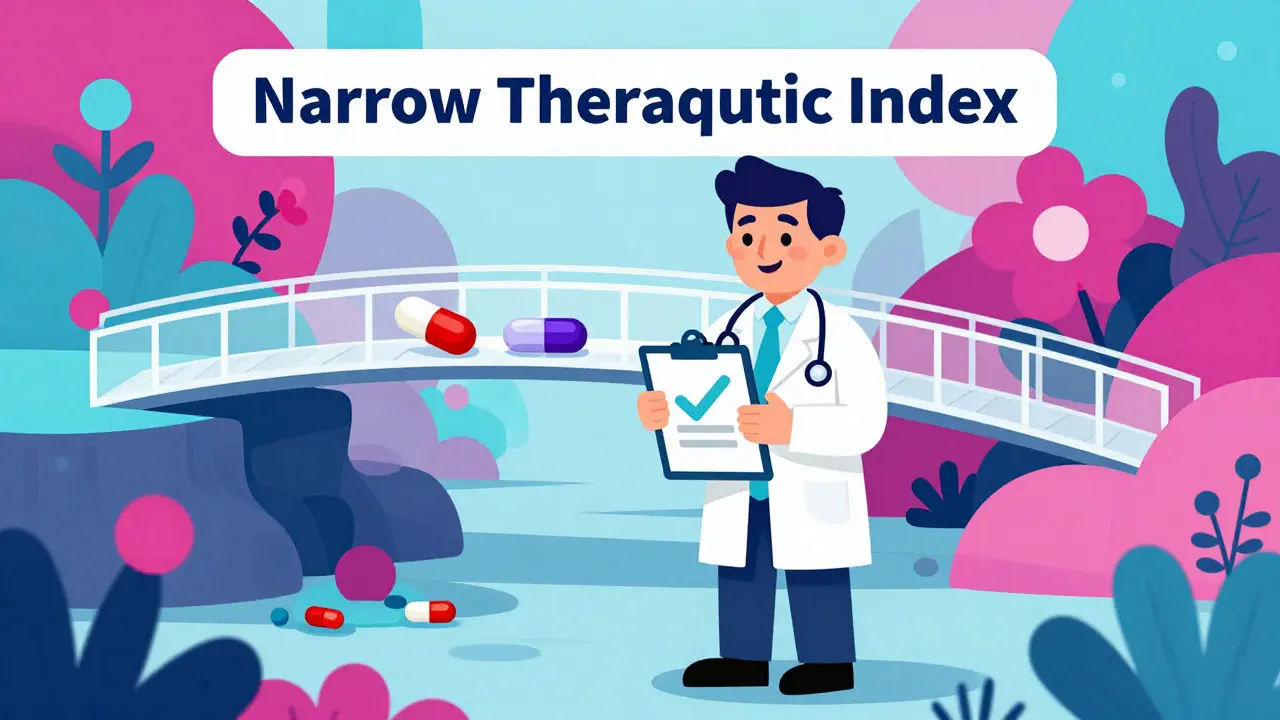
If the story stopped there, prescribing generics would be a no-brainer for every single patient. But medicine rarely works that way. There is a subset of drugs known as Narrow Therapeutic Index (NTI) drugs. These medications have a small margin between a therapeutic dose and a toxic dose. Examples include tacrolimus (used in transplant rejection), warfarin, and lithium.
For NTI drugs, small variations in blood levels can lead to serious consequences. That’s why the FDA uses stricter criteria called Scaled Average Bioequivalence (SCABE). However, even here, the evidence supports equivalence. A 2020 study in Nature Scientific Reports looked at transplant recipients switching between brand-name and generic tacrolimus. By assessing intra-individual variability over 42 days, researchers demonstrated that the switches did not lead to unstable drug levels or increased rejection risks.
Dr. Randall Stafford of Stanford University noted that while population-level studies show equivalence, subtle formulation differences in certain NTI drugs *may* occasionally affect individual patients. This doesn't mean the generic is bad; it means monitoring might need to be tighter during the transition. If you’re managing a patient on warfarin or tacrolimus, don’t shy away from generics, but do keep a closer eye on INR levels or trough concentrations for the first few weeks after a switch.
Addressing Patient Concerns and Perception Gaps
Here’s where the rubber meets the road: patient perception. Many patients believe generics are inferior because they look different. Different colors, shapes, or inactive ingredients (excipients) can trigger anxiety. "If it looks different, it must work differently," is a common thought.
The data suggests this fear is unfounded. An FDA study confirmed that appearance differences do not affect clinical outcomes. Furthermore, a 2017 FDA analysis of "switch-back" patterns-where patients go from brand to generic and then back to brand-found that only 1.8% to 2.7% of patients made this move. Crucially, when they switched back, it wasn't because of adverse clinical events. It was often due to perceived changes or pharmacy issues, not proven medical failure.
In fact, real-world data from 3.5 million Medicare beneficiaries initially showed higher survival rates for generic users. But once researchers adjusted for confounding factors (like healthier patients being prescribed generics), the gap narrowed significantly. This highlights a key point: generics aren't magic, but they aren't risky either. The "healthier user bias" means that in observational studies, generics often look *better* than they actually are relative to brands, simply because who gets them matters.
Practical Guidelines for Providers
So, how should this change your practice? Not much, actually. The American College of Physicians concluded in 2016 that physicians should generally prescribe generics when available. Here’s a practical checklist for your daily workflow:
- Check the Orange Book Rating: Most generics receive an "A" rating, meaning they are therapeutically equivalent. Only about 3% receive a "B" rating, indicating potential differences in bioavailability. If you see a B-rated generic, especially for an NTI drug, consider checking if an A-rated alternative exists.
- Educate Proactively: When a patient complains that their new generic "doesn't work," ask specific questions. Is it a change in side effects? Or just a feeling? Remind them that the active ingredient is identical and the FDA has verified absorption rates.
- Monitor NTI Drugs Closely: For warfarin, digoxin, or phenytoin, schedule follow-up labs sooner after a switch. This isn't because the generic is likely to fail, but because it respects the narrow window of safety.
- Document Adverse Events: If you suspect a generic is causing an issue, report it to the FDA’s Adverse Event Reporting System. Data shows that only 0.02% of adverse event reports specifically implicate the generic status, compared to 3.2% for brand-name drugs, suggesting that true generic-specific problems are rare.
Remember, the goal isn't to force a switch against a patient's will, nor is it to ignore a valid concern. It’s about using evidence to guide shared decision-making. If a patient is stable on a brand-name drug and refuses to switch, respect that choice. But if they are open to it, the evidence strongly supports the switch as safe and effective.
Frequently Asked Questions
Are generic drugs cheaper because they use lower-quality ingredients?
Not necessarily. The lower price comes from not having to recoup the massive R&D costs associated with developing the original brand-name drug. While inactive ingredients (fillers, dyes) may differ, the active pharmaceutical ingredient must be chemically identical. The FDA strictly regulates manufacturing quality, so "lower quality" is a myth rather than a fact.
What is a Narrow Therapeutic Index (NTI) drug?
An NTI drug is a medication where a small change in blood concentration can lead to either toxicity or loss of efficacy. Examples include warfarin, levothyroxine, and phenytoin. For these drugs, the FDA applies stricter bioequivalence standards, and clinicians are advised to monitor patients more closely during transitions between brand and generic versions.
Does it matter if I switch from one generic manufacturer to another?
For most drugs, no. Each generic manufacturer must prove bioequivalence to the reference brand-name drug, not necessarily to other generics. However, for NTI drugs, switching between different generic manufacturers could theoretically cause slight fluctuations in blood levels. Consistency with a single manufacturer is preferred for sensitive patients, but it is not a strict requirement for all medications.
Why do some patients feel generics don't work as well?
This is often due to the placebo effect or nocebo effect, where expectations influence perceived outcomes. Differences in tablet color or shape can subconsciously signal a "change" to the patient. Large-scale studies show that discontinuation rates are statistically similar between generic and brand-name users, suggesting that the "feeling" of ineffectiveness is not backed by hard clinical data.
How long does it take for the FDA to approve a generic drug?
The average review time for an Abbreviated New Drug Application (ANDA) is approximately 10 months. This period includes chemical, manufacturing, and controls (CMC) reviews, as well as bioequivalence data evaluation. This timeline ensures that quality standards are met without the lengthy clinical trial phases required for new molecular entities.