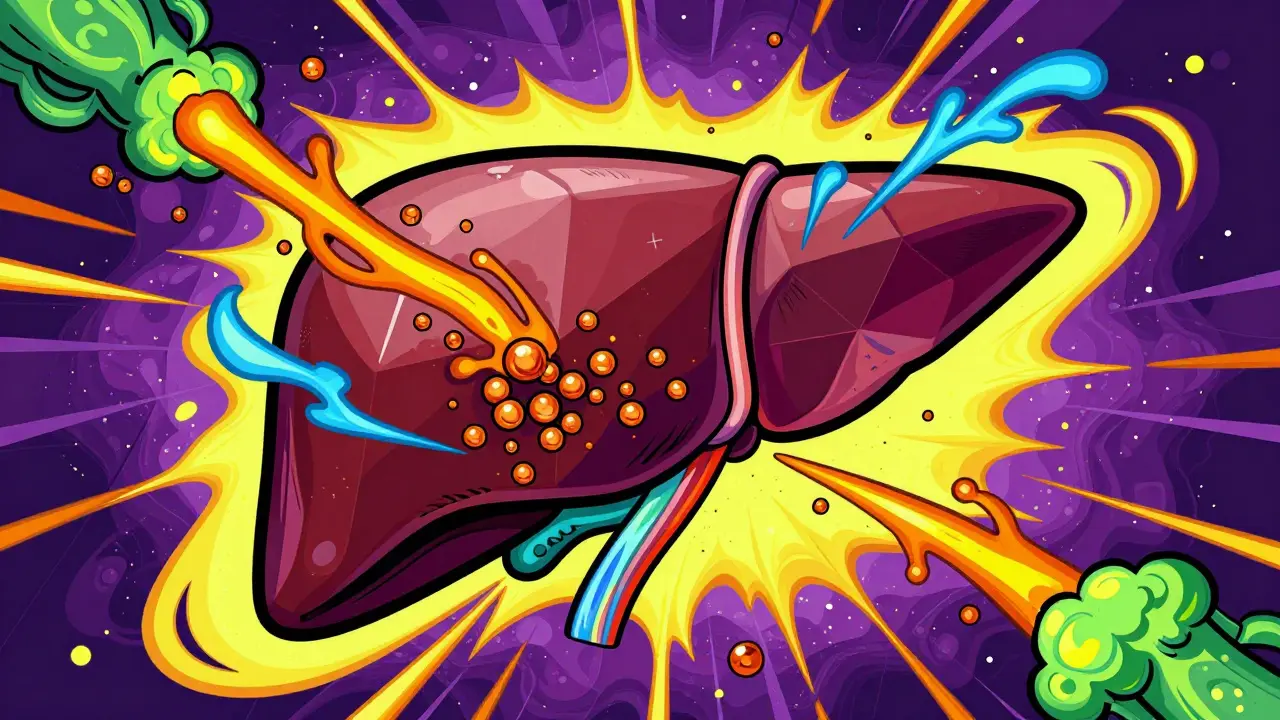
Imagine your body trying to store too much of something you need just to survive. It sounds harmless, but copper isn't like calcium in your bones. When your liver can't get rid of extra copper, it starts leaking into your blood and settling in places it doesn't belong, like your brain. This is Wilson’s Disease, a genetic condition that causes dangerous copper buildup in vital organs. Without intervention, this silent poison leads to severe organ damage, but the good news is modern medicine has effective ways to manage it.
The Mechanism Behind Copper Buildup
To understand why this happens, you need to look at the instructions your cells follow. In healthy people, your liver acts like a recycling plant for copper. It takes what you eat, attaches it to a protein called ceruloplasmin, and sends the rest out through bile. But in someone with Wilson’s, a specific gene called ATP7Bis a copper-transporting P-type ATPase located on chromosome 13 essential for moving copper into bile malfunctions. Think of ATP7B as a broken truck meant to haul waste away from a construction site. When the truck stops working, the waste stays piled up in the warehouse-the liver.
This accumulation follows a predictable timeline. Initially, your liver tries to protect itself by storing copper in special binding proteins known as metallothionein. For years, you might feel perfectly fine because the liver is buffering the excess. However, once those storage bins fill up, free copper begins to spill over. This non-ceruloplasmin-bound copper circulates through your bloodstream, eventually damaging the kidneys, eyes, and most critically, the basal ganglia of your brain. Research shows that when brain copper concentrations exceed 250 micrograms per gram of dry weight, neurological symptoms typically emerge.
Recognizing the Signs Early
Catching this disorder early changes everything. Unfortunately, diagnosis often gets delayed by an average of 2.7 years because symptoms mimic other common conditions like autoimmune hepatitis. The classic physical sign is Kayser-Fleischer ringscopper deposits in the cornea appearing as brownish-green rings around the iris. These show up in about 95% of patients with neurological involvement but can be hard to spot without a specialized exam.
Beyond the eyes, watch for these red flags:
- Liver Issues: Unexplained fatigue, jaundice, or elevated liver enzymes that doctors can’t explain.
- Movement Problems: Tremors, slurred speech, or difficulty swallowing often signal copper affecting the brain.
- Psychiatric Changes: Sudden mood swings or depression that seem disconnected from life stress.
If you have a family history of liver disease or unexplained tremors, tell your doctor immediately. A simple blood test checking serum copper levels below 20 mg/dL alongside low ceruloplasmin is usually the first step toward confirmation.

How Doctors Confirm the Diagnosis
Diagnosing Wilson’s isn't just about one test; it’s a puzzle. Doctors combine blood tests, urine analysis, and sometimes genetic testing. One critical metric is 24-hour Urinary Copper Excretiona measurement used to assess how much copper leaves the body, with normal levels under 40 μg/24h. If this number jumps above 100 μg per day, it strongly suggests the disease. Recent guidelines updated in 2023 have lowered this threshold slightly to improve sensitivity for younger patients.
Another tool is measuring free copper in the blood. Even if total serum copper looks normal, the 'free' fraction tells the real story of toxicity. Doctors also look for the specific mutations on chromosome 13q14.3. While older diagnostic scoring systems relied heavily on eye exams and liver biopsies, modern approaches prioritize genetic testing for the ATP7B gene. This reduces biopsy risk and provides definitive proof for family screening.
| Marker | Normal Range | Wilson's Disease Range |
|---|---|---|
| Serum Ceruloplasmin | 20-50 mg/dL | <20 mg/dL |
| 24-Hour Urine Copper | <40 μg/24h | >100 μg/24h |
| Serum Free Copper | <10 μg/dL | Often Elevated |
Treatment Options: Chelation Therapy Explained
Once diagnosed, the goal shifts to removing excess copper while protecting your body from going overboard into deficiency. The standard approach involves Chelation Therapymedical treatment using agents that bind to metals and help excrete them from the body. These medications grab onto the copper stored in your tissues and flush it out through urine. However, starting these drugs requires careful planning.
D-penicillamine has been the go-to treatment since the 1950s. It's affordable and effective, costing around $300 a month compared to newer alternatives. However, about half of patients report side effects, including nausea or even lupus-like symptoms. A major risk during the first few weeks is 'paradoxical worsening,' where neurological symptoms get worse before they get better. To counter this, doctors often start with a lower dose or add zinc supplements right away.
For those who can't tolerate penicillamine, there is Trientine. It works similarly but is gentler on some immune systems. The catch is cost-typically priced around $1,850 monthly in the US. Despite the price tag, many prefer it for long-term stability. Another option is Zinc Acetate. Instead of pulling copper out aggressively, it blocks absorption in the gut. This is fantastic for maintaining health after the initial cleanup phase, achieving 92% efficacy in preventing deterioration.

Life Beyond the Medication
Living with Wilson’s means treating it as a lifelong condition, not a temporary bug. You’ll need regular blood work every three months to check liver function and copper levels. The target during maintenance is keeping free copper below 10 μg/dL. Dietary changes play a smaller role than people think, but limiting high-copper foods like shellfish, chocolate, and mushrooms helps avoid unnecessary load.
New developments are changing the landscape too. Recent trials in late 2023 explored novel copper-binding polymers showing fewer side effects. Some patients are now accessing tetrathiomolybdate, which crosses the blood-brain barrier better than older drugs. This matters most for those with neurological symptoms. With these tools, the prognosis has shifted dramatically. A study published in the Lancet review noted that with early management, patients can expect a near-normal lifespan.
Navigating the Challenges of Therapy
Taking meds forever is hard. Surveys suggest 35% of patients miss doses due to side effects like metallic taste or stomach upset. Sticking to a strict schedule is non-negotiable because stopping treatment lets copper reaccumulate quickly. Many find success by setting alarms or linking pill-taking to daily routines like brushing teeth. Joining support groups also helps manage the emotional toll, as 68% of patients reported feeling isolated during initial misdiagnosis.
Monitoring isn't just about blood tests either. Regular eye exams track Kayser-Fleischer ring progression, while psychological evaluations monitor mental health. It’s a team effort involving hepatologists, neurologists, and dietitians. Remember, undiagnosed Wilson’s is fatal, but managed well, it allows for a normal life.
Can Wilson's Disease be cured?
There is no permanent cure for the genetic mutation causing Wilson's Disease. However, with lifelong treatment, the toxic copper can be kept at safe levels, effectively managing the condition so it does not progress. Many patients live full, normal lives with consistent therapy.
Why do symptoms start in young adulthood?
The disease is present from birth, but the liver compensates for copper buildup for years. Symptoms typically appear between ages 5 and 35 once the body's natural buffers (like metallothionein) become saturated and copper spills into other organs like the brain.
Is dietary change enough to treat it?
Diet alone cannot treat Wilson's Disease. While avoiding high-copper foods helps, medical chelation therapy or zinc supplementation is required to remove accumulated copper from tissues. Diet is supportive, not curative.
What are the risks of delaying treatment?
Delaying treatment can lead to irreversible liver cirrhosis and permanent brain damage. Once significant scarring occurs in the liver or neurons are destroyed in the brain, reversing the damage becomes extremely difficult. Early diagnosis is vital.
Are there side effects to chelation drugs?
Yes, common side effects include nausea, metallic taste, and potential kidney issues. About 22% of users experience lupus-like syndromes with D-penicillamine. Doctors monitor blood counts closely to mitigate these risks.



Christopher Curcio
March 31, 2026 AT 03:52The pathophysiology involving the ATP7B gene mutation fundamentally alters hepatic copper excretion mechanisms in affected individuals. Without adequate ceruloplasmin binding capacity, free copper accumulates rapidly in parenchymal tissues. Chelation agents bind divalent metals effectively to facilitate urinary elimination pathways. Patients presenting with hemolysis require urgent assessment before initiating treatment protocols. Baseline neurological status determines the choice between D-penicillamine versus Trientine hydrochloride administration. Monitoring free fraction copper is superior to total serum measurements for tracking progression. Liver enzymes often remain elevated until biochemical equilibrium is restored completely.
Carolyn Kask
March 31, 2026 AT 07:02Healthcare costs are obviously designed to keep people dependent on pharmaceutical companies forever. Paying thousands for zinc acetate sounds ridiculous when generic options exist nearby. The government should regulate these prices instead of letting greedy corporations dictate treatment plans.
Jonathan Sanders
April 1, 2026 AT 12:34It feels like nobody really cares about the daily struggle unless you stop working entirely. Missing doses makes you feel like a failure even though biology fights against you constantly. People forget how draining it is to take pills that taste terrible every single morning. You just want someone to acknowledge the exhaustion that comes with managing this forever. Financial ruin becomes the hidden symptom of the disease itself.
emma ruth rodriguez
April 1, 2026 AT 20:24The diagnostic algorithm for Wilson’s Disease requires a comprehensive approach utilizing multiple clinical markers simultaneously; it is imperative that clinicians do not rely solely upon serum ceruloplasmin levels alone. A 24-hour urine copper collection must be performed meticulously to ensure accurate quantification of renal excretion rates. Hepatic copper concentration via biopsy remains the gold standard despite associated risks; therefore, tissue sampling is justified when non-invasive methods yield inconclusive results. Neurological manifestations typically emerge when concentrations exceed twenty-five hundred micrograms per gram of dry weight significantly. Ophthalmologic examination for Kayser-Fleischer rings provides critical phenotypic evidence of systemic accumulation within the corneal stroma. Recent guidelines updated during 2023 emphasize genetic testing for mutations located specifically on chromosome thirteen q14 dot three. Family screening is essential because asymptomatic siblings possess a significant probability of harboring identical mutations silently. Treatment initiation demands careful titration to prevent paradoxical worsening of neurological signs during the initial chelation phase. Monitoring frequency should occur every ninety days to detect rebound elevation swiftly. Patient education regarding dietary restrictions involves avoiding foods with high bioavailability such as shellfish or organ meats. Compliance is monitored through regular hematological evaluations alongside renal function assessments periodically. Long-term prognosis depends entirely on adherence to lifelong pharmacological maintenance regimens consistently. Untreated cases invariably progress toward cirrhosis or acute hepatic failure precipitating mortality early. Early intervention allows for a near-normal lifespan expectation statistically speaking. Support groups offer psychological buffering against the isolation felt by many patients chronically. Continuous research into novel polymers may offer better tolerability profiles in the near future soon.
Ruth Wambui
April 3, 2026 AT 17:06Modern medicine loves to push chemicals that poison the body further under the guise of treatment. Why does everyone trust the ATP7B narrative without questioning if we really need to remove copper this way? Big labs profit from keeping us sick and buying new drugs constantly. Natural detoxification exists but is buried under patents and marketing campaigns selling fear.
Beccy Smart
April 5, 2026 AT 04:10People who ignore medical consensus are essentially risking their lives unnecessarily 🙅♀️ Trusting established science protects families from preventable tragedy 💀 Always follow your hepatologist advice 💊
sanatan kaushik
April 5, 2026 AT 09:21Survival depends on discipline regardless of where you live or what money you have.
Angel Ahumada
April 6, 2026 AT 03:33existential burden of carrying a genetic flaw forces one to contemplate mortality with stark clarity and i find this fascinating because society ignores fragility until death appears knocking at doors quietly. modernity claims control yet biology dictates destiny always and copper becomes a symbol of internal decay manifesting physically through eyes that ring like warnings
Rick Jackson
April 6, 2026 AT 17:38The philosophy of living with chronic conditions shifts focus toward acceptance rather than defeat. Discipline replaces desire for a cure since the genetic code remains immutable regardless of wishful thinking.
Katie Riston
April 8, 2026 AT 08:44Living with a hereditary disorder like this changes the perspective one holds on vulnerability and the shared human experience of bodily limitation over time. It is interesting to observe how medical advances transform fatalistic diagnoses into manageable lifestyles requiring constant vigilance and dedication from every individual affected. We must recognize that the narrative surrounding illness is not purely tragic but also contains threads of resilience and adaptation that define our character deeply. Society often overlooks the quiet courage required to ingest medication daily without fail despite side effects that diminish quality of life temporarily or permanently. The balance between treatment efficacy and tolerability remains an ongoing negotiation between the patient and the healthcare provider involved. Understanding the mechanism behind metal toxicity helps demystify the process of healing which is actually a continuous state of maintenance rather than a final destination reached quickly. Every laboratory value represents a snapshot of internal chemistry struggling to maintain equilibrium against overwhelming odds stacked heavily against homeostasis.