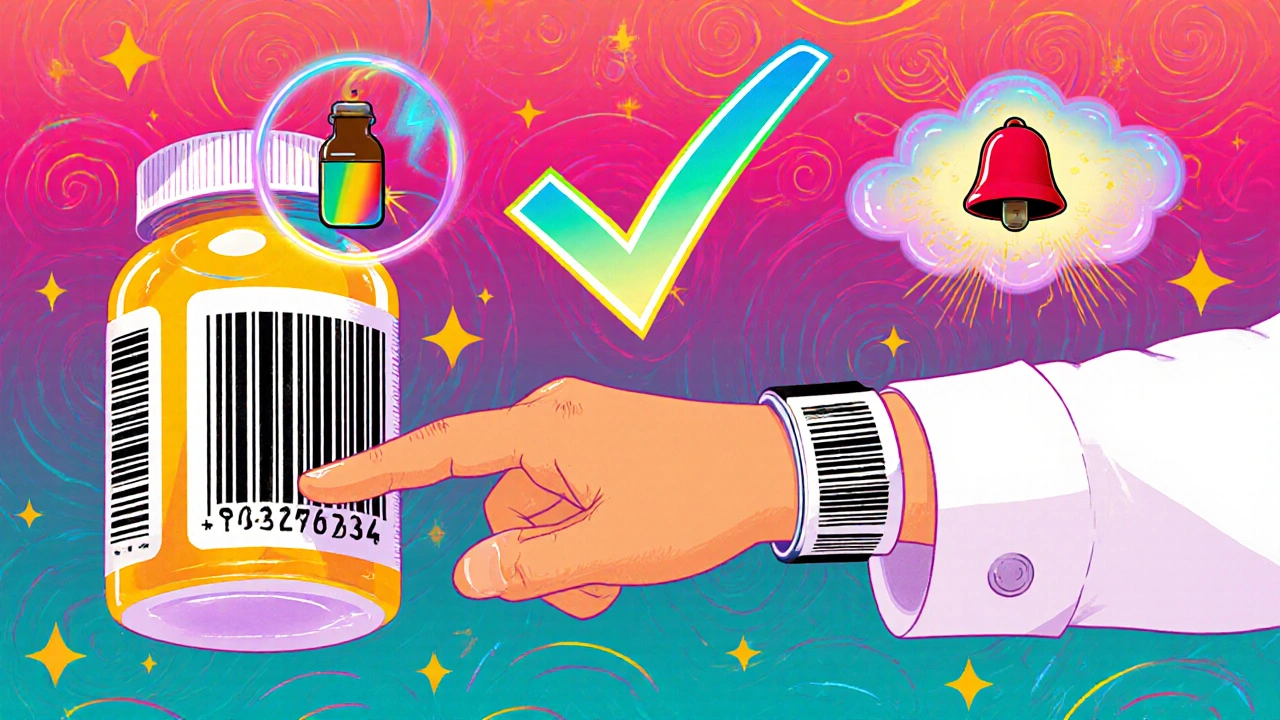
Every year, over 1.3 million medication errors happen in U.S. hospitals. Many of these aren’t caused by careless staff-they’re caused by human fatigue, similar-looking labels, or rushed workflows. But there’s a simple tool that’s stopped thousands of these mistakes before they reach patients: barcode scanning.
How Barcode Scanning Stops Errors Before They Happen
Pharmacy barcode systems don’t just make things faster-they act like a second pair of eyes. When a pharmacist picks up a pill bottle, they scan the barcode on the medication and the patient’s wristband. The system instantly checks: Is this the right drug? The right dose? For the right person? At the right time? If anything doesn’t match, it stops the process dead. No exceptions. This is called Barcode Medication Administration (BCMA). It enforces the "five rights" of medication safety: right patient, right drug, right dose, right route, right time. Before BCMA, pharmacists relied on visual checks. Studies show those manual checks catch only about 36% of errors. BCMA catches 93.4%. One hospital in Pennsylvania tracked this firsthand. Before scanning, their accuracy rate was 86.5%. After installing BCMA, it jumped to 97%. That’s not a small improvement-it’s life-saving.What Barcodes Actually Contain
Not all barcodes are the same. Most medications use 1D linear barcodes that store just the National Drug Code (NDC). This is a unique 11-digit number assigned by the FDA to every drug package. Since 2006, the FDA has required this barcode on all unit-dose medications. That means every pill, capsule, or injection vial you get from a pharmacy has a machine-readable ID tied directly to its name, strength, and manufacturer. Newer 2D matrix barcodes (like QR codes) are starting to appear. These can hold more data: lot numbers, expiration dates, even batch-specific warnings. The FDA is testing these in pilot programs. By 2026, over 65% of medications are expected to use 2D codes, up from just 22% in 2023. The system doesn’t just check the barcode-it cross-references it with the patient’s electronic health record. If the doctor ordered 5 mg of warfarin, but the bottle says 10 mg, the scanner flags it. If the patient is allergic to sulfa and the drug contains sulfamethoxazole, it alerts the pharmacist before they touch the bottle.Why Manual Checks Aren’t Enough
You might think: "Why not just double-check?" It sounds simple. But human attention fades. In a busy pharmacy, staff might scan 150 prescriptions in a shift. Fatigue sets in. Distractions happen. A pill that looks like another? Easy to miss. A 2021 study in BMJ Quality & Safety found that manual double-checks catch only about one-third of errors. That’s why hospitals still see hundreds of wrong-drug or wrong-dose incidents every year-even in top facilities. BCMA removes guesswork. It doesn’t care if you’re tired, distracted, or rushed. It only cares if the data matches. And if it doesn’t? It forces a pause. That pause is what saves lives.
Where It Falls Short
BCMA isn’t magic. It can’t fix everything. Some medications don’t have standard packaging. Insulin pens, ampules, IV bags, and compounded drugs often lack barcodes-or have them damaged, smudged, or incorrectly applied. In these cases, pharmacists must visually verify the medication. But here’s the danger: if a pharmacy tech puts a correct barcode on the wrong drug, the scanner will still approve it. There have been cases where vancomycin was labeled correctly but given in the wrong concentration-because the label matched the barcode, not the actual contents. The ECRI Institute warns: "When a barcode won’t scan, you must visually verify the medication. Never just send a label." That’s a critical rule. Too many staff skip this step when they’re pressed for time. Another problem? Workarounds. About 68% of hospitals report staff finding ways to bypass scanning-especially during emergencies or when scanners freeze. One pharmacist on Reddit said their system adds 15-20 minutes per shift because of failed scans. In rush hours, some techs just click "override." That’s when errors slip through.Real Stories from the Front Lines
A hospital pharmacist in California told a story about a levothyroxine error. The system flagged a 10x overdose-100 mcg instead of 10 mcg. The pharmacist caught it before it went to the patient. That’s the kind of win BCMA delivers daily. But it’s not all success stories. Another pharmacist in Ohio said their scanner fails on insulin pens 3-4 times a day. They have to use a special tray, hold the pen at a perfect angle, and wait for the light to hit just right. "We lose 30 minutes a day just fixing scanners," they said. A 2023 survey of 1,247 pharmacists found 78% said BCMA reduced errors. But 63% said it slowed them down. And 41% admitted they’d skipped a scan at least once during a busy shift. The truth? BCMA works-but only if people use it right.What Makes It Work (and What Breaks It)
The biggest factor isn’t the hardware. It’s the workflow. Hospitals that succeed with BCMA don’t just install scanners. They redesign how pharmacists work. They train staff to never override a scan without a second visual check. They assign teams to test new products before they hit the shelves. They monitor data weekly to find which medications are most often scanned incorrectly. The American Society of Health-System Pharmacists (ASHP) recommends scanning the manufacturer’s barcode directly-never a pharmacy-applied label. That’s because pharmacy labels can be misprinted. The original manufacturer’s code is more reliable. Training matters too. One study found 52% of staff didn’t know what to do when a barcode failed. That’s a huge gap. If you don’t know the backup plan, you’ll just guess.
Adoption Rates and Market Trends
In U.S. hospitals with 300+ beds, 92% use BCMA. In small community pharmacies? Only 35%. Why? Cost. A full system-scanners, software, integration, training-can run $50,000 to $200,000. For a small pharmacy, that’s a hard investment to justify. But the numbers are shifting. The global pharmacy automation market hit $6.2 billion in 2023 and is growing over 10% a year. Big players like Epic, Cerner, and Omnicell dominate. Epic’s system has the highest user satisfaction score-4.7 out of 5. Cerner’s is lower at 3.8. The future? More 2D barcodes. AI that predicts scanning failures. Mobile scanners built into handheld devices. Epic’s latest update in March 2024 improved scanning success by 22% just by moving from fixed scanners to mobile ones.What You Can Do
If you’re a patient: Ask if your pharmacy uses barcode scanning. If they don’t, ask why. You have the right to know your meds are being checked properly. If you’re a pharmacist or tech: Never override a scan without a visual check. Report broken barcodes. Push for training. Review your system’s error logs every week. If you’re a hospital admin: Don’t just buy scanners. Redesign the workflow. Make scanning non-negotiable. Tie compliance to performance reviews. Reward teams that reduce errors.Final Thought
Barcode scanning isn’t about technology. It’s about discipline. It’s about saying: "We’re not going to rely on memory, speed, or luck anymore. We’re going to use a system that doesn’t get tired." It’s not perfect. It’s not foolproof. But when used correctly, it turns a 36% success rate into a 93% one. That’s not just efficiency. That’s safety. And in a pharmacy, safety isn’t optional-it’s everything.How effective is barcode scanning at preventing medication errors?
When properly implemented, barcode scanning prevents 93.4% of potential dispensing errors, according to a 2021 BMJ Quality & Safety study. This includes 89% of wrong-drug errors, 86% of wrong-dose errors, and 92% of wrong-patient errors. That’s far better than manual double-checks, which catch only about 36% of mistakes.
Do all medications have barcodes?
Since 2006, the FDA has required a National Drug Code (NDC) barcode on all unit-dose medications in the U.S. This includes pills, capsules, and pre-filled syringes. However, some medications like insulin pens, ampules, compounded drugs, and emergency stock items often lack standard barcodes-or have them damaged. In these cases, pharmacists must visually verify the medication.
Can barcode scanning cause errors?
Yes, if misused. If a pharmacy staff member applies a correct barcode to the wrong medication, the scanner will approve it. This is called "automation bias." There have been cases where vancomycin was labeled correctly but given in the wrong concentration because the barcode matched the label, not the actual drug. The key rule: never trust the barcode alone. Always visually verify when in doubt.
Why do some pharmacists bypass barcode scanning?
Common reasons include scanner failures (especially with small vials or damaged barcodes), system slowdowns during busy times, and lack of training on how to handle scanning errors. About 68% of hospitals report staff finding workarounds-especially during emergencies. This is one of the biggest risks to BCMA’s effectiveness.
Is barcode scanning used in community pharmacies?
Adoption is low. While 78% of U.S. hospital pharmacies use barcode scanning, only about 35% of community pharmacies do. The main barrier is cost-equipment and software can run $50,000 or more. Smaller pharmacies often rely on manual checks or automated dispensing systems without scanning. However, as costs drop and regulations tighten, adoption is slowly increasing.
What’s the difference between 1D and 2D barcodes in pharmacies?
1D barcodes (linear) store only the National Drug Code (NDC)-the drug’s name, strength, and manufacturer. 2D barcodes (matrix) can store more data: lot number, expiration date, serial number, and even warnings. The FDA is testing 2D codes in pilot programs. By 2026, over 65% of medications are expected to use 2D barcodes, up from 22% in 2023.
How long does it take to implement barcode scanning in a pharmacy?
Implementation takes 6-8 weeks on average. This includes scanning and verifying 10,000-15,000 medication SKUs, installing hardware, integrating with pharmacy systems, and training staff. Staff typically need 8-12 weeks to become fully proficient. The biggest delays come from barcode issues on existing inventory and staff resistance to workflow changes.
What should I do if a barcode won’t scan?
Never override the scan without visually verifying the medication. Check the drug name, strength, dosage form, and manufacturer against the prescription. If the barcode is damaged, report it to your vendor. Use a specialized tray for small vials or ampules. If the problem repeats, notify your pharmacy’s safety team or the Institute for Safe Medication Practices (ISMP). Always document the incident.

Austin Simko
November 28, 2025 AT 10:55Barcodes are just the beginning. Soon they'll track your DNA too. They're building a pharmaceutical surveillance state.
Sam txf
November 28, 2025 AT 18:36Let me guess-you think this tech is magic? Nah. It's just a band-aid on a bullet wound. Pharmacies are still run by overworked zombies who skip scans because the system's a dumpster fire. You don't fix human failure with more machines-you fix it with better pay, fewer shifts, and zero tolerance for lazy overrides. This whole post reads like a vendor brochure.
Michael Segbawu
November 29, 2025 AT 11:34USA invented this shit and now every other country is copying it. We got the best meds the best scanners the best rules. Dont let them tell you otherwise. Barcodes save lives and if you dont like it you can move to a third world country where they still guess your pills. #AmericaFirst #PharmaTech
Aarti Ray
December 1, 2025 AT 01:03in india we still use paper logs and handwritten prescriptions but i see how this helps. my uncle got the wrong medicine once and almost died. i hope one day we can afford this. also barcodes are cool
Alexis Mendoza
December 2, 2025 AT 12:45It's interesting how we outsource safety to machines. We used to trust our eyes, our memory, our judgment. Now we trust a machine that can be fooled by a misprinted label. Are we becoming too dependent? Or is this just evolution? Maybe the real question isn't whether the barcode works-but whether we've stopped caring enough to double-check even when it fails.
Michelle N Allen
December 3, 2025 AT 22:41Look i read the whole thing and honestly i dont know why this is even a thing. i mean sure it catches errors but it also takes forever. i work in a pharmacy and we get so backed up because of these scanners. sometimes you just need to hand someone their meds and move on. also the barcodes on insulin pens are impossible to scan and everyone just yells at the tech and then they override it anyway. so what's the point really
Madison Malone
December 4, 2025 AT 23:54I used to work in a hospital pharmacy and I remember the first time the scanner caught a 10x overdose. I froze. The patient was 87. It could’ve been fatal. I cried after my shift. This tech isn’t perfect but it’s the closest thing we have to a safety net. I wish every pharmacy had it. Even if it slows you down-it’s worth it.
Graham Moyer-Stratton
December 6, 2025 AT 04:36Barcodes are just another way for corporations to control the process. The real problem is profit over people. They don't care if you live or die as long as the system logs a scan.
tom charlton
December 6, 2025 AT 06:11While the data clearly demonstrates the efficacy of barcode medication administration, it is imperative to recognize that technological adoption alone does not guarantee safety. The human element remains the most critical variable. Training protocols, organizational culture, and systemic reinforcement of procedural integrity must be prioritized alongside hardware implementation. Without these, even the most advanced systems become vulnerable to circumvention and complacency. The American Society of Health-System Pharmacists has consistently emphasized this point since 2018.
Jacob Hepworth-wain
December 6, 2025 AT 18:31My cousin is a pharmacist in Nebraska and she told me the scanner fails on IV bags like 5 times a day. She says they just use a flashlight and a magnifying glass sometimes. I asked if they get in trouble for overriding and she laughed and said 'if you dont override you dont get home till midnight'. The system is broken but the people are trying. Maybe we need better hardware not more rules.
Craig Hartel
December 7, 2025 AT 17:26My dad used to be a pharmacy tech back in the 90s. He told me stories about how they’d have to read tiny handwriting on scrips and guess the dose. He said sometimes they’d call the doctor three times just to confirm. I’m glad we’ve moved past that. Barcodes aren’t perfect but they’re a huge step up from hoping your eyes don’t trick you on a 12-hour shift.
Katrina Sofiya
December 8, 2025 AT 06:35Thank you for sharing such a thoughtful and well-researched piece. This is exactly the kind of insight that reminds us how critical systems are in healthcare-not because they’re flashy, but because they’re consistent. I’ve seen firsthand how fatigue can lead to mistakes, and I’m grateful that technology is stepping in to protect patients when humans are stretched too thin. Let’s keep pushing for better training, better equipment, and better support for the incredible people on the front lines. You’ve given us all a reason to believe safety is possible.