Clinical Trial vs. Real World Safety Simulator
Configuration
Detection Probability Analysis
Based on a hypothetical rare side effect occurring in 1 in 1,000 patients (0.1% incidence).
Key Insight
Adjust the inputs to see the statistical difference between controlled trials and real-world usage.
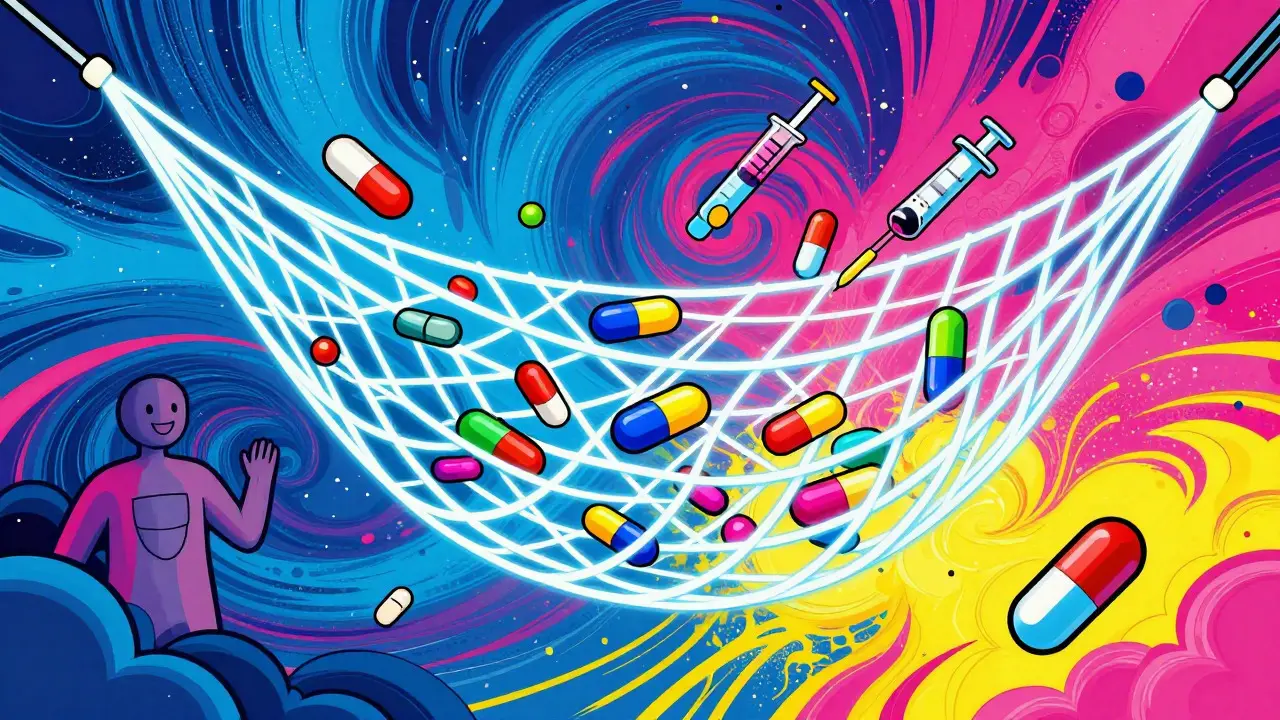
Imagine taking a new medication that was tested on thousands of people before it hit the shelves. The trials were rigorous, the data looked clean, and regulators gave the green light. So why do doctors sometimes warn you about rare but serious side effects months or even years later? The answer lies in post-marketing pharmacovigilance, which is the systematic monitoring of drug safety after regulatory approval to detect adverse reactions missed during clinical trials. It’s the safety net that catches what early testing couldn’t see.
Clinical trials are essential, but they have blind spots. They typically involve 1,000 to 5,000 participants who are carefully selected for health and compliance. Real life is messier. You might be taking three other medications, managing diabetes, or eating foods that interact with your new pill. Post-marketing pharmacovigilance (PMPV) exists to bridge this gap between controlled lab conditions and the chaotic reality of millions of diverse patients using drugs daily.
The Origins: From Tragedy to Global Standard
Pharmacovigilance didn’t start as a bureaucratic requirement; it started as a response to disaster. In the late 1950s and early 1960s, the drug thalidomide was prescribed to pregnant women for morning sickness. It caused severe birth defects in thousands of babies worldwide because its risks hadn’t been identified in pre-market studies. This tragedy shook the medical world and led to the creation of formal safety monitoring systems.
In 1968, the World Health Organization (WHO) launched the International Drug Monitoring Programme. This marked the beginning of global cooperation in tracking drug safety. Since then, countries have built their own frameworks. For example, the United Kingdom established the Yellow Card Scheme in 1964, making it one of the oldest voluntary reporting systems in the world. Today, nearly every country has a national center dedicated to watching how drugs perform in the real world.
Why Clinical Trials Miss Things
To understand why we need ongoing monitoring, we have to look at what clinical trials actually test. During Phase III trials, researchers focus on efficacy-does the drug work?-and common side effects. But rare adverse drug reactions (ADRs), those occurring in fewer than 1 in 1,000 people, often slip through the cracks simply due to sample size limitations.
Consider the case of Vioxx (rofecoxib), a painkiller approved by the U.S. Food and Drug Administration (FDA) in 1999. Trials involved about 5,000 patients and showed minimal risk. However, once it reached over 80 million users, data revealed a nearly two-fold increase in heart attacks. By the time it was withdrawn in 2004, thousands had suffered cardiac events. This example highlights a critical truth: only large-scale, long-term use can expose low-frequency, high-severity risks.
Additionally, trials exclude vulnerable groups like the elderly, pregnant women, and those with multiple chronic conditions. When these populations start using the drug post-approval, new interactions emerge. Pharmacovigilance tracks these nuances, ensuring that safety profiles evolve alongside real-world usage patterns.
How Signals Are Detected: Passive vs. Active Surveillance
Regulators and pharmaceutical companies use two main methods to find hidden dangers: passive and active surveillance. Understanding the difference helps explain why some risks are caught quickly while others take years.
Passive Surveillance relies on spontaneous reports. Doctors, pharmacists, or patients notice something wrong and submit a report to a central database. In the U.S., this happens through the FDA’s MedWatch program. In Europe, reports go into EudraVigilance. While easy to set up, passive systems suffer from underreporting. Studies suggest only 1% to 10% of actual adverse events are ever reported. If a side effect is mild or expected, people rarely bother filing paperwork.
Active Surveillance takes a more proactive approach. Instead of waiting for reports, agencies mine existing health data to find patterns. The FDA’s Sentinel Initiative, launched in 2008, accesses electronic health records from over 300 million patients. It runs automated queries to spot spikes in hospitalizations or specific diagnoses linked to a drug. Similarly, the UK uses the Clinical Practice Research Datalink (CPRD), which covers 45 million patients, to link prescriptions with outcomes. These systems don’t rely on human memory or willingness to report; they let the data speak for itself.
| Method | Data Source | Strengths | Weaknesses |
|---|---|---|---|
| Spontaneous Reporting (e.g., MedWatch) | Voluntary submissions from healthcare providers and patients | Low cost, detects unexpected events globally | High underreporting, biased toward severe or novel events |
| Electronic Health Record Mining (e.g., Sentinel) | Automated analysis of patient medical records | Large sample sizes, objective data, faster detection | Requires complex infrastructure, privacy concerns |
| Patient Registries | Longitudinal tracking of specific patient cohorts | Detailed data on rare diseases or specific drugs | Expensive, slow to establish, limited generalizability |

The Role of Technology and AI
As data volumes explode, traditional manual review isn’t enough. That’s where artificial intelligence comes in. In 2023, the FDA upgraded its Sentinel System to version 3.0, incorporating natural language processing (NLP). This allows the system to scan unstructured doctor’s notes and discharge summaries for clues about side effects, speeding up signal detection by 73% compared to older methods.
Other innovations include blockchain for secure data sharing between competitors, as piloted by Novartis and Roche, achieving 99.8% data integrity. Wearable technology is also entering the mix. Apple partnered with Pfizer in 2023 to monitor atrial fibrillation via smartwatches, providing continuous real-world data rather than sporadic clinic visits. These tools help regulators move from reactive monitoring to predictive analytics, potentially identifying risks before they cause widespread harm.
Global Differences in Safety Monitoring
Not all countries handle drug safety the same way. The European Union operates under a harmonized framework called Good Pharmacovigilance Practices (GVP), implemented in 2012. All member states feed data into EudraVigilance, creating a unified view across 30 countries. As of 2022, this database processed 2.4 million individual case safety reports. The EU also mandates Risk Management Plans (RMMs) for higher-risk drugs, requiring things like restricted distribution programs or mandatory patient alert cards.
In contrast, Japan’s Pharmaceuticals and Medical Devices Agency (PMDA) requires a mandatory reexamination period of 4 to 10 years for new drugs. During this time, companies must conduct intensive post-marketing surveillance. Meanwhile, the U.S. relies heavily on its hybrid model of passive MedWatch reports and active Sentinel mining. Each system has strengths: the EU offers standardization, Japan ensures deep initial scrutiny, and the U.S. leverages massive data infrastructure. However, disparities remain. Africa, for instance, has only 38 operational national centers serving 54 countries, leading to extremely low reporting rates of just 0.2 reports per 100,000 people compared to 182.7 in the EU.

What Happens When a Risk Is Confirmed?
Finding a potential problem is only half the battle. Once a "signal" is detected-a statistical association suggesting a possible causal link-regulators must act. The process usually involves validation, assessment, and decision-making. According to the International Council for Harmonisation (ICH) E2H guideline published in 2023, signals should be validated within 30 days, assessed within 60 days, and result in regulatory action within 120 days if necessary.
Actions vary based on severity. Minor issues might lead to updated prescribing information or added warnings on the label. More serious risks could trigger black box warnings, restrictions on who can prescribe the drug, or even market withdrawal. The goal is always risk minimization without unnecessarily removing effective treatments from patients who need them.
Challenges Facing Modern Pharmacovigilance
Despite technological advances, significant hurdles remain. One major issue is data quality. An FDA analysis in 2022 found that 37% of adverse event reports lacked complete dosage information, making it hard to determine if the reaction was truly drug-related. Another challenge is resource disparity. Large pharmaceutical giants employ dozens of specialists for pharmacovigilance, while small biotech firms may have only three full-time staff members handling everything from case processing to regulatory filings.
There’s also the problem of delayed studies. A JAMA Internal Medicine study noted that while 71% of novel drugs approved between 2009 and 2018 required post-marketing studies, 40% of these were completed late or not at all. This delays critical safety insights and leaves patients exposed to unknown risks longer than intended.
How long does it take to detect a new side effect?
It varies widely. Common side effects appear within months, but rare ones can take 5 to 10 years to surface. The FDA notes that 31% of serious safety issues emerged more than five years after approval.
Can patients report side effects directly?
Yes. In the U.S., patients can use the MedWatch form online. In the UK, the Yellow Card app allows direct submission. While only 12% of consumers know about these options, regulators encourage public participation to improve data coverage.
What is a 'safety signal'?
A safety signal is any information that suggests a new potential causal relationship between a drug and an adverse event. It doesn't prove causation but triggers further investigation to confirm or rule out the risk.
Why aren't all side effects found in clinical trials?
Clinical trials have limited sample sizes (1,000-5,000 people) and exclude complex patients. Rare events (less than 1 in 1,000) often require tens of thousands of users to become statistically visible, which only happens after widespread market release.
How does AI improve drug safety monitoring?
AI accelerates signal detection by analyzing vast amounts of unstructured data like doctor's notes and social media posts. The FDA's Sentinel 3.0 uses NLP to identify potential risks 73% faster than previous manual methods, allowing quicker regulatory responses.