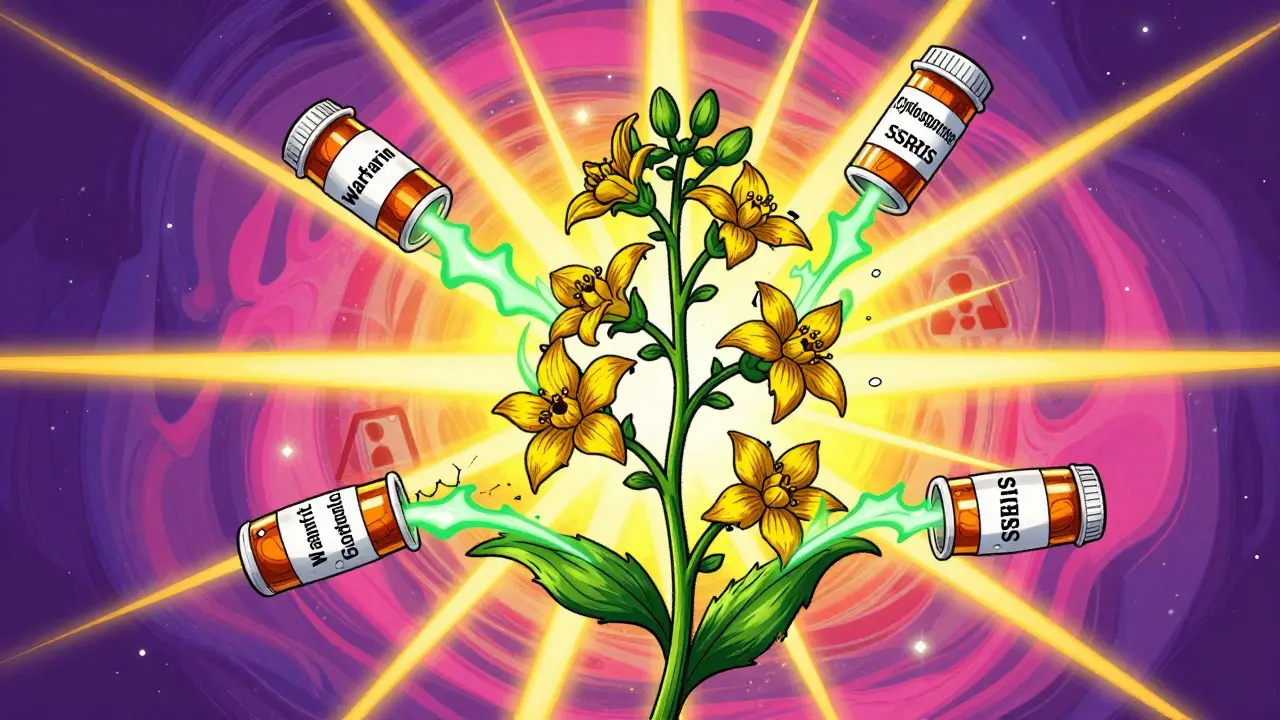
St. John’s Wort might seem like a harmless natural fix for low mood, but it’s one of the most dangerous herbal supplements you can take if you’re on any prescription medication. It doesn’t just blend quietly into your routine-it actively changes how your body processes drugs, sometimes with life-threatening results. You might think, "It’s just a plant," but this herb is stronger than many people realize. In fact, the U.S. National Institutes of Health classifies it as high risk for drug interactions, and regulators in Europe and the U.S. have issued repeated warnings for over two decades.
How St. John’s Wort Changes Your Body’s Chemistry
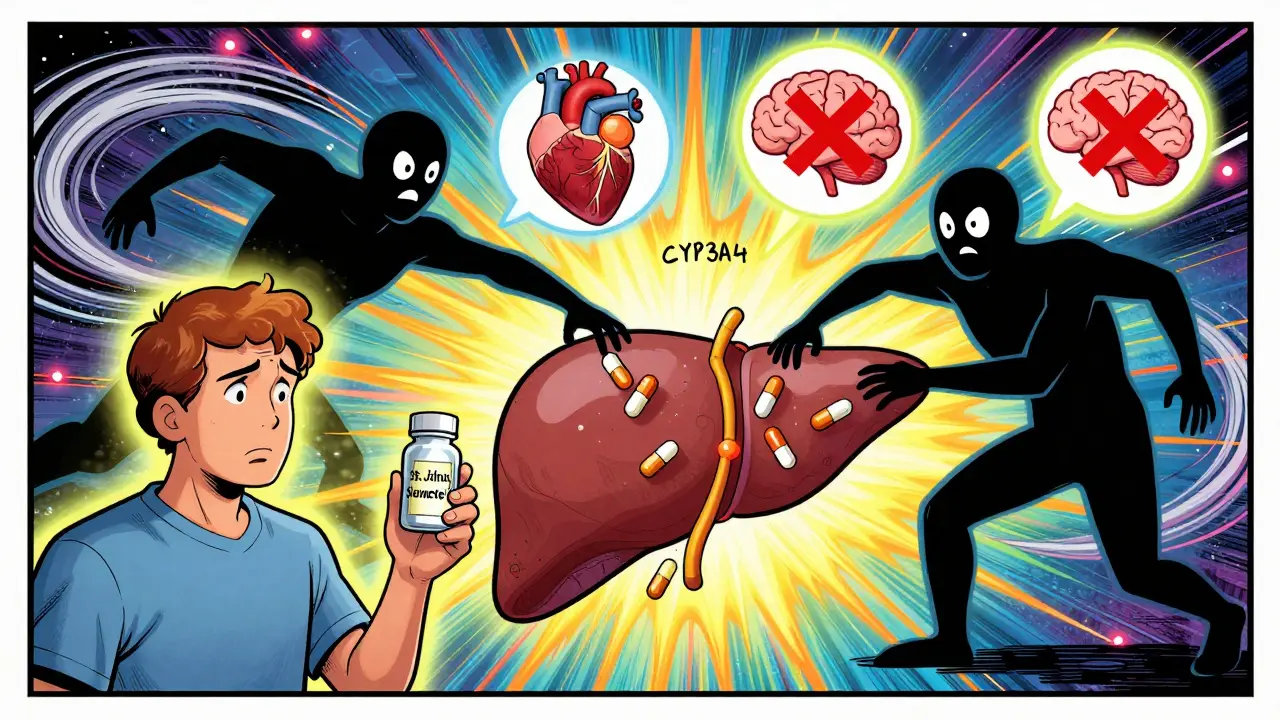
St. John’s Wort works by triggering a powerful biological switch inside your liver and intestines. Its active ingredient, hyperforin, turns on a receptor called PXR, which tells your body to make more of certain enzymes-especially CYP3A4-and to pump out more of a protein called P-glycoprotein. These aren’t just random chemicals; they’re your body’s main cleanup crew for medications. When they’re overworked, your drugs get broken down too fast and leave your system before they can do their job.
This isn’t theoretical. In a 2006 study, people taking a standard St. John’s Wort supplement saw their CYP3A4 enzyme activity jump by 2 to 3 times within just two weeks. That means any medication processed by this enzyme-like blood thinners, HIV drugs, or birth control-gets cleared from your body at nearly double the speed. The effect doesn’t vanish the day you stop taking it, either. Experts say it can take up to two weeks for your enzyme levels to return to normal after you quit.
Warfarin and Other Blood Thinners: The Invisible Bleeding Risk
If you’re on warfarin (Coumadin) or phenprocoumon (Marcoumar), St. John’s Wort could put you at serious risk of a blood clot. These drugs need to stay in your bloodstream at just the right level-too little, and you’re vulnerable to clots; too much, and you could bleed internally. St. John’s Wort drops warfarin levels by speeding up its breakdown. One documented case involved a 62-year-old man whose INR (a measure of blood clotting time) fell from a safe 2.8 to a dangerous 1.4 in just seven days after starting the supplement. That’s the difference between protection and a stroke or heart attack.
Between 1998 and 2000, European health agencies recorded 22 cases of warfarin interactions linked to St. John’s Wort. All of them caused unstable INR values. In the UK, doctors now routinely ask patients about herbal supplement use before prescribing blood thinners. If you’re on warfarin, even a single capsule of St. John’s Wort can undo months of careful dosing.
Organ Transplants: A Deadly Mix with Immunosuppressants
For transplant patients, St. John’s Wort isn’t just risky-it’s potentially fatal. Cyclosporine and tacrolimus keep the body from rejecting a new kidney, liver, or heart. These drugs have extremely narrow safety margins. Even a small drop in their concentration can trigger rejection. A 2004 study of 10 kidney transplant patients found that adding St. John’s Wort caused cyclosporine levels to plunge by 54%. Two of those patients suffered acute organ rejection. Another study showed tacrolimus levels dropped by up to 60%.
The European Medicines Agency reviewed 17 cases of transplant rejection tied to St. John’s Wort and issued a formal warning in 2007. Since then, transplant centers across Europe and North America have added screening for herbal supplements to their intake protocols. If you’ve had a transplant, taking St. John’s Wort is not an option. It’s not a gamble-it’s a gamble with your life.
Birth Control Failure: More Common Than You Think
Many women assume herbal supplements are safe to use with birth control. They’re wrong. St. John’s Wort reduces the levels of both estrogen and progestin in oral contraceptives. A 2005 study showed a 15% drop in estrogen and a 26% drop in progestin. That’s enough to make the pill ineffective.
The Swedish Medical Products Agency tracked 47 cases of unintended pregnancy between 2000 and 2003 directly linked to St. John’s Wort use. GoodRx’s 2022 analysis of FDA reports found 217 cases of contraceptive failure tied to this herb. In one case, a woman in her 30s got pregnant after taking St. John’s Wort for mild anxiety while on the pill. She had no idea the two could interact. Today, the FDA and European regulators require warning labels on St. John’s Wort products that specifically mention birth control. But most consumers still don’t know.
HIV Medications: Risk of Drug Resistance
If you’re living with HIV and taking antiretroviral drugs, St. John’s Wort can be catastrophic. It slashes the effectiveness of protease inhibitors like indinavir. A 2004 clinical study showed that indinavir levels dropped by an average of 57%-in some cases, by as much as 99%. That’s not just reduced effectiveness; it’s treatment failure.
When HIV drugs don’t work properly, the virus mutates and becomes resistant. That means the drugs you rely on stop working, and your options shrink. A UK case report described a patient whose viral load spiked after starting St. John’s Wort. The U.S. Department of Health and Human Services explicitly bans its use with all HIV medications. Yet, a 2023 Consumer Reports survey found only 18% of supplement users knew about this interaction.
Antidepressants: The Serotonin Syndrome Danger
St. John’s Wort itself has antidepressant effects. That’s why people take it. But if you’re already on an SSRI like fluoxetine or an SNRI like venlafaxine, combining them can overload your brain with serotonin. That’s serotonin syndrome-a rare but deadly condition.
Symptoms include sweating, fast heartbeat, muscle spasms, confusion, and agitation. In one 2021 case, an 18-year-old man developed paranoid behavior, a heart rate of 128 bpm, and high blood pressure after mixing St. John’s Wort with 5-HTP and melatonin. He ended up in the hospital needing IV fluids and sedatives. The Mayo Clinic says serotonin syndrome occurs in 76-92% of cases with these combinations. The American Psychiatric Association now advises waiting at least 14 days after stopping an antidepressant before starting St. John’s Wort-and vice versa.
Other Dangerous Interactions
St. John’s Wort doesn’t stop at the big names. It also messes with:
- Benzodiazepines like alprazolam (Xanax): Reduces effectiveness by up to 40%, making anxiety worse.
- Digoxin (Lanoxin): Lowers blood levels by 25%, risking heart rhythm problems.
- Antiseizure drugs like phenytoin (Dilantin): Reduces levels by 19-46%, increasing seizure risk. The FDA logged 12 cases of breakthrough seizures between 2000 and 2005.
- Chemotherapy drugs: Some studies suggest reduced effectiveness, though more research is needed.
There are over 142 documented drug interactions with St. John’s Wort, according to the St. John’s Wort Drug Interaction Checker. That’s more than most prescription medications.

What You Should Do
Don’t assume herbal means safe. If you’re taking any prescription drug, check with your pharmacist before starting St. John’s Wort-or any supplement. Pharmacists are trained to spot these interactions. A 2021 study showed that targeted counseling cut inappropriate use by 68%.
If you’re already taking it and a prescription:
- Stop immediately and talk to your doctor.
- Don’t quit cold turkey if you’re using it for depression-work with your provider to switch safely.
- Wait at least two weeks after stopping St. John’s Wort before starting a new medication that’s metabolized by CYP3A4.
And if you’re considering it for depression? Talk to your doctor first. There are safer, proven options with fewer risks.
The Future: Is There a Safer Version?
Researchers are trying to fix the problem. A new type of St. John’s Wort extract, with hyperforin reduced to under 0.5%, showed similar antidepressant effects in a 2023 trial-but only caused a 9% drop in a key drug’s level, compared to 56% with the standard version. The NIH is funding a $2.4 million study to see if this could be a breakthrough. But until it’s approved and widely available, stick with the warning: if you’re on medication, don’t touch it.
Regulatory Warnings Are Getting Stronger
The FDA announced in June 2023 that all St. John’s Wort products sold in the U.S. must carry a "Drug Interaction Alert" symbol on the front label starting January 2025. That’s the same level of warning as black box warnings on the riskiest prescription drugs. The European Union already requires labels to mention interactions with HIV meds, transplant drugs, birth control, and antidepressants.
Despite this, awareness is shockingly low. Only 32% of supplement users know it can make birth control fail. Just 18% know it can interfere with HIV treatment. The gap between marketing and reality is deadly.
Can I take St. John’s Wort if I’m not on any medications?
Even if you’re not currently on medications, you might start taking them in the future. St. John’s Wort’s effects linger for up to two weeks after you stop. If you’re planning surgery, pregnancy, or any new treatment, it could interfere. It’s safest to avoid it unless you’re under medical supervision.
Is St. John’s Wort regulated like a drug?
No. In the U.S., it’s sold as a dietary supplement, so manufacturers aren’t required to prove safety or effectiveness before selling it. The FDA only steps in after problems arise. That’s why warning labels are often missing or unclear. In Europe, regulations are stricter, but the product is still not classified as a medicine.
Are all St. John’s Wort products the same?
No. The amount of hyperforin-the compound that causes interactions-varies widely between brands and batches. Ethanol extracts tend to have more hyperforin than CO2 extracts. Even the same brand can change over time. There’s no reliable way for consumers to know the strength of what they’re taking.
Can I take St. John’s Wort with over-the-counter painkillers like ibuprofen or acetaminophen?
There’s no strong evidence of serious interaction with common pain relievers like ibuprofen or acetaminophen. But since St. John’s Wort affects liver enzymes, it’s still best to avoid combining them unless you’ve checked with a pharmacist. Some people report reduced effectiveness of pain meds, though this isn’t well-documented.
What should I tell my doctor if I’ve been taking St. John’s Wort?
Be honest and specific. Say: "I’ve been taking St. John’s Wort for [reason], for [length of time], and I’m currently taking [list of all medications]." Don’t say "I take herbal stuff"-name the supplement. Many doctors don’t ask about supplements, so you need to bring it up. It’s not judgment-it’s safety.
Final Thought: Natural Doesn’t Mean Safe
St. John’s Wort is a powerful plant with real biochemical effects. It’s not a gentle tea. It’s a drug in disguise. The fact that it’s sold on shelves next to vitamins doesn’t make it safe. If you’re on any prescription medication-especially for heart, mental health, HIV, or transplants-avoid it completely. There’s no safe middle ground. The science is clear. The warnings are loud. Ignoring them isn’t being natural-it’s being reckless.


Vu L
December 27, 2025 AT 16:00Mimi Bos
December 28, 2025 AT 12:05Payton Daily
December 29, 2025 AT 07:08Kelsey Youmans
December 30, 2025 AT 22:12Sydney Lee
January 1, 2026 AT 16:05oluwarotimi w alaka
January 3, 2026 AT 10:35Debra Cagwin
January 3, 2026 AT 12:34Hakim Bachiri
January 4, 2026 AT 15:57Celia McTighe
January 5, 2026 AT 16:51Ryan Touhill
January 7, 2026 AT 07:47Teresa Marzo Lostalé
January 7, 2026 AT 12:49ANA MARIE VALENZUELA
January 8, 2026 AT 08:05Bradly Draper
January 8, 2026 AT 10:12