Methotrexate-NSAID Safety Calculator
Your Risk Assessment
This tool calculates your risk of kidney toxicity when taking methotrexate with NSAIDs based on your kidney function and NSAID choice. Always consult your doctor before making medication changes.
Your risk: Low
When you're living with rheumatoid arthritis, pain relief is non-negotiable. But what happens when the drug that controls your disease - methotrexate - meets the painkiller you reach for every day? It’s not just a simple mix. This combination can quietly wreck your kidneys and push methotrexate levels into dangerous territory. And most people don’t know it until it’s too late.
How Methotrexate Works - And Why Your Kidneys Matter
Methotrexate isn’t just a painkiller. At low doses (5-25 mg weekly), it’s a disease-modifying drug for rheumatoid arthritis. At high doses (over 150 mg), it’s a chemotherapy agent. Either way, your body relies on your kidneys to clear it. About 80% of methotrexate leaves your body through urine. If your kidneys slow down, the drug builds up. And that’s where things get risky.
Methotrexate doesn’t follow simple rules. Its clearance isn’t linear - meaning small changes in kidney function can cause big spikes in blood levels. At low doses, it’s eliminated in 3-10 hours. At high doses, that window stretches to 8-15 hours. When NSAIDs step in, they can cut that clearance by 25-40%. That’s not a minor tweak. That’s a red flag.
How NSAIDs Interfere - It’s Not Just About Pain Relief
NSAIDs like ibuprofen, naproxen, and diclofenac work by blocking enzymes that make prostaglandins. Prostaglandins help keep blood flowing to your kidneys. When you block them, your kidneys get less blood. Less blood means less filtering. Less filtering means methotrexate lingers.
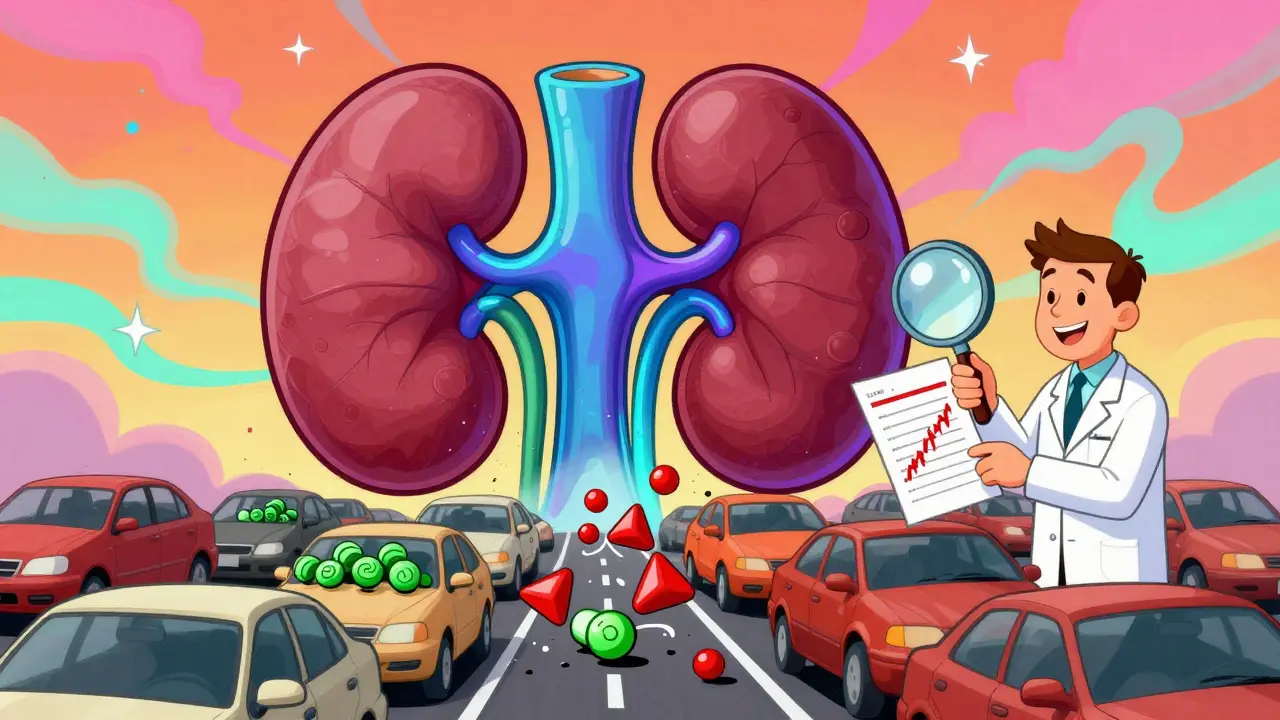
But it’s worse than that. NSAIDs also compete with methotrexate for the same transporters in your kidney tubules. Think of it like two cars trying to use the same narrow exit ramp. One gets stuck. In this case, methotrexate gets stuck - and stays in your bloodstream longer. Studies show this can raise free methotrexate levels by up to 30% because NSAIDs also knock methotrexate off its protein-binding sites in the blood.
Not all NSAIDs are created equal. Ketorolac is the worst offender - it can spike methotrexate levels by 50%. Ibuprofen? Around 25-30%. Celecoxib, a COX-2 inhibitor, is the least risky - maybe 10-15%. But even that small increase matters if your kidneys are already struggling.
High-Dose vs. Low-Dose: The Real Difference in Risk
Here’s where people get confused. If you’re on low-dose methotrexate for arthritis, you might hear, “It’s probably fine.” But that’s misleading. The risk isn’t the same for everyone.
For cancer patients on high-dose methotrexate (500 mg/m² or more), adding an NSAID increases the risk of life-threatening toxicity - like bone marrow failure or kidney shutdown - by nearly five times. There are documented cases of death from this combo.
For RA patients on low-dose methotrexate (≤25 mg weekly), the data is mixed. One large 2019 study of over 4,000 patients found no significant rise in serious side effects - but only if their kidneys were healthy. When kidney function dipped below 60 mL/min/1.73m², the risk jumped 3.2 times. That’s the key. It’s not the methotrexate. It’s not the NSAID. It’s the combination in people with existing kidney trouble.
Who’s Most at Risk - And Why You Might Not Know
You don’t feel kidney damage until it’s advanced. That’s the problem. In a 2020 review, 63% of methotrexate-NSAID kidney injuries were found only because someone got a routine blood test. No symptoms. No warning.
People over 65? Higher risk. Those with diabetes or high blood pressure? Higher risk. Anyone with a past history of kidney stones or dehydration? Higher risk. Even being on other drugs that affect the kidneys - like diuretics or ACE inhibitors - makes this combo more dangerous.
And here’s the scary part: 78% of serious cases happened in people who hadn’t had a kidney function test in the past 30 days. That’s not negligence - it’s ignorance. Many doctors assume low-dose methotrexate is safe. Many patients assume NSAIDs are harmless. Neither is true.
Real Stories - From Reddit to the ER
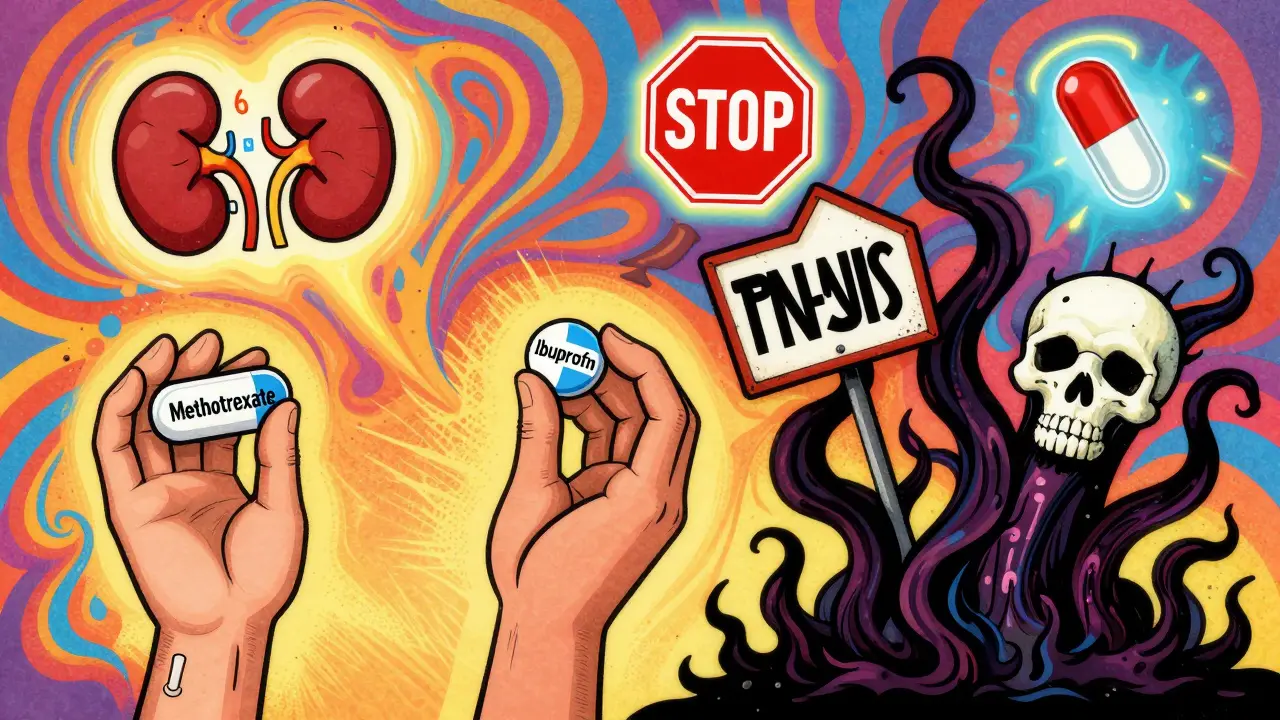
On Reddit, a user named RAWarrior2020 wrote: “My rheumatologist prescribed naproxen without checking my kidneys. Three days later, I was nauseated, my white blood cells dropped to 1.8. I needed leucovorin to save me.”
Another user, MTXandMe, said: “I’ve taken ibuprofen with methotrexate for eight years. My doctor checks my blood every four weeks. That’s why I’m still here.”
That’s the difference. One person got lucky. The other got care. The Arthritis Foundation found that 41% of patients who added NSAIDs without monitoring had an adverse event. Only 9% did when they had regular blood tests.
What You Should Do - Practical Steps to Stay Safe
If you’re on methotrexate and need pain relief, here’s what actually works:
- Get your kidney function tested - eGFR and serum creatinine. Do it before starting any NSAID. Repeat it 48-72 hours after you start.
- Avoid NSAIDs if your eGFR is below 60. That’s the cutoff. No exceptions.
- If you must use an NSAID, pick the lowest dose for the shortest time. Ibuprofen is safer than naproxen. Celecoxib is safer than both.
- Space out the doses. Take methotrexate in the morning, NSAID in the evening. This reduces peak overlap.
- Get blood work every 4-6 weeks - not just creatinine, but a full CBC. Low white cells or platelets are early signs of toxicity.
For people on high-dose methotrexate (cancer treatment), the rules are stricter. You need methotrexate blood levels checked at 24, 48, and 72 hours after your dose if you’re on an NSAID. This isn’t optional. It’s life-saving.
Alternatives to NSAIDs - What Else Can You Try?
You don’t have to suffer. There are safer options:
- Acetaminophen (paracetamol) - up to 3 grams per day. It doesn’t affect kidney clearance of methotrexate. Safe for most.
- Low-dose opioids - for short-term flare-ups. Not for daily use, but better than risking kidney failure.
- DMARDs or biologics - if your arthritis is flaring, maybe it’s time to adjust your disease control, not just mask the pain.
- Physical therapy, heat, or braces - sometimes the best pain relief isn’t a pill.

The Bigger Picture - Why This Keeps Happening
This interaction has been known since the 1980s. Yet, in 2023, 62% of RA patients on CreakyJoints said they weren’t warned about it. Why?
Because doctors assume low-dose methotrexate is “safe.” Because patients think NSAIDs are like aspirin - harmless. Because labs don’t always flag abnormal kidney values. Because no one checks.
The FDA and EMA both warn about this. The American College of Rheumatology and EULAR have clear guidelines. But guidelines don’t change practice unless people are reminded.
Pharmacists are the missing link. A 2023 study showed pharmacist-led checks reduced dangerous interactions by 63%. That’s not magic. That’s asking one question: “Are you taking any painkillers?”
What’s Next - The Future of Monitoring
Researchers are now looking at genetics. About 15% of Caucasians carry a gene variant (SLC19A1 80G>A) that makes them absorb more methotrexate. When they take NSAIDs, their levels spike 40% more than others. We’re not testing for this yet - but we should be.
Point-of-care blood tests for methotrexate levels are in phase 3 trials. Imagine a finger-prick test that tells you your drug level before you take your next NSAID. That’s coming. Soon.
Until then, the rule is simple: Don’t guess. Test.
Can I take ibuprofen with methotrexate?
You can, but only if your kidney function is normal (eGFR above 60 mL/min/1.73m²) and you’re on low-dose methotrexate (25 mg or less weekly). Use the lowest dose of ibuprofen for the shortest time possible. Always check your creatinine and blood counts 48-72 hours after starting it. If your eGFR is below 60, avoid ibuprofen entirely.
What happens if I take NSAIDs with methotrexate without knowing?
You might not feel anything at first. But methotrexate can build up in your blood, leading to kidney damage, low white blood cells, mouth sores, or severe fatigue. In worst cases, it can cause acute kidney injury or bone marrow failure. These effects often show up only after a blood test. Many people don’t realize they’re in danger until they’re hospitalized.
Is celecoxib safer than other NSAIDs with methotrexate?
Yes. Celecoxib is a COX-2 selective NSAID, which means it’s less likely to reduce kidney blood flow compared to older NSAIDs like naproxen or diclofenac. Studies show it raises methotrexate levels by only 10-15%, compared to 25-50% with others. But it’s not risk-free - especially if your kidneys are already impaired. Always monitor kidney function and blood counts.
How often should I get blood tests if I’m on methotrexate and NSAIDs?
If you’re starting an NSAID while on methotrexate, get a creatinine and complete blood count (CBC) within 48-72 hours. After that, continue testing every 4-6 weeks. If your eGFR is below 60 or you’re on high-dose methotrexate, test every 2-4 weeks. Don’t wait for symptoms - they come too late.
What should I do if I already took NSAIDs with methotrexate?
Stop the NSAID immediately. Call your doctor or pharmacist. Get a creatinine and CBC test as soon as possible. If you’re on high-dose methotrexate or have kidney issues, go to urgent care. Symptoms like nausea, vomiting, mouth sores, extreme fatigue, or reduced urination mean you may need leucovorin - a rescue treatment that reverses methotrexate toxicity.
Can I take acetaminophen instead of NSAIDs with methotrexate?
Yes. Acetaminophen (up to 3 grams per day) is the safest pain reliever to use with methotrexate. It doesn’t interfere with kidney clearance or increase methotrexate levels. It’s not anti-inflammatory, so it won’t treat swelling - but it’s excellent for pain. If your arthritis pain is persistent, talk to your rheumatologist about adjusting your disease-modifying drugs instead of relying on painkillers.
Final Takeaway - Don’t Risk It Without Knowing
This isn’t a theoretical risk. It’s a real, documented, and preventable danger. Thousands of people take methotrexate. Millions take NSAIDs. The overlap is huge. And the consequences? They’re silent until they’re catastrophic.
You don’t need to avoid all pain relief. You just need to know how to use it safely. Test your kidneys. Choose the right drug. Monitor your blood. Talk to your pharmacist. These aren’t extra steps - they’re your safety net.




Shelby Price
February 3, 2026 AT 14:14So I’ve been on methotrexate for 6 years and ibuprofen for 8. Never checked my kidneys. Guess what? I’m fine. Maybe this whole thing is just fearmongering with fancy stats.
Keith Harris
February 4, 2026 AT 20:17Oh wow, another ‘pharma shill’ article pretending to care about patients. Let me guess - the real agenda is to push you toward expensive biologics and ‘monitoring packages’ that cost more than your rent? The FDA doesn’t give a damn about you. They care about liability. Your doctor? They’re too busy typing in EHRs to actually talk to you. This isn’t safety - it’s profit-driven fear. And you fell for it. 😏
pradnya paramita
February 5, 2026 AT 12:18Let’s clarify the pharmacokinetics: methotrexate is primarily excreted via renal tubular secretion via RFC-1 and BCRP transporters. NSAIDs inhibit these via competitive binding, particularly OAT3 and MRP2. The 25-40% reduction in clearance is well-documented in *Clin Pharmacokinet* 2017. For low-dose MTX (<25mg/wk), the absolute risk remains low in eGFR >60, but the relative risk escalates exponentially with concomitant ACEi, diuretics, or age >65. The 2020 JAMA Rheum meta-analysis showed 3.2x higher incidence of acute kidney injury in patients with baseline eGFR 45-59. Monitoring isn’t optional - it’s biochemically imperative.
caroline hernandez
February 6, 2026 AT 03:35As a rheumatology NP, I see this every week. Patient comes in with joint pain, takes ibuprofen daily, says ‘my doc said it’s fine.’ Then their creatinine jumps from 0.9 to 1.8 in 3 weeks. CBC shows WBC 2.1. They’re confused. ‘But I felt fine!’ - yeah, because your kidneys don’t scream until they’re shutting down. We now require eGFR and CBC before prescribing NSAIDs to any MTX patient. No exceptions. It’s not paranoia. It’s standard of care. And yes, acetaminophen is the new first-line. Not perfect, but safe.
Jhoantan Moreira
February 8, 2026 AT 00:23Thanks for laying this out so clearly 🙏 I’ve been on MTX for 4 years and just started celecoxib last month after my doc warned me. I get bloodwork every 6 weeks now - honestly, it’s become part of my routine. I used to think ‘I’m young, I’m fine’ - but now I know better. Knowledge is power. And so is a good pharmacist. 💪
Samuel Bradway
February 9, 2026 AT 11:59My mom took naproxen with MTX for years. Never checked her kidneys. Got hospitalized last year with acute renal failure. They gave her leucovorin. She’s okay now but scared to death. I made her stop all NSAIDs. Now she uses heat packs and physical therapy. She says it’s annoying but worth it. Just… please, if you’re on MTX, get tested. Don’t wait for the ER.
Daz Leonheart
February 11, 2026 AT 11:44i read this and i just thought… wow. i’ve been taking advil with my mtx for 5 years and never even thought about it. my doc never mentioned it. i guess i’m lucky so far. but i’m gonna get my bloodwork done this week. thanks for the wake up call.
Prajwal Manjunath Shanthappa
February 13, 2026 AT 05:22How utterly pedestrian. You’ve taken a complex, nuanced pharmacokinetic interaction - one that has been meticulously studied in peer-reviewed journals since the 1980s - and reduced it to a bullet-pointed pamphlet for the clinically illiterate. You cite ‘Reddit users’ as evidence, as if anecdotal testimony from anonymous internet strangers carries the weight of a randomized controlled trial. And you dare suggest that ‘getting a blood test’ is the solution? The real problem is that medical education has devolved into a checklist culture - test, monitor, warn, repeat - while ignoring the root: systemic underfunding of rheumatology, the commodification of patient care, and the abdication of clinical judgment to algorithmic guidelines. You’re not saving lives. You’re performing performative medicine.
Jamillah Rodriguez
February 14, 2026 AT 22:20So… NSAIDs = bad. But acetaminophen is fine? 😂 LMAO. Did you know acetaminophen can cause liver failure if you drink alcohol? And your ‘safe’ option is just a slower suicide? Also - who’s funding this article? Big Pharma? The kidney machine industry? Someone’s making bank off this fear. 🤔
Caleb Sutton
February 15, 2026 AT 04:26They’re lying. This is all a lie. Methotrexate doesn’t even work. The whole RA diagnosis is a scam. Your ‘kidney damage’ is just your body fighting the poison they’re forcing into you. They don’t want you to heal. They want you dependent. And they’re using ‘blood tests’ to gaslight you into thinking you’re sick. Don’t trust the system.
Mandy Vodak-Marotta
February 16, 2026 AT 10:04Okay so I’ve been on MTX since 2020 and I take ibuprofen like it’s candy - like, I literally take 2 every night for my back. I’ve had 3 blood tests in 4 years. My doc says ‘you’re fine.’ But now I’m reading this and I’m like… wait, did I almost kill myself? I’ve had weird fatigue, mouth sores, and once I peed blood and thought it was a UTI. Maybe it wasn’t. I’m going to the clinic tomorrow. Also, I didn’t know celecoxib was less bad? That’s new info. I’ve been using naproxen because it’s cheaper. I feel dumb. But also… thank you? I think?
Alec Stewart Stewart
February 18, 2026 AT 03:09Hey, I just want to say this is super important. I’m a nurse and I’ve seen too many patients get sick from this combo. You don’t have to be scared - just informed. If you’re on MTX, talk to your pharmacist. They’re the real heroes here. And if you’re feeling tired or sore, don’t just pop pills - call your doc. You’re not alone. We’ve got you.
Susheel Sharma
February 18, 2026 AT 10:42While the pharmacodynamic interplay between NSAIDs and methotrexate is well-established, the clinical significance of low-dose MTX exposure in healthy renal function remains statistically marginal. The cited 2019 study’s hazard ratio of 3.2 is predicated on a cohort with pre-existing renal compromise - a subgroup that should be stratified, not generalized. Moreover, the assertion that ‘78% of serious cases occurred without recent renal testing’ is a classic case of selection bias: those who were tested were more likely to be flagged. The real issue? Overmedicalization of benign pharmacokinetic interactions. Let patients make informed choices - not dictate compliance through fear.
Alex LaVey
February 20, 2026 AT 01:55As someone from India who’s been on MTX for 8 years, I want to say - this post saved my life. In my country, doctors rarely explain drug interactions. I found this on Reddit and took it to my local clinic. They tested my eGFR - it was 58. I stopped NSAIDs. Started acetaminophen. Now I feel better than I have in years. This isn’t just science. It’s survival. Thank you for writing this.