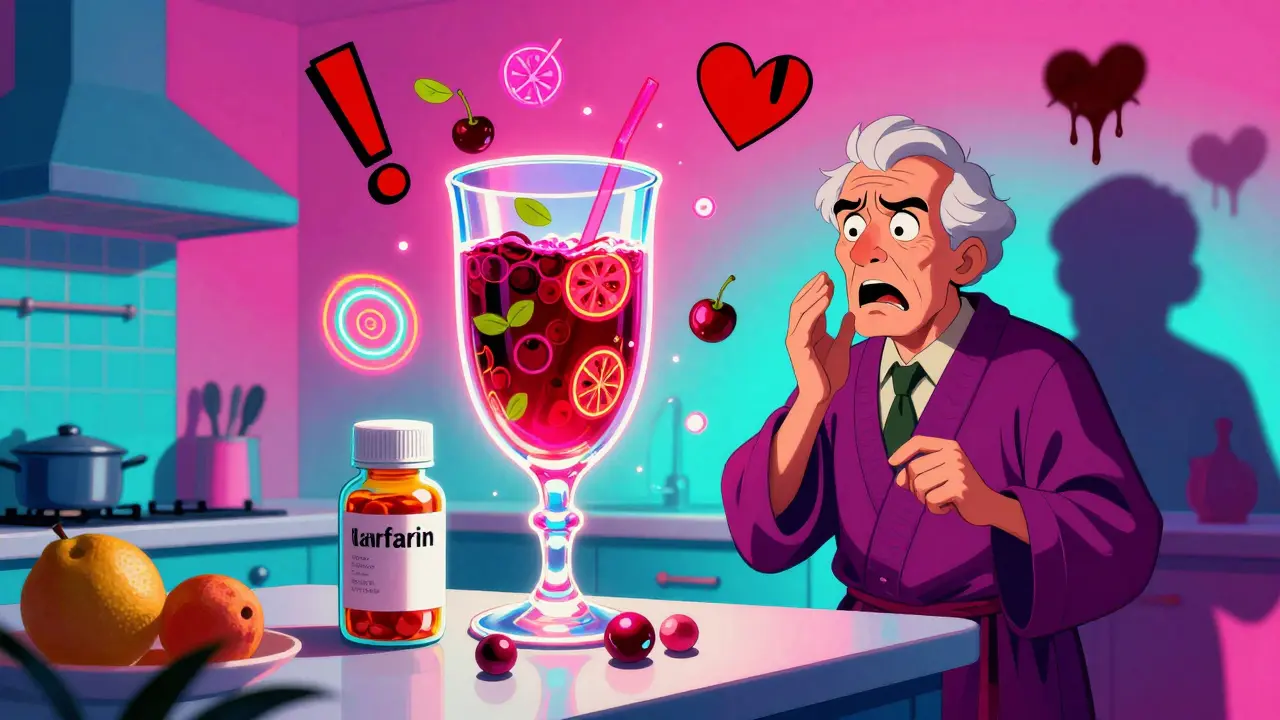
If you're taking warfarin, a simple glass of cranberry juice could be more dangerous than you think. It’s not just a healthy drink for your bladder-it’s a hidden trigger that can send your blood-thinning medication into overdrive, raising your risk of serious bleeding. This isn’t speculation. It’s been documented in hospitals, reported to health agencies, and confirmed by doctors who see patients in the ER after their INR spikes for no clear reason.
Why Cranberry Juice Can Be Risky with Warfarin
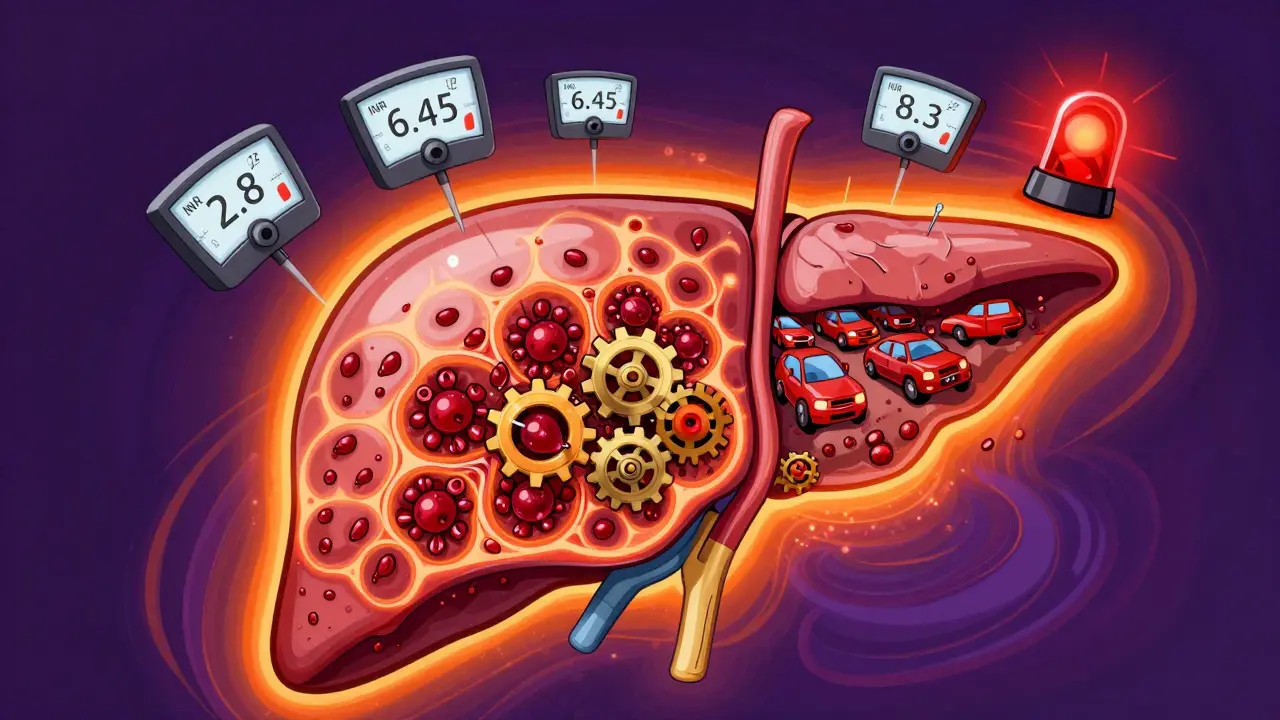
Warfarin is a powerful drug. It keeps your blood from clotting too much, which is vital if you have atrial fibrillation, a mechanical heart valve, or a history of blood clots. But it’s also tricky. The dose has to be just right. Too little, and you’re at risk of stroke or clotting. Too much, and you could bleed internally-inside your brain, gut, or joints. That’s why your doctor checks your INR regularly. A normal range is 2.0 to 3.0. Anything above 4.0 is dangerous. Above 6.0? That’s a medical emergency. Cranberry products-juice, capsules, extracts, even flavored sodas-have been linked to INR spikes in hundreds of cases since the early 2000s. One patient in a VA hospital drank half a gallon of cranberry-apple juice every week while on warfarin. His INR jumped from a stable 2.8 to 6.45. He nearly bled out. Another woman, taking cranberry juice daily for UTI prevention, saw her INR climb from 2.5 to 8.3 in just 10 days. She ended up in the hospital with gastrointestinal bleeding. The reason? Cranberries contain compounds like quercetin and other flavonoids that block an enzyme in your liver called CYP2C9. This enzyme breaks down the active part of warfarin (S-warfarin). When it’s blocked, warfarin builds up in your blood. You’re essentially taking a higher dose without realizing it. Studies show this can increase warfarin levels by 30% to 50%-enough to push someone into dangerous territory.What Counts as a Cranberry Product?
It’s not just the juice. Many people think they’re safe if they avoid the juice. But that’s a mistake.- Cranberry juice (even diluted or mixed with apple juice)
- Cranberry capsules or tablets (often sold as urinary tract supplements)
- Cranberry extract (concentrated, sometimes sold as “potent” or “standardized”)
- Cranberry sauce (especially store-bought, which can be loaded with added extracts)
- Cranberry-flavored drinks (sports drinks, sodas, teas-check the label for “cranberry extract” or “natural flavor”)
- Dried cranberries (some brands are coated in cranberry juice concentrate)
What the Science Says-And What It Doesn’t
You might hear conflicting things. Some studies say cranberry doesn’t affect warfarin. Others say it’s a major risk. Why the confusion? The truth is, it’s messy. Not every study finds a problem because:- Some cranberry products vary wildly in strength. A cheap juice might have almost no active compounds. A supplement labeled “500mg cranberry extract” could be packed with them.
- People’s genetics matter. If you have a variation in your CYP2C9 gene (called *CYP2C9*2 or *CYP2C9*3), you break down warfarin slower already. Cranberry hits you harder.
- Some studies used small doses or short time frames. Real patients often drink cranberry juice daily for months.
What Doctors Recommend
The American College of Chest Physicians, the American Heart Association, and the Merck Manual all say the same thing: avoid cranberry products entirely if you’re on warfarin. If you’ve been drinking cranberry juice to prevent urinary tract infections, talk to your doctor about alternatives. There are safer options:- Methenamine hippurate (a non-antibiotic that makes urine acidic)
- Low-dose antibiotics (taken daily, prescribed by your doctor)
- Drinking plenty of water
- Urinating after sex
Real Stories, Real Consequences
A 78-year-old man in Los Angeles was stable on warfarin for years. He drank cranberry juice every morning because he thought it helped his kidneys. One day, he felt dizzy. His wife called 911. He had a brain bleed. His INR was 12.0. He survived, but he lost his ability to walk independently. A 62-year-old woman in the UK started taking cranberry capsules after a UTI. She didn’t tell her anticoagulation clinic. Two weeks later, she passed blood in her stool. Her INR was 7.1. She needed a blood transfusion. These aren’t rare. The FDA’s adverse event database recorded 17 cranberry-warfarin interaction reports between 2020 and 2022. That’s just what got reported. Many more go unreported.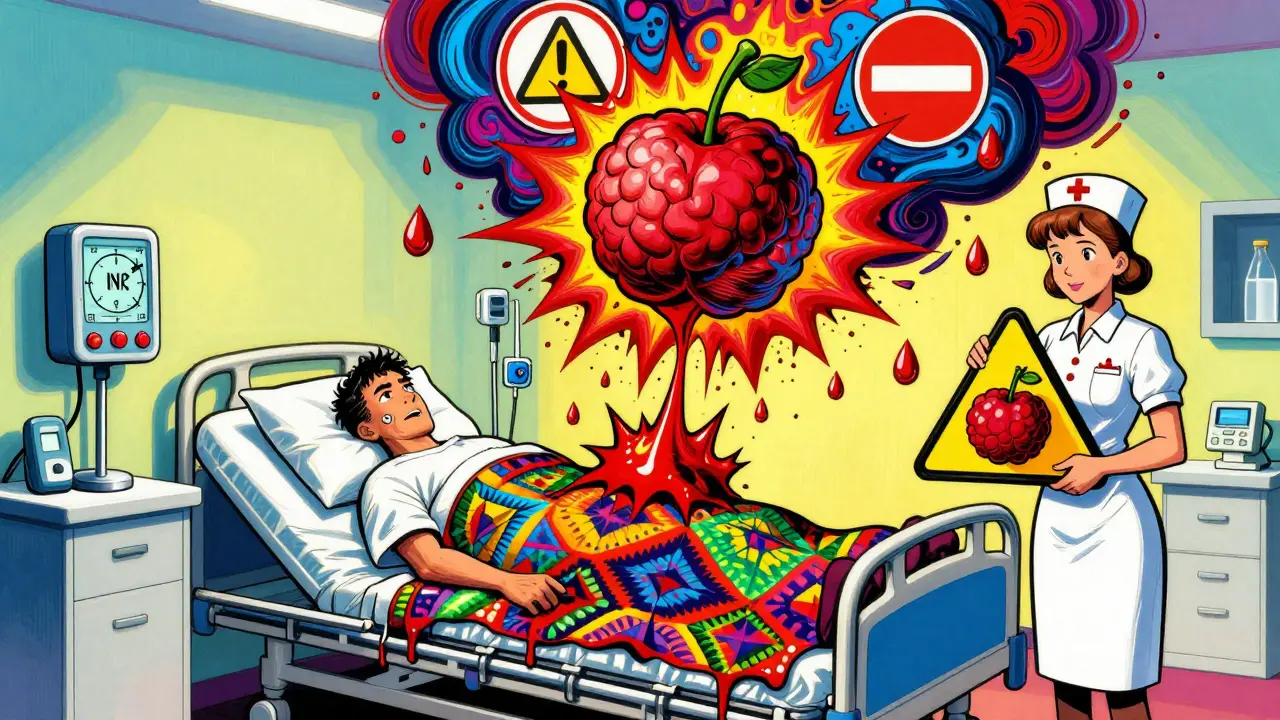
What You Should Do Today
If you take warfarin:- Stop all cranberry products. No exceptions. Not even “a little.”
- Check your pantry. Look at labels on juices, sauces, snacks, and supplements. If it says “cranberry,” avoid it.
- Tell your doctor. If you’ve been using cranberry products, let them know. They may need to check your INR sooner than scheduled.
- Ask for alternatives. Ask your doctor what’s safe for UTI prevention or general health.
- Don’t assume supplements are safe. Just because something is “natural” doesn’t mean it’s safe with warfarin.


Lauren Wall
January 21, 2026 AT 18:24Cranberry juice is not a health food-it’s a silent killer for people on warfarin. Stop pretending it’s harmless because you ‘like the taste.’ Your life isn’t a coffee shop experiment.
Lana Kabulova
January 22, 2026 AT 16:47Wait-so if I drink cranberry juice once a week, and my INR is stable, does that mean I’m genetically lucky?? Or is this just a myth that got exaggerated because some guy drank a gallon?? I need data, not fear-mongering!!
Rob Sims
January 23, 2026 AT 23:30Oh wow, another ‘natural=bad’ panic. Next they’ll ban sunlight because it ‘interacts with blood thinners.’
Let me guess-your doctor also told you to stop breathing oxygen? Because that one’s got a 100% mortality rate if you don’t control it properly. Funny how they don’t warn you about that, huh?
Meanwhile, real people are dying from blood clots because they got scared off cranberries and stopped taking their meds. Who’s the real villain here?
arun mehta
January 24, 2026 AT 14:40Dear friends, this is a matter of life and death. 🙏
Warfarin is a delicate dance with chemistry, and cranberry is a misstep that can end the song. 🌿💔
As a medical professional from India, I have seen too many patients suffer because they trusted ‘natural’ labels. Supplements are not regulated like pharmaceuticals. A ‘cranberry capsule’ could contain anything. Please, listen to your doctors. Your family needs you. 🌏❤️
Chiraghuddin Qureshi
January 24, 2026 AT 22:55My grandma in Delhi takes warfarin and drinks cranberry juice every morning with her chai. She’s 84, walks 5km daily, and her INR is always 2.6. 🌞
Maybe it’s not the juice-it’s the fear? In India, we don’t panic over every label. We listen to our bodies. Maybe science is still catching up?
Kenji Gaerlan
January 25, 2026 AT 01:14lol i’ve been drinkin cranberry juice for 10 yrs on warfarin and im still alive. probly just a scam to sell more blood tests. my doc never said nothin. guess i got lucky 😎
Oren Prettyman
January 26, 2026 AT 01:22It is imperative to address the methodological inconsistencies inherent in the literature regarding cranberry-warfarin interactions. The majority of case reports lack standardized dosing protocols, control for dietary confounders, and longitudinal INR tracking. Furthermore, the pharmacokinetic variability of CYP2C9 polymorphisms across ethnic populations is rarely accounted for. One cannot extrapolate from anecdotal evidence to a population-wide contraindication without a randomized controlled trial. Until such data is available, the blanket recommendation to avoid cranberry products is scientifically unsound and potentially harmful to patient autonomy.
Tatiana Bandurina
January 26, 2026 AT 17:09You know, it’s funny how everyone suddenly cares about ‘natural’ ingredients when it’s convenient. But you never hear about the 500 other supplements that interact with warfarin. Why pick on cranberry? Is it because it’s popular? Because it’s pink? Because it sounds cute?
Meanwhile, people are still taking St. John’s Wort, ginkgo, garlic pills, green tea extract-none of those get the same attention. Why? Because cranberry’s a marketing target. Not a medical one.
Philip House
January 28, 2026 AT 07:20Look, if you’re on warfarin, you’re already playing Russian roulette with your liver. Cranberry’s just the bullet. The real problem? You’re trusting a drug that’s been around since WWII to be precise. We’re talking about a chemical that requires weekly blood tests just to not kill you.
Meanwhile, the FDA lets Big Pharma sell warfarin like candy while banning herbal teas. That’s not medicine. That’s control. And cranberry? It’s the one thing you can still enjoy without asking permission.
Akriti Jain
January 28, 2026 AT 09:22They say cranberry causes bleeding… but who funds the studies? Big Pharma? The same companies that make warfarin? 🤔
They want you to stop the juice so you keep buying expensive blood tests and pills. And what about the ‘cranberry extract’ in their own drugs? Huh? Why is it safe in pills but not in juice? 😏
They’re scared you’ll figure out nature works better than their lab-made poison. 🍒💀
Mike P
January 30, 2026 AT 04:37My uncle’s on warfarin, drinks cranberry juice every day, and his INR’s been 2.1 for 8 years. He’s 89 and still fixes his own car. You wanna tell him he’s gonna bleed out? Nah, he’s got more sense than half the doctors in this thread.
Stop scaring people. If your INR’s stable, don’t panic. Talk to your doc, sure. But don’t throw out your whole life because some study says ‘maybe.’
Jasmine Bryant
January 31, 2026 AT 20:39Just wanted to add-dried cranberries are sneaky! I didn’t realize mine had juice concentrate until I checked the label. One bag = 3x the flavonoids of juice. If you’re eating them for snacks, you’re probably ingesting way more than you think. Also, cranberry tea (like Celestial Seasonings) often lists ‘cranberry extract’-check the ingredients, not just the name!
And yes, I’ve had my INR jump after a holiday cranberry sauce binge. Lesson learned. 😅
Liberty C
February 1, 2026 AT 00:47How utterly pedestrian. You’re all treating this like a dietary faux pas, when in reality, this is a grotesque demonstration of pharmaceutical hegemony wrapped in the velvet gloves of ‘medical advice.’
Cranberry, a fruit revered since Native American apothecaries, now vilified because it dares to interfere with a $2 billion-a-year anticoagulant? How quaint. How predictable. How depressingly corporate.
You don’t need to ‘avoid’ cranberry. You need to demand better medicine. Something that doesn’t require weekly needle pricks and dietary puritanism just to stay alive. But no-better to scapegoat a berry than fix the system.
And if you’re still taking warfarin in 2025? Honey, you’re not just on a drug-you’re on a relic.