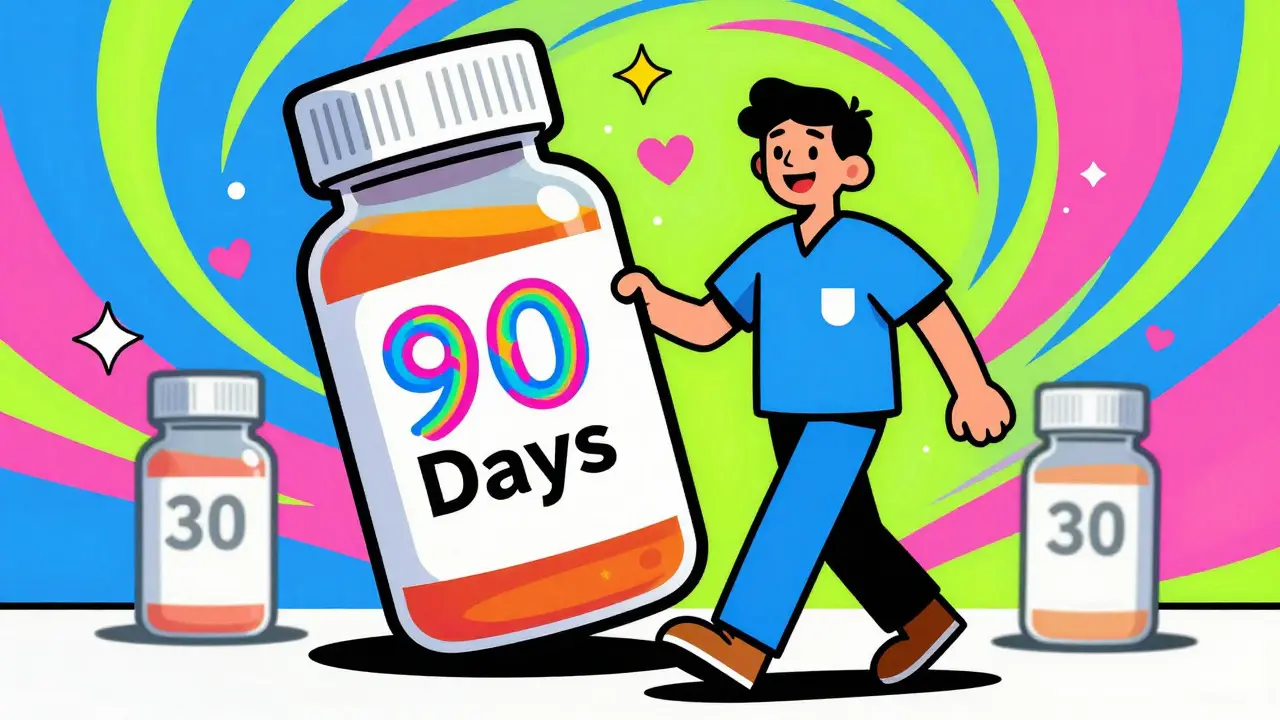
Picture this: you walk into your local pharmacy, pay your standard $4.90 copay, and walk out with a three-month supply of your blood pressure medication instead of just one month. That’s the power of 90-day prescription fills, which are a dispensing method where patients receive a three-month supply of maintenance medications for a single copay, significantly reducing annual out-of-pocket costs. It sounds too good to be true, but it is a standard benefit for millions of Americans managing chronic conditions. If you are taking daily medication for diabetes, high cholesterol, or hypertension, you might be leaving money on the table by sticking to traditional 30-day refills.
The core problem isn't just the price of the drug itself; it's the frequency of payment. Most insurance plans charge a flat fee per fill. When you get a 90-day supply, you pay that same fee once every quarter instead of three times a year. According to data from Health Plan of San Mateo (HPSM), a patient paying a $4.90 copay can save up to $39.20 annually per medication by switching to a 90-day fill. While that number might seem small for one pill, multiply it by five or six daily medications, and you are looking at hundreds of dollars in yearly savings without changing your doctor or your insurance plan.
Who Qualifies for 90-Day Prescriptions?
Not every bottle of pills qualifies for this discount structure. Insurance companies design these programs specifically for maintenance medications, which are drugs taken regularly over long periods to manage chronic health conditions rather than treat acute illnesses. Think about what you take every day versus what you take only when you have a sinus infection. Antibiotics, painkillers for injuries, and short-term treatments do not qualify. The list usually includes medications for:
- Hypertension (high blood pressure)
- Type 2 Diabetes
- Hyperlipidemia (high cholesterol)
- Asthma or COPD maintenance inhalers
- Depression or anxiety management
- Thyroid disorders
Beyond the type of medication, there is a stability requirement. Your insurer needs to know that you will actually take the drug as prescribed. This means you typically must have been on the medication for at least 90 days without skipping doses or needing dosage adjustments. If your doctor recently changed your dose from 10mg to 20mg, you likely need to wait another cycle before you are eligible for a bulk fill. This rule protects both you and the insurer from waste-if you stop taking the med after two weeks because of side effects, you don't want 70 days of unused pills sitting in your cabinet.
Mail-Order vs. Retail Pharmacy: Where Should You Fill?
You generally have two paths to get your 90-day supply: mail-order pharmacies, which are specialized services that deliver 90-day supplies directly to your home, often offered by Pharmacy Benefit Managers (PBMs) like CVS Caremark, or your local retail store. Each has distinct advantages depending on your lifestyle.
| Feature | Mail-Order Pharmacy | Retail Pharmacy (In-Store) |
|---|---|---|
| Cost Savings | Often highest; some plans offer lower copays exclusively for mail-order | Standard 90-day copay; matches 30-day cost in many plans |
| Convenience | Delivered to door; auto-refill reminders | Pick up immediately; no shipping wait time |
| Pharmacist Access | Phone/video consults; less personal interaction | Face-to-face advice; quick questions answered |
| Inventory | High availability of niche chronic meds | May require ordering if not in stock |
Mail-order services, such as those run by CVS Caremark, a major Pharmacy Benefit Manager (PBM) that administers prescription drug benefits for health insurers and employers, are designed exclusively for maintenance drugs. They ship blister packs or bottles directly to your house. For someone who hates running errands, this is a game-changer. However, if you live in an area with unreliable mail delivery or need immediate access to your meds, a local retail chain like Walgreens, a large American pharmacy chain that offers both retail and mail-order prescription services, or CVS Pharmacy, a retail pharmacy brand that provides in-store filling services alongside its mail-order options, might be better. Many retail stores now offer 90-day fills in-store to compete with mail-order, though you should check if your specific plan incentivizes one channel over the other.

Step-by-Step: How to Switch to 90-Day Fills
Making the switch is straightforward, but you cannot just ask for it at the counter without preparation. Follow these steps to ensure a smooth transition.
- Check Your Plan Documents: Look for sections labeled "Mail Order," "90-Day Supply," or "Chronic Medication Benefits." Confirm that your current medications are classified as maintenance drugs under your policy. Some Medicare Part D plans automatically enroll you in mail-order for eligible drugs, while others require manual opt-in.
- Talk to Your Doctor: You need a new prescription written specifically for a 90-day supply. Call your physician’s office and say, "I would like to switch my [Medication Name] to a 90-day refill schedule to lower my costs." Most doctors are happy to help because it improves adherence. Ensure they write "Dispense as Written" if you need a specific generic brand, or allow substitution if generics are preferred for cost.
- Contact Your Pharmacist: Before sending the prescription, call your chosen pharmacy (mail-order or retail). Ask them to verify eligibility with your insurance PBM. They can tell you instantly if the drug qualifies and what your exact copay will be.
- Transfer Your Records: If moving to mail-order, transfer your active maintenance prescriptions. Do not transfer acute medications (like antibiotics) unless instructed. Keep a 30-day supply of any non-qualifying meds at your local pharmacy for emergencies.
- Set Up Auto-Refills: Both mail-order and major retail chains offer automatic refills. Set this up so the next 90-day supply ships or is ready for pickup before you run out. This prevents gaps in coverage, which is critical for conditions like hypertension.

Hidden Costs and Pitfalls to Avoid
While the savings are real, there are nuances that can catch you off guard. One major issue is the "gap period." If you switch mid-cycle, you might end up with leftover pills from your 30-day supply. Do not throw them away. Take them until they run out, then start the 90-day pack. Wasting medication defeats the purpose of saving money.
Another pitfall involves travel. If you frequently go on vacation, a 90-day supply might be bulky. However, most mail-order services provide smaller, portable containers upon request. Just call ahead. Also, be aware that some insurance plans have a "donut hole" or coverage gap in Medicare Part D. In some cases, having a large supply on hand during the coverage gap months can protect you from higher out-of-pocket costs later in the year. Consult a pharmacist to strategize around your plan's specific tiers.
Finally, consider the impact on your local pharmacy. As noted in industry research, pharmacies filling 90-day prescriptions receive fewer dispensing fees and see reduced foot traffic. This economic pressure can sometimes lead to resistance from independent pharmacists. Supporting larger chains or utilizing mail-order ensures you get the benefit, but if you prefer your local independent shop, ask them if they can partner with a third-party mail service to offer you the same pricing.
Maximizing Savings Beyond the Fill Size
Getting a 90-day fill is a powerful tool, but it works best when combined with other cost-saving strategies. Always compare the cash price of generic medications using tools like GoodRx or SingleCare. Sometimes, the uninsured cash price for a 90-day generic supply is lower than your insurance copay, even with the bulk discount. For example, if your copay is $15 for a 90-day supply, but the cash price for the generic is $12, pay out of pocket.
Additionally, look into Patient Assistance Programs (PAPs) offered by pharmaceutical manufacturers. These programs can provide free or low-cost medications to qualifying individuals, regardless of your insurance status. Combining a PAP with a 90-day fill strategy can reduce your annual medication budget to near zero for many common chronic conditions.
The shift toward 90-day fills is accelerating. UnitedHealth Group reported in mid-2025 that home delivery of maintenance meds generates hundreds of millions in savings for consumers. By adopting this simple change, you align yourself with broader healthcare trends that prioritize efficiency and affordability. You spend less time in lines, less money at the register, and more time focusing on your health rather than managing your pharmacy visits.
Does my insurance cover 90-day fills for all medications?
No, 90-day fills are typically restricted to maintenance medications used for chronic conditions like diabetes, hypertension, and high cholesterol. Acute medications, such as antibiotics or pain relievers for short-term injuries, are rarely eligible because they are not taken continuously over long periods.
Is mail-order always cheaper than picking up at a retail pharmacy?
Not always, but often. Many insurance plans offer a lower copay specifically for mail-order 90-day fills to encourage their use. However, some plans equalize the cost between retail and mail-order. You should check your specific plan's formulary or call your pharmacy benefit manager to compare the exact copay amounts for both channels.
What happens if I move or change addresses while on mail-order?
You must update your address with your mail-order pharmacy immediately. Most services have online portals or phone lines dedicated to profile updates. Failure to update your address can result in lost medication packages, leading to gaps in treatment. It is also wise to keep a small emergency supply at your local pharmacy during transitions.
Can I switch back to 30-day fills after getting a 90-day prescription?
Yes, you can switch back at any time. However, you may lose the cost savings associated with the bulk fill. If you switch mid-supply, you will need to dispose of or return the remaining medication, which is wasteful. It is best to finish your current 90-day supply before requesting a change in refill frequency.
Do 90-day fills affect my Medicare Part D coverage gap?
They can help. Having a 90-day supply on hand allows you to stretch your spending during the initial coverage phase. Depending on how your plan calculates the "true out-of-pocket" costs, purchasing in bulk might delay your entry into the coverage gap or reduce the amount you pay during the catastrophic phase. Consult your plan administrator for personalized advice.