You walk out of the pharmacy with a small paper bag in hand. It feels routine. You’ve done it a thousand times. But what if that bag contains the wrong pill? Or the wrong strength? A moment’s hesitation could save you from a serious health crisis. Medication bag auditing is the final safety checkpoint where patients verify their prescriptions before leaving the pharmacy. This simple act prevents thousands of dangerous mistakes every year.
According to a 2023 report by the Institute for Safe Medication Practices (ISMP), approximately 1.5 million people in the United States suffer from medication errors annually. These mistakes cost the healthcare system $3.5 billion in additional expenses. The good news? Research published in JAMA Internal Medicine in October 2024 shows that when patients perform a structured verification, they catch 87% of these errors. That is your power. Here is how to use it.
The Seven-Point Verification Checklist
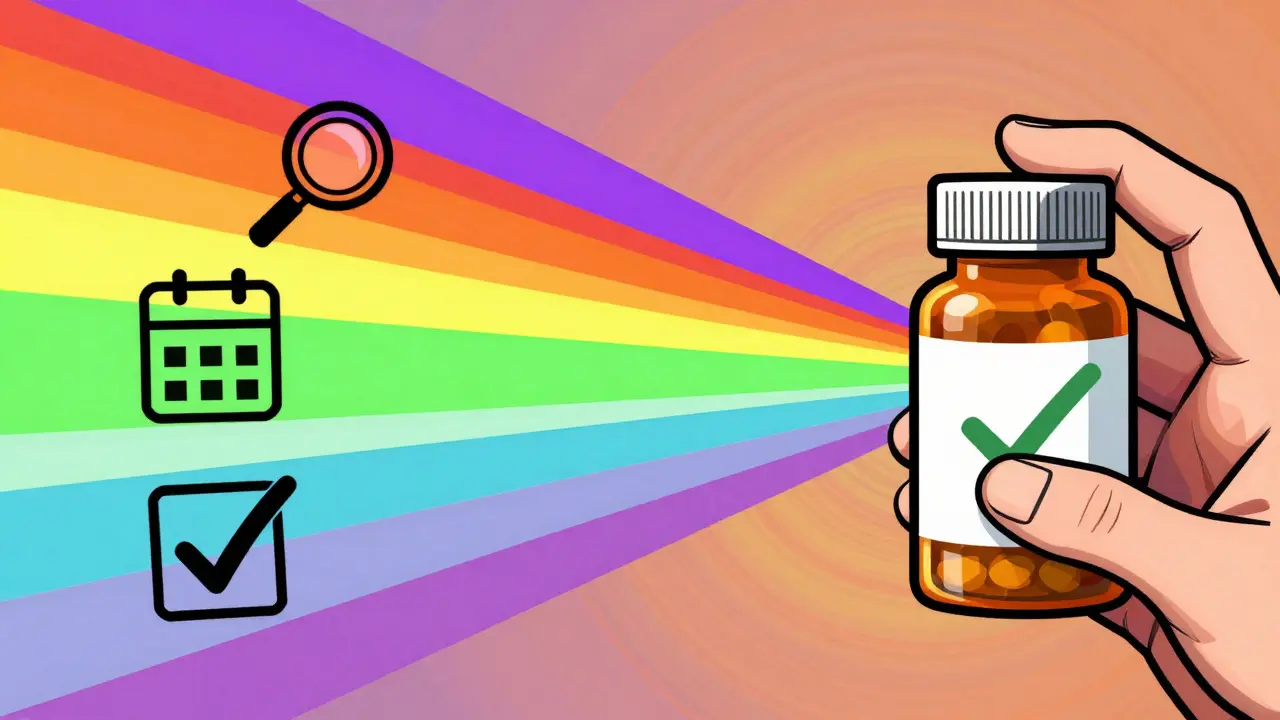
Do not just glance at the label and leave. Take thirty seconds. This brief pause is the difference between safety and risk. The American Pharmacists Association (APhA) updated its guidelines in 2022 to recommend a specific six-point check, but experts now agree on seven critical steps. Use this checklist every single time.
- Patient Name: Does the name on the bottle match your legal name exactly? In 2024, the National Community Pharmacists Association (NCPA) found that 12.7% of errors involved giving medicine to the wrong person because names sounded similar. If you are picking up for someone else, verify their full name against the prescription.
- Medication Name: Check both the brand and generic names. Look-alike and sound-alike drugs cause confusion. For example, Proventil and Proventil HFA are different. The FDA’s 2023 MedWatch report recorded 1,842 incidents of wrong-drug errors due to this exact issue. Compare the name on the bottle to the name on your prescription slip.
- Dosage Strength: Look at the numbers and the units. Is it 5 mg or 50 mg? ISMP data reveals that strength errors account for 32% of serious dispensing mistakes. A tenfold error can be fatal, especially with powerful drugs like warfarin or insulin. Never assume the number looks right; read it aloud.
- Quantity: Count the pills if possible, or at least check the total count on the label. Does it match what the doctor prescribed? CMS Pharmacy Audit data from 2024 showed that 8.3% of errors involve incorrect pill counts. If you expect 30 tablets and see only 15, ask immediately.
- Expiration Date: Check the date printed on the label. For chronic medications, the date should be at least six months in the future. According to USP General Chapter <795>, medications degrade over time. An expired drug might not work as intended. If the date is close, request a fresh batch.
- Appearance: Look at the pill itself. What color is it? What shape? Are there any markings? Compare it to images on the FDA’s Drugs@FDA database or a reference photo provided by the pharmacist. If the pill looks different from what you took last month, stop. Ask questions.
- Instructions: Read the directions for use. Do they match what the prescriber told you? Should you take it with food? Once daily or twice? The 2023 APhA Medication Safety Report documented that 14.2% of errors involve incorrect directions. If the label says "take one tablet" but your doctor said "take two," do not guess. Clarify.
Why This Matters More Than Ever
You might think, "The pharmacist checked it already." They did. But human error happens. Fatigue, distractions, and high-volume workflows create blind spots. Dr. Michael Cohen, President of ISMP, states clearly: "The 30 seconds a patient spends verifying their medication before leaving the pharmacy prevents 8 of 10 dispensing errors that reach the patient."
This practice is not about blaming pharmacists. It is about shared responsibility. Dr. Lucinda L. Maine, CEO of APhA, emphasized in her 2024 testimony before the House Committee on Energy and Commerce that "patient verification is the final, critical checkpoint in our multi-layered safety system." Pharmacies that implement structured patient verification protocols saw a 47% reduction in malpractice claims. When you check your bag, you protect yourself and help improve the entire system.
Tools and Technology to Help You
If reading small print is difficult, you are not alone. Many patients struggle with vision issues or complex terminology. Fortunately, technology offers support. Mobile apps like MedSafe (version 3.2, released January 2025) allow you to scan barcodes. This verifies 98.7% of National Drug Codes (NDCs) against your prescription records instantly. However, Pew Research Center data notes that 42% of seniors lack the technological literacy to use these apps effectively.
For those who prefer low-tech solutions, the CDC’s 2024 Medication Safety Kit provides laminated wallet cards with the seven-point checklist. These are available free at 92% of U.S. pharmacies. Additionally, many chains like Walgreens have implemented magnifying cards since March 2024 to help patients read labels clearly. If you need assistance, ask the staff. Under 2024 Pharmacy Technician Certification Board requirements, technicians are trained to assist with verification.
| Method | Error Detection Rate | Best For | Limitations |
|---|---|---|---|
| Seven-Point Patient Audit | 87% | All patients, immediate verification | Requires focus and time (30+ seconds) |
| Mobile App Scanning (e.g., MedSafe) | 98.7% | Tech-savvy users, quick checks | Excludes 42% of seniors; requires smartphone |
| Brown Bag Review | 76% | Comprehensive medication reviews | Impractical for immediate pharmacy exit; requires bringing all meds |
| MedsCheck Program | 92% | Complex polypharmacy (10+ meds) | Requires pharmacist-led session; not instant |
Real-Life Success Stories
Does this really make a difference? Yes. On Reddit’s r/pharmacy community in March 2025, user u/MedSafetyMom shared how she prevented a tenfold dosing error for her child’s antibiotic. The label said "give 5 mL" but the bottle was marked "50 mg/5mL." The pharmacist had written "give 5" without specifying units. Her quick audit caught the ambiguity before her child took the dose.
In January 2025, a Pennsylvania patient avoided a potentially fatal warfarin dosing error by noticing a strength discrepancy during verification. These stories highlight that vigilance saves lives. Conversely, failure cases often involve rushed verification. A 2024 study in Patient Education and Counseling found that checking in under 15 seconds detects only 22% of errors, compared to 87% when taking 30 or more seconds. Slow down. Breathe. Check.
Overcoming Common Challenges
Sometimes, the system works against you. Poor label printing affects 18% of CVS Pharmacy transactions, according to 2024 NCPA data. Small font sizes make verification impossible for those with macular degeneration. If you face these issues, speak up. Ask for a larger label or verbal confirmation. Some pharmacies offer voice-guided prompts, such as Amazon Pharmacy’s partnership with Alexa launching in Q2 2025.
Another challenge is understanding pharmaceutical terms. Knowing that "mg" means milligrams and recognizing common dosage forms is basic medication literacy. The FDA’s 2025 MedEd initiative addresses this through point-of-care educational materials. If you feel confused, do not leave until you understand. Your health depends on clarity.
Looking Ahead: A Safer Future
The landscape of medication safety is evolving. The FDA announced in December 2024 that standardized medication labels will include QR codes linking to verification instructions. This aims to reduce ambiguity and empower patients further. Regulatory bodies like CMS are also tying pharmacy reimbursement rates to verification compliance starting in 2026. This signals a major shift toward accountability.
However, challenges remain for vulnerable populations. The National Council on Aging reports that 63% of low-literacy patients require assistance with verification. To address this, pictogram-based verification systems are currently in beta testing at 12 community health centers nationwide. These visual aids could revolutionize how we check our meds, making safety accessible to everyone.
How long does it take to audit my medication bag?
It takes approximately 30 seconds. Studies show that verification performed in under 15 seconds detects only 22% of errors, while taking 30 or more seconds increases detection to 87%. Make it a habit to pause and check thoroughly.
What should I do if I find an error?
Stop immediately. Do not leave the pharmacy. Inform the pharmacist or technician politely but firmly. Show them the discrepancy. They will correct the mistake and ensure you receive the right medication. This protects your health and helps them improve their processes.
Is medication bag auditing necessary if I trust my pharmacist?
Yes. Even the most careful professionals make mistakes due to fatigue or distraction. Patient verification serves as a critical secondary safety layer. It reduces dispensing errors by up to 73% when combined with pharmacist prompts. Trust is important, but verification is essential.
Can I use my phone to verify my medications?
Absolutely. Apps like MedSafe allow barcode scanning to verify National Drug Codes. The FDA MedCheck app has been downloaded 1.2 million times since November 2024. However, if you are not comfortable with technology, ask for assistance or use printed wallet cards from the CDC.
What if I have trouble reading the label due to vision problems?
Ask the pharmacy for a magnifying card or request a larger font label. Many locations, including 67% of Walgreens stores, provide magnifiers. You can also ask the staff to verbally confirm each detail. Do not hesitate to seek help; your safety comes first.

Yuvraj Singh
May 19, 2026 AT 06:46I work in a pharmacy in Mumbai, and honestly, this checklist is gold. We see so many errors because patients are just too rushed or embarrassed to ask questions. The seven-point verification isn't just a suggestion; it's a lifeline. I always tell my customers that their health is a partnership between them and us. If you spot something off, speak up immediately. It saves lives.
Jeremiah Cassandra
May 20, 2026 AT 15:40Oh, look at that. Another article telling Americans they need to do the pharmacist's job for them 🙄. Because clearly, the reason for 1.5 million errors is that patients aren't checking their bags hard enough, not because we're understaffed and underpaid. But sure, blame the victim instead of fixing the broken system. #CapitalismWorks
Kris Wong
May 22, 2026 AT 09:51The FDA wants you to check your meds? LOL. They want you to be complicit in their own failures 😂. You think they don't know about these errors? Of course they do. They just don't care. That's why they push these apps like MedSafe. Data collection, people! They want to track what you take before you even swallow it. Wake up sheeple 🐑💊.
Danny S
May 22, 2026 AT 22:26(¬_¬) This is exactly what I've been saying. The government doesn't trust their own workers, so they shift the liability onto the public. It's a classic distraction tactic while they cut funding to proper oversight. Don't fall for it. The real solution is deregulation, not more 'checks' that create bureaucracy.
Mollie Louise
May 24, 2026 AT 05:56I absolutely love this initiative! It makes me feel so much safer knowing there are concrete steps we can take to protect ourselves and our families. I started doing this last month after reading a similar article, and it only takes thirty seconds, but it gives me such peace of mind. I also printed out those CDC wallet cards and keep one in every purse I own. Sharing this with my entire book club because everyone deserves to feel empowered about their healthcare journey! Let's normalize being proactive about our well-being together! 💖✨
Javier Arauz
May 26, 2026 AT 05:38This is pathetic. In America, we should have standards that don't require citizens to act as quality control inspectors for basic services. If the pharmacist messes up, fire them. Don't make the customer do the work. It's a sign of a failing system. We pay for this service. Get it right.
Sam Mackellar
May 26, 2026 AT 15:37While I appreciate the intent behind shared responsibility, it is important to note that pharmacists undergo rigorous training specifically to prevent these errors. Relying on patient verification may inadvertently erode professional accountability. However, if one chooses to verify, please do so respectfully and without causing undue delay to other patrons.
Warren Brewer
May 26, 2026 AT 16:21Good advice. Simple stuff. Just look at the name and the number. If it looks wrong, say something. Don't be shy. Your life is worth more than being polite for ten seconds.
Christina Moran
May 26, 2026 AT 22:21i tried using the app mentioned here but my phone kept crashing lol. maybe its just my old samsung tho. i still think checking the pills visually is good though. last time i got a pink pill when i usually get white ones and it turned out to be a different brand but same drug. still freaked me out!
Anthony Red
May 27, 2026 AT 11:55Hey guys, great discussion here. I think Yuvraj makes a solid point about the partnership aspect. I've been trying to implement this at my local CVS, and the staff actually appreciates it when I double-check calmly. It's not about distrust; it's about safety. Keep the vibes positive and stay safe out there!
charles robert
May 28, 2026 AT 16:39We are all just cogs in the machine, grinding away until the final error consumes us. The bag is a metaphor for our mortality. Do you really think checking the label will save you from the inevitable decay? Or are you just seeking false comfort in a chaotic universe? 🎭💀
Tanya KLIMCHUK Klimchuk
May 28, 2026 AT 21:43Stop making excuses! If you are going to pick up medication, you HAVE to check it. No ifs, ands, or buts. I caught a wrong dosage last week because I didn't trust the label blindly. Be aggressive with your own safety. Demand perfection. If they made a mistake, call it out loud so everyone hears. It keeps them honest.
Lori Wildrick
May 30, 2026 AT 09:14I quietly started doing this after my mother had a scare. It's not about being difficult; it's about being careful. I always thank the pharmacist after verifying, which seems to soften the interaction. We are all human, and mistakes happen. A gentle reminder helps everyone.