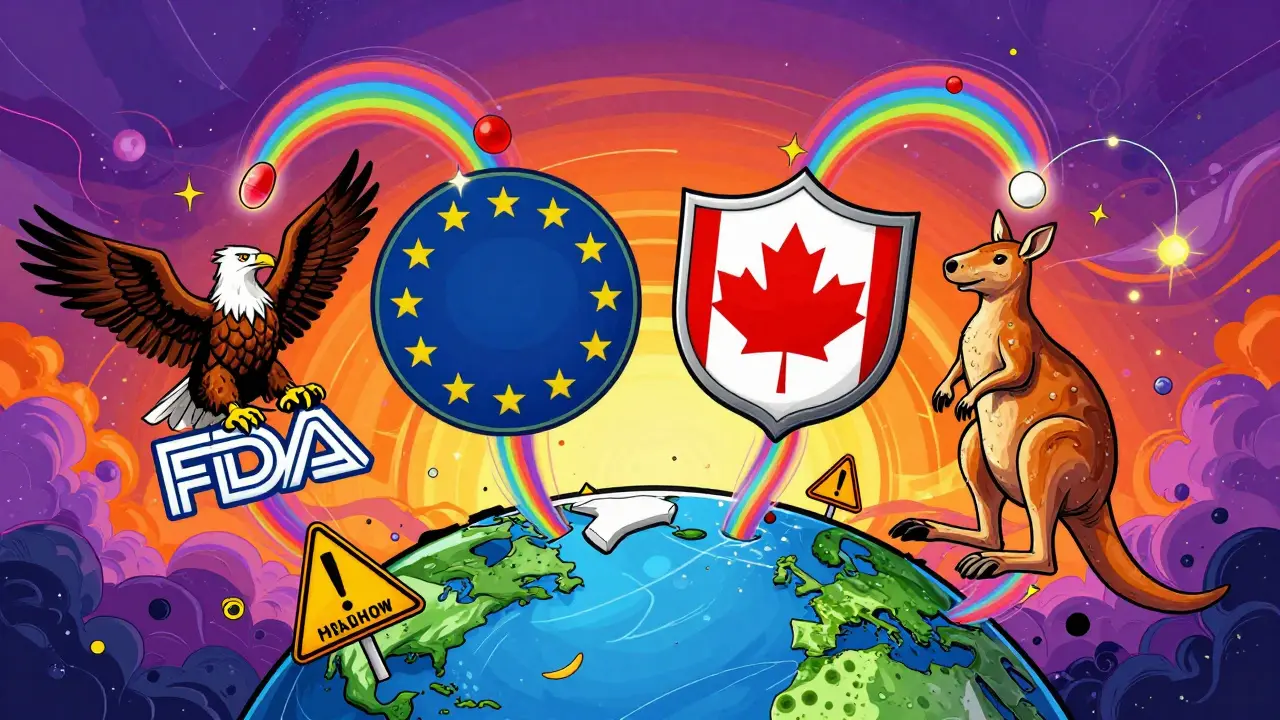
Global Drug Regulatory Comparison Tool
Compare Regulatory Systems
Select the regulatory agencies you'd like to compare. This tool shows key metrics including approval timelines, safety warning approaches, and transparency levels based on the latest available data.
Regulatory Comparison Results
| Comparison Metric | U.S. FDA | EU EMA | Canada Health Canada | Australia TGA |
|---|---|---|---|---|
| Approval Timeline (average months) | 10.2 | 12.7 | 11.0 | 11.5 |
| Safety Warning Approach | Wait for strong evidence | Act on early signals | Follows EU for major cases (87%) | Relies on FDA data (79% agreement) |
| Transparency Level | MedWatch alerts (83% satisfaction) | Full public assessments (71% satisfaction) | Improving transparency | AI-driven review, real-world data required |
| Key Differentiator | Centralized system | Decentralized network | EU-aligned with FDA | Risk-based approach |
| Major Challenge | Slow to react to subtle long-term effects | Complex for companies (68% report headaches) | Moderate speed | Small agency capacity |
Key Insight: Safety warnings from different regulators agree only 10.3% of the time due to different risk assessment approaches. This means a drug flagged as risky in one country might be deemed safe in another.
Every pill you take, every injection you receive, has passed through a complex web of rules before it reached your hands. But those rules aren’t the same everywhere. A drug approved in the United States might be banned in the EU. A safety warning issued in Australia might never make it to a pharmacy in Nigeria. This isn’t confusion-it’s the reality of global medication safety, where national systems operate with different rules, speeds, and priorities.
How the U.S. FDA Approves Drugs: Speed, Clarity, and Centralization
The U.S. Food and Drug Administration (FDA) runs a tightly controlled, single-agency system. If you’re a drug company, you submit everything to one place. No multiple applications. No jumping between regional offices. That’s the upside: predictability. In 2022, the FDA approved new drugs in an average of 10.2 months. That’s faster than most other major regulators.
But speed comes with trade-offs. The FDA’s process is rigid. Every document must follow exact formatting rules. Submissions for a single new drug can run 15,000 to 20,000 pages. Companies say it’s easier to plan for, but harder to adapt when something unexpected pops up. During the pandemic, review times jumped 37% because the system wasn’t built for sudden, massive surges.
Doctors in the U.S. report high satisfaction with FDA safety alerts. In a 2022 survey, 83% said the warnings were timely and clear. That’s because the FDA’s MedWatch system is direct and centralized. When a drug is pulled or labeled with a new risk, the message goes out fast. But critics say this system can be slow to react to subtle, long-term side effects. The FDA often waits for more data before acting, which can delay warnings.
The EU’s Hybrid System: Flexibility, Complexity, and Shared Risk
Europe doesn’t have one regulator. It has 27 national agencies working under the umbrella of the European Medicines Agency (EMA). For new, complex drugs-like cancer treatments or gene therapies-the EMA handles approval. For older, generic medicines, each country decides for itself. That means a drug can be approved in Germany but held up in Poland.
This system is messy. Sixty-eight percent of European drug companies say navigating multiple national rules is a major headache. But it also lets countries respond quickly to local concerns. When the Vioxx scandal broke in 2004, 22 EU countries acted together within 14 days. In the U.S., it took 28 days. The EU’s networked structure lets it move faster when threats are widespread.
Doctors in Europe rate EMA’s benefit-risk reports as more comprehensive than FDA’s. Seventy-one percent say they’re easy to understand. That’s because the EMA publishes detailed public assessments-every study, every concern, every debate. But that depth comes at a cost. Approval timelines average 12.7 months, longer than the FDA’s. And while the EU has Mutual Recognition Agreements with Canada and others, it still doesn’t have a formal agreement with the U.S. for drug inspections.
Canada’s Middle Ground: EU Alignment and Practical Efficiency
Canada sits between the U.S. and EU systems. Health Canada follows its own laws, but it’s heavily aligned with the EU. Since 2019, Canada and the EU have had a Mutual Recognition Agreement for Good Manufacturing Practices (GMP). That means if a factory passes inspection in Germany, it doesn’t need another in Canada.
The result? Canada’s safety decisions match the EU’s in 87% of major cases. That’s higher than its alignment with the FDA. Canada also moves faster than the EU on new drugs, approving them in about 11 months on average. It’s not as fast as the U.S., but it’s more predictable than the EU’s patchwork.
Health Canada doesn’t publish public assessment reports like the EMA, but it’s improving. The agency has been adopting more transparent communication since 2021. For patients, this means fewer surprises. For companies, it means less duplication. Canada’s system is small, but it’s efficient-designed to avoid the worst of both extremes.

Australia’s TGA: Precision, Caution, and Global Influence
Australia’s Therapeutic Goods Administration (TGA) is small but highly respected. It doesn’t approve as many drugs as the FDA or EMA, but its decisions carry weight. The TGA uses a risk-based approach: it doesn’t rush new drugs, but it doesn’t wait forever either. In 2022, it approved new medicines in about 11.5 months-slightly faster than the EU, slower than the U.S.
What makes the TGA stand out is its alignment with the FDA. It agrees with U.S. safety decisions 79% of the time. But it only matches the EMA 63% of the time. Why? Because Australia often looks to the FDA’s data and standards as a benchmark. It doesn’t blindly follow, but it trusts the U.S. system’s rigor.
The TGA also leads in digital innovation. It was one of the first regulators to accept electronic submissions in full format. It now uses AI to screen applications, cutting review times for routine cases by 20%. And unlike many countries, Australia requires drug companies to submit real-world safety data after approval-not just clinical trial results.
Why Safety Warnings Don’t Match Up
Here’s the startling truth: when the U.S., EU, Canada, and Australia issue safety warnings for the same drug, they agree only 10.3% of the time. That’s not a typo. That’s from a major 2019 study published in PMC.
Why such a low number? Because each system weighs risk differently. The FDA often waits for clear evidence of harm. The EMA acts faster on signals-even if they’re not yet proven. Australia leans on U.S. data. Canada follows the EU. So a drug flagged for liver damage in Europe might be deemed safe in the U.S. because the data didn’t meet their higher burden of proof.
This isn’t just bureaucratic noise. It puts patients at risk. Imagine someone traveling from Germany to the U.S. and continuing their medication. They get a warning in Germany that the drug causes heart rhythm problems. But their U.S. doctor sees no such alert. They keep taking it. That’s not hypothetical. It’s happened.

Who Pays the Price for This Fragmentation?
Drug companies pay the most. Setting up global compliance costs an average of $1.2 million per company. The paperwork alone-different formats, different requirements, different deadlines-adds months to development. A single drug can require 20 different sets of documents just to get approved in four major markets.
Patients in low-income countries pay too. In Nigeria and Bangladesh, safety alerts often never reach pharmacies. The International Alliance of Patients’ Organizations found only 42% of patients in these regions get timely warnings. That’s because many national regulators lack the infrastructure to relay information from the U.S. or EU.
Even in wealthy nations, the system is exhausting. A 2023 survey found that 61% of drug companies struggle with conflicting pediatric testing rules. The U.S. requires studies in children for most new drugs. The EU does too-but the timing, design, and reporting rules are different. Companies end up running two parallel trials.
Is Global Harmonization Possible?
The International Council for Harmonisation (ICH) has been trying to fix this for 30 years. It’s created 100+ guidelines on everything from clinical trials to manufacturing. By 2023, 89% of major regulators had adopted ICH E6(R3), which simplified clinical trial documentation by 22%.
But full harmony? Still far off. The FDA and EMA still don’t recognize each other’s inspections. Canada and the EU are aligned on manufacturing, but not on safety decision-making. Australia follows the FDA on warnings but uses EU-style benefit-risk frameworks for approval.
AI might change that. The FDA is already using AI to review 43% of manufacturing inspections. The EMA is doing the same with advanced therapy applications. By 2027, AI could cut approval times by 30-40%. If regulators start sharing AI tools and data standards, we might finally see real alignment.
What’s Next for Global Medication Safety?
The FDA’s 2022 Modernization Act 2.0 removed mandatory animal testing for some drugs. That could cut approval times by 18 to 24 weeks. The EU’s 2021 Pharmaceutical Strategy aims to cut approval times by 25% by 2025. Both are moving toward faster, smarter systems.
But the biggest shift might come from below. Countries like India and South Africa are building stronger regulators. India’s CDSCO increased inspections by 40% in 2022. Africa’s new African Medicines Agency has harmonized rules across 22 countries. These aren’t just local changes-they’re steps toward a more balanced global system.
The goal isn’t to make every country identical. It’s to make sure that when a drug is safe in one place, it’s not dangerous in another. That means sharing data. Aligning standards. And putting patients-not bureaucracy-at the center.
Why do drug safety warnings differ between countries?
Each country’s regulator uses different criteria to weigh risks. The U.S. FDA often waits for strong statistical proof before acting, while the EU’s EMA acts on early warning signals. Australia leans on U.S. data, and Canada follows the EU. This leads to different decisions on the same drug-even when the underlying science is identical.
Which country has the fastest drug approval process?
The U.S. FDA has the fastest average approval time at 10.2 months. Canada is close behind at 11 months. The EU’s centralized process takes 12.7 months, and Australia averages 11.5 months. Speed depends on the type of drug-new cancer therapies move faster in the EU, while rare disease drugs are approved quicker in the U.S.
Are drugs safer in the U.S. or the EU?
Neither system is inherently safer. The U.S. has fewer post-market withdrawals because it requires more upfront data. The EU approves more drugs earlier, but monitors them more closely after launch. Studies show both systems catch serious side effects-but they catch them at different points. The real risk is inconsistency: a drug deemed safe in one country may be restricted in another, confusing patients and doctors.
Why doesn’t the U.S. and EU recognize each other’s inspections?
Despite ongoing talks since 2017, the U.S. and EU have not signed a formal Mutual Recognition Agreement for pharmaceutical inspections. The FDA wants tighter control over foreign facilities, while the EU fears losing its ability to enforce its own standards. Until trust and data-sharing systems improve, inspections will remain separate, forcing companies to pay for duplicate audits.
How do developing countries handle drug safety?
Many developing countries rely on WHO guidelines, which are not legally binding. India and South Africa have strengthened their regulators in recent years, but only 37% of manufacturing facilities in Africa meet basic safety standards. Patients there often get medications approved elsewhere, but without timely safety updates. This creates a dangerous gap: drugs enter the market, but warnings don’t.
Will AI make global drug regulation more consistent?
Yes, potentially. The FDA and EMA are already using AI to analyze inspection data and clinical trial results. If regulators start sharing AI tools and training data, they could begin making similar decisions based on the same inputs. By 2027, AI could reduce approval times by 30-40% and increase alignment on safety signals. But only if countries agree to share data openly-and that’s still a political hurdle.



Sangeeta Isaac
January 21, 2026 AT 11:40so like... the FDA approves a drug in 10 months, but then someone gets a heart attack from it 2 years later and they’re like ‘oops, our bad’? 🤦♀️ Meanwhile the EU’s over there publishing 200-page PDFs with footnotes on every sneeze a mouse had during the trial. I get the caution, but also… can we just share data before someone dies? 😅
Alex Carletti Gouvea
January 22, 2026 AT 13:05Let’s be real - America leads the world in innovation. Why should we bend over backward for Europe’s bureaucracy? If a drug’s safe here, it’s safe. End of story. Stop trying to make the FDA look like the bad guy because other countries can’t get their act together.
Philip Williams
January 22, 2026 AT 19:03The fragmentation of global drug regulation is not merely inefficient - it is a systemic failure of public health governance. The lack of mutual recognition between the FDA and EMA represents a profound institutional inertia. Each duplicate inspection, each divergent safety alert, imposes quantifiable human cost: delayed treatment, avoidable adverse events, and eroded trust in medical institutions. Harmonization is not a luxury - it is an ethical imperative.
Ben McKibbin
January 23, 2026 AT 07:18Here’s the thing nobody wants to admit: we’re all playing musical chairs with patient safety. The FDA waits for ironclad proof, the EU pounces on whispers, Australia copies the U.S., Canada just copies the EU, and Nigeria? They get whatever lands on their dock. AI might fix this - but only if we stop treating drug regulation like a sovereignty contest and start treating it like a shared public good. Imagine if every regulator used the same AI model trained on the same global dataset. No more 10% agreement on warnings. We’d be at 90%. And that’s not sci-fi - it’s math.
Uju Megafu
January 24, 2026 AT 07:06OF COURSE the U.S. is dangerous! They approve drugs like they’re selling TikTok filters! 🤬 And now they want to skip animal testing?! Are you kidding me?! Meanwhile, Europe is actually trying to protect people, but NOOOO, the Americans think they’re smarter. My cousin in Lagos died because his blood pressure med wasn’t recalled here - but it was banned in the EU! This isn’t policy, this is genocide by paperwork!
Amber Lane
January 25, 2026 AT 10:06Canada’s doing it right - not too fast, not too slow, just listening.
Ashok Sakra
January 26, 2026 AT 21:04why u guys not fix this? in india we get drugs from usa and eu and no one tell us if its dangerous. my aunt took medicine and got sick. no warning. why? because you all care about money not people. fix it. now.
Andrew Rinaldi
January 27, 2026 AT 21:04It’s fascinating how each system reflects its cultural values - America’s individualism and speed, Europe’s precaution and consensus, Australia’s pragmatic pragmatism. But maybe the real question isn’t which system is better… but whether we’re willing to sacrifice some sovereignty for collective safety. The answer, so far, has been no. And that’s not a technical problem - it’s a human one.
Gerard Jordan
January 29, 2026 AT 16:38AI + shared data = game changer 🤖🌍
Imagine if every regulator could say: ‘Hey, this AI flagged the same signal in 4 countries - let’s act.’ No more 10% agreement. We could cut approval times, save lives, and stop drug companies from playing regulatory whack-a-mole. The tech is ready. The will? That’s the only thing left to invent. 💡💊 #GlobalHealthNow