Imagine paying $400 for a prescription that costs $15 to make. That is the reality for many patients stuck with brand-name drugs when cheaper alternatives exist. The U.S. Food and Drug Administration (FDA) is the federal agency responsible for protecting public health by ensuring the safety, efficacy, and security of human and veterinary drugs steps in to bridge this gap. Its regulatory authority over generic drugs isn't just about cutting costs; it is a rigorous scientific process designed to guarantee that a cheaper pill works exactly like the expensive one.
If you have ever picked up a generic version of a medication at the pharmacy, you relied on the FDA’s approval system. But how does an agency approve a drug without running massive clinical trials? The answer lies in a specific legal framework and a streamlined application process known as the Abbreviated New Drug Application (ANDA). Understanding this mechanism reveals why generics are safe, effective, and essential to the healthcare system.
The Legal Backbone: Hatch-Waxman and the ANDA Pathway
The foundation of generic drug approval rests on the Hatch-Waxman Act is a 1984 law that balanced incentives for innovation with competition in the pharmaceutical industry. Before this act, brand-name companies held patents so long that generics rarely entered the market. The Hatch-Waxman Act created Section 505(j) of the Federal Food, Drug, and Cosmetic Act, which established the Abbreviated New Drug Application (ANDA) is a submission pathway allowing generic manufacturers to prove their product is equivalent to an already approved brand-name drug.
This "abbreviated" label is key. Unlike a New Drug Application (NDA) is the comprehensive application required for new medicines, including full preclinical and clinical trial data, which requires billions of dollars and years of testing to prove safety and efficacy from scratch, an ANDA relies on existing data. The generic manufacturer must demonstrate that their drug is bioequivalent to the Reference Listed Drug (RLD) is the original brand-name drug approved by the FDA that serves as the standard for generic comparison. This means they don’t need to repeat the costly human trials that proved the original drug works. Instead, they prove their version delivers the same active ingredient into the patient’s body at the same rate and extent.
This legal framework is administered by the Office of Generic Drugs (OGD) is the FDA division within CDER dedicated to reviewing and approving generic drug applications, part of the Center for Drug Evaluation and Research (CDER). The OGD handles thousands of applications annually, ensuring that competition lowers prices without compromising quality.
Proving Equivalence: Bioequivalence and Manufacturing Standards
You might wonder, if the ingredients aren't identical down to the coloring agent, how can the drug be considered the same? The FDA requires strict proof of Bioequivalence is the absence of a significant difference in the rate and extent to which the active ingredient becomes available at the site of drug action. For most oral solid dosage forms, this involves pharmacokinetic studies in healthy volunteers. Researchers measure how much of the drug enters the bloodstream (AUC) and how fast it peaks (Cmax).
The math is precise. The 90% confidence interval for the ratio of geometric means between the generic and the brand-name drug must fall within 80.00% to 125.00%. If the generic absorbs too slowly or too quickly, it fails. This statistical range ensures that any minor differences do not impact therapeutic effect. While inactive ingredients like fillers or dyes may differ, the active pharmaceutical ingredient (API), strength, dosage form, and route of administration must be identical.
Manufacturing quality is equally critical. Facilities producing generics must comply with Current Good Manufacturing Practice (CGMP) is regulations requiring proper facilities, controls, and procedures to ensure drug identity, strength, quality, and purity regulations under 21 CFR parts 210 and 211. The FDA inspects these facilities rigorously. In recent years, inspection rates for generic drug facilities have averaged over 82%, ensuring that the pills produced meet consistent quality standards batch after batch.
| Feature | New Drug Application (NDA) | Abbreviated New Drug Application (ANDA) |
|---|---|---|
| Purpose | Approve new innovative drugs | Approve generic equivalents to existing drugs |
| Clinical Trials | Required (Phase I-III) | Not required (relies on RLD data) |
| Cost Estimate | ~$2.6 billion | $2.4-$6.3 million |
| Time to Market | 10-15 years | 3-4 years |
| Primary Requirement | Safety and Efficacy | Bioequivalence and Pharmaceutical Equivalence |

The Review Process: From Submission to Approval
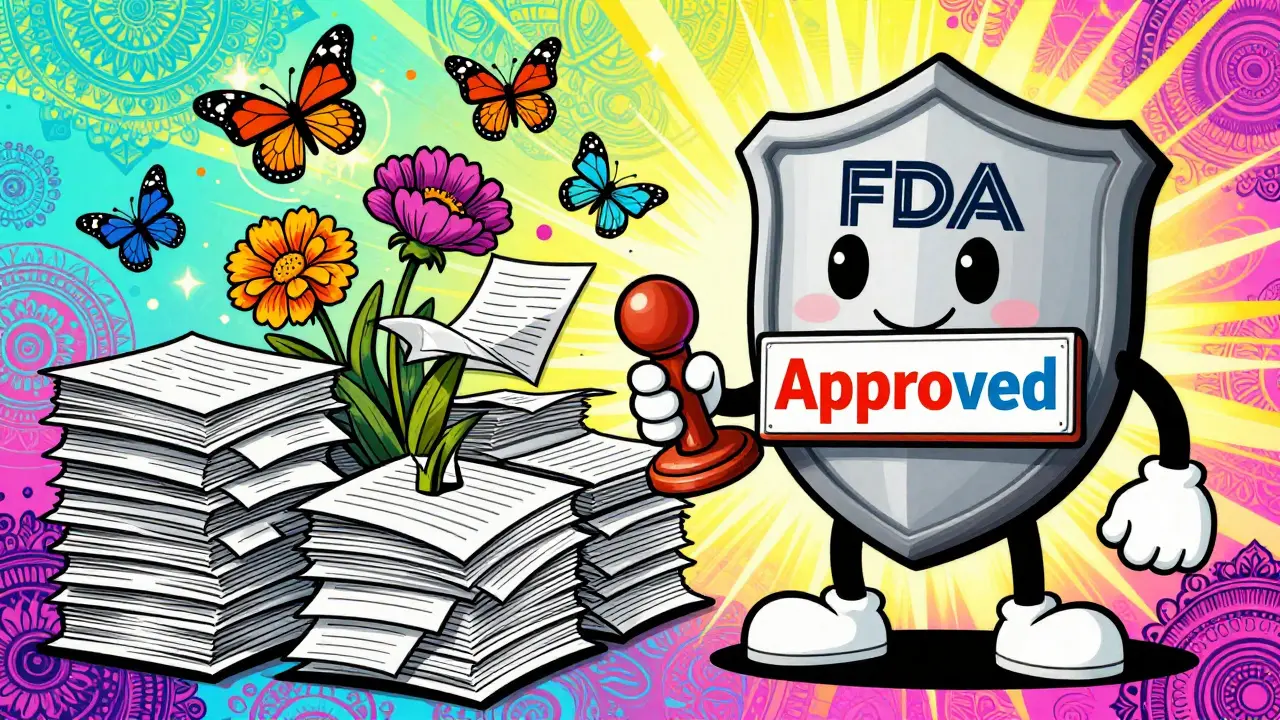
Submitting an ANDA is not a simple form-filling exercise. It is a complex regulatory undertaking. Manufacturers submit approximately 15,000 to 20,000 pages of documentation. The review process begins with a Filing Review by the FDA’s Division of Filing Review. If the submission is incomplete-often due to missing chemistry, manufacturing, and controls (CMC) data-it receives a Refuse-to-Receive (RTR) letter. In 2022, about 15.3% of submissions faced this hurdle.
Once filed, the application moves to Substantive Review. Under the GDUFA III is Generic Drug User Fee Amendments III, a program setting performance goals and funding for FDA's generic drug review commitment letter, the FDA aims for Target Action Dates (TADs) of 10 months for standard applications and 8 months for priority reviews. Priority status applies to drugs in shortage or first-time generics that break a patent monopoly.
In fiscal year 2023, the FDA approved 1,256 ANDAs, a significant increase from previous years. However, challenges remain. Backlogs occur, and resource constraints can delay reviews. Senator Bernie Sanders’ 2022 report highlighted that hundreds of applications waited over three years for review. To combat this, the FDA has implemented strategies like the Drug Competition Action Plan, which reduced approval times for first generics by 37% between 2017 and 2023.
Complex Generics and Future Developments
Not all generics are simple tablets. Complex generics include inhalers, topical creams, extended-release formulations, and injectables. These products require specialized bioequivalence methodologies because they cannot always be compared using standard blood tests. The FDA’s Complex Generic Drugs Initiative has prioritized these areas. In 2023, nearly 38% of approvals involved complex products, up from 22% in 2018.
Looking ahead, the FDA is modernizing its approach. GDUFA IV negotiations concluded in late 2024 with a $2.1 billion funding commitment through 2027, including significant resources for complex generics. The agency is also exploring artificial intelligence-assisted review and real-world evidence integration. A pilot program announced in October 2025 offers faster reviews for companies manufacturing generics domestically, aiming to strengthen supply chain resilience.
Despite occasional criticisms regarding delays, the system remains robust. Consumer satisfaction surveys show that nearly 80% of patients express confidence in FDA-approved generics. Pharmacists report that these drugs reduce out-of-pocket costs by 80-85%. With generics comprising 9 out of 10 prescriptions filled in the U.S., the FDA’s role in maintaining this balance between affordability and safety is indispensable.
How does the FDA ensure generic drugs are as effective as brand-name drugs?
The FDA requires generic manufacturers to prove bioequivalence, meaning the drug delivers the same active ingredient into the bloodstream at the same rate and extent as the brand-name reference listed drug. This is verified through rigorous pharmacokinetic studies where the 90% confidence interval for absorption metrics must fall within 80-125% of the brand-name drug. Additionally, manufacturing facilities undergo strict CGMP inspections to ensure consistent quality.
What is the difference between an NDA and an ANDA?
An NDA (New Drug Application) is used for new innovative drugs and requires extensive preclinical and clinical trial data to prove safety and efficacy, costing billions and taking over a decade. An ANDA (Abbreviated New Drug Application) is used for generics and relies on existing safety data from the brand-name drug, focusing instead on proving bioequivalence and pharmaceutical equivalence. This makes ANDAs significantly cheaper ($2.4-$6.3 million) and faster (3-4 years) to develop.
Why do some generic drugs look different from brand-name versions?
While the active pharmaceutical ingredient must be identical, generic drugs may contain different inactive ingredients such as fillers, binders, or dyes. These differences can affect the pill’s color, shape, or size but do not impact its therapeutic effectiveness. The FDA strictly regulates these variations to ensure they do not alter the drug’s performance or cause allergic reactions.
How long does it take for the FDA to approve a generic drug?
Under GDUFA III guidelines, the FDA targets a 10-month review period for standard ANDA applications and 8 months for priority reviews. However, actual timelines can vary depending on the complexity of the drug, the completeness of the submission, and current backlog levels. First-time generics often receive priority status to accelerate market entry and reduce drug shortages.
Are complex generics like inhalers approved differently?
Yes, complex generics such as inhalers, topical creams, and extended-release formulations require specialized bioequivalence methodologies because standard blood tests may not adequately compare them. The FDA’s Complex Generic Drugs Initiative focuses on developing specific guidance and tools for these products. As of 2023, over 37% of generic approvals involved complex products, reflecting the growing importance of this segment.