
Imagine your child is struggling to breathe, wheezing and coughing. You reach for their asthma inhaler, press the button, and hope for the best. But here is the hard truth: if you are using a standard metered-dose inhaler (MDI) without a spacer, or if the technique is off, your child might be getting less than 20% of the medicine they need. The rest? It hits the back of their throat or floats away into the air. This isn't just about convenience; it’s about survival and quality of life. Getting the technique right can mean the difference between a good night's sleep and an emergency room visit.
We often think that once we have the prescription, the job is done. But in pediatric asthma care, the device is only half the equation. The other half is how you use it. For young children who cannot coordinate a quick breath with a spray, the spacer with mask is not just an accessory-it is essential. Research from the National Heart, Lung, and Blood Institute (NHLBI) shows that proper technique with these tools can boost medication delivery to over 80%. Let’s break down exactly how to do this, step by step, so you can trust that every puff counts.
Why Spacers Are Non-Negotiable for Kids
You might wonder why you can’t just use the inhaler directly on your child’s mouth. The answer lies in physics and development. An MDI releases a high-speed cloud of medication. To catch it, you need to inhale quickly and deeply at the exact same moment the button is pressed. Most adults struggle with this timing, but for a toddler or preschooler, it is physically impossible. Their lungs are smaller, and their coordination skills are still developing.
This is where the valved holding chamber, commonly known as a spacer, comes in. Think of it as a reservoir. When you press the inhaler, the medicine goes into the spacer tube instead of shooting out at high speed. This allows the particles to slow down and become lighter, making them easier for small lungs to pull in. According to guidelines from the Global Initiative for Asthma (GINA), using a spacer increases drug delivery from roughly 10-20% to 60-80%. That is a massive improvement in efficacy.
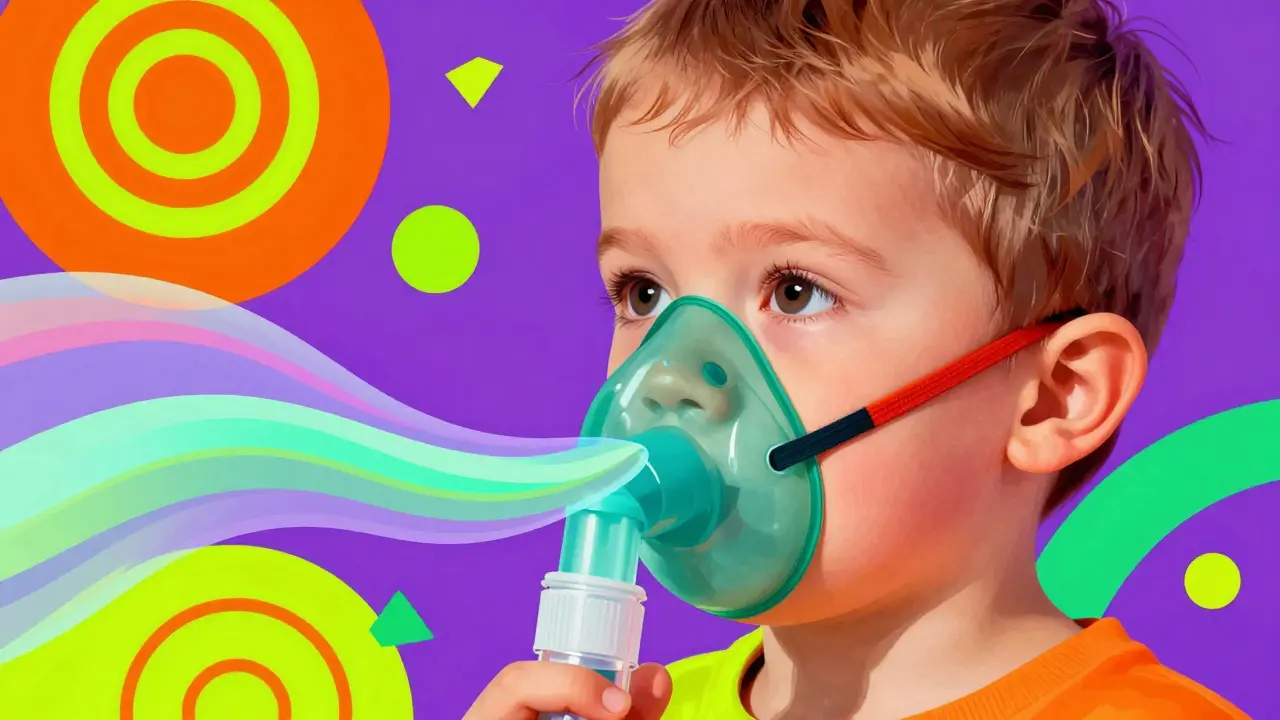
For children under five, a face mask attached to the spacer is usually required because they cannot form a tight seal around a mouthpiece. Even for older children, many experts recommend continuing with a spacer until they can consistently demonstrate perfect coordination. Dr. Robert Strunk, a leading pediatric pulmonologist, has noted that proper technique matters far more than the brand of device you choose. A simple plastic bottle cut open can work in a pinch, but a designed spacer ensures consistent flow and reduces static charge issues.
Gathering Your Equipment: What You Need
Before you start, make sure you have the right gear. Not all spacers are created equal, and using the wrong size can lead to poor results. Here is what you should check:
- The Inhaler: Ensure it is a Metered-Dose Inhaler (MDI). Dry powder inhalers (DPIs) require strong breathing effort and generally do not work with spacers for young children.
- The Spacer: Choose one appropriate for your child’s age. Infants (under 12 months) typically need a spacer with a volume of 150-350 mL. Toddlers (1-3 years) benefit from 350-500 mL chambers, while preschoolers (3-8 years) often use 500-750 mL models.
- The Mask: This must fit snugly over the nose and mouth. If it is too big, air will leak out. If it is too small, it won’t cover enough area. Look for masks with soft edges to prevent skin irritation.
- A Clean Environment: Have a towel ready. Static electricity can build up inside plastic spacers, causing medication particles to stick to the walls rather than going into your child’s lungs. We will cover cleaning later.
Market data shows that devices like the AeroChamber and Vortex are widely used because they meet ISO standards for aerosol delivery. However, availability varies by region. In the UK and US, most pharmacies carry several brands. Check with your pharmacist if you are unsure which size fits your child best.
Step-by-Step: Administering the Medication
Consistency is key. Follow these steps every time to ensure your child gets the full dose. This protocol aligns with recommendations from major institutions like Johns Hopkins Medicine and the American Lung Association.
- Shake the Inhaler: Remove the cap and shake the MDI vigorously for 10 seconds. This mixes the medication with the propellant. If it hasn’t been used in a while, prime it by spraying into the air twice first.
- Connect the Devices: Insert the bottom of the inhaler into the top of the spacer. Make sure it is secure. Do not insert it too deep, as this can block the valve.
- Position the Mask: Hold the spacer upright. Place the mask gently but firmly over your child’s nose and mouth. Create a tight seal. If you see light around the edges, adjust your grip. Leakage here means lost medicine.
- Start Breathing: Ask your child to breathe normally. For infants and toddlers, let them take 5 to 10 normal tidal breaths. For older children who can cooperate, you might switch to a single deep breath followed by a 10-second hold, but tidal breathing is safer for younger kids.
- Press the Inhaler: As your child begins to inhale, press the inhaler down once to release one puff into the spacer. If they are taking multiple breaths, press once at the start. Some protocols suggest pressing once per breath for very young children, but standard guidance is one puff per administration cycle unless prescribed otherwise.
- Continue Breathing: Keep the mask sealed. Let your child continue breathing through the spacer for another 5-10 breaths after the puff is released. This ensures the remaining mist is inhaled.
- Wait Between Puffs: If your child needs two puffs, wait 1 to 3 minutes before repeating the process. This allows the lungs to absorb the first dose and prevents overwhelming the airways.
- Clean Up: Once done, remove the mask. Wipe your child’s face if there is any residue. Store the inhaler and spacer separately to avoid accidental activation.
Notice that step 4 and 5 are critical. Many parents press the button too early or too late. The goal is to synchronize the release with the child’s natural breathing rhythm. For infants, since they cannot follow instructions, rely on their natural tidal breathing pattern. Press the button as they begin to inhale.
Common Mistakes That Waste Medicine
Even experienced parents make errors. A 2022 multicenter audit found that over 60% of observed attempts had at least one significant flaw. Here are the biggest pitfalls to avoid:
| Mistake | Consequence | Fix |
|---|---|---|
| Poor Mask Seal | Medication leaks out around the nose/mouth | Use both hands to hold the mask firmly against the skin |
| Insufficient Shaking | Inconsistent dose delivery | Shake for a full 10 seconds before each use |
| Too Few Breaths | Child misses the majority of the mist | Allow 5-10 breaths for toddlers; don't rush |
| Static Charge Buildup | Particles stick to spacer walls | Wash spacer weekly with mild detergent and air dry |
| Wrong Spacer Size | Inefficient airflow dynamics | Check GINA guidelines for age-appropriate volumes |
One surprising issue is static electricity. Plastic spacers naturally develop a positive charge that attracts the negatively charged medication particles. This can reduce delivery by nearly 30%. Washing the spacer with mild soap and water once a week helps neutralize this charge. However, be careful not to wash it daily, as some newer materials retain anti-static properties that wear off with frequent washing. Air drying is crucial-never use a towel, as friction creates more static.
Handling Resistance and Distraction
Let’s be honest: putting a mask on a frightened or resistant child is challenging. You are not alone. Surveys show that nearly 80% of children initially resist mask placement. Fighting them rarely works. Instead, try distraction techniques.
Parents report success with methods like asking the child to "blow out birthday candles" to encourage exhalation before the puff, or watching a favorite cartoon during administration. For toddlers, having a stuffed animal "wear" the mask first can demystify the process. If your child has autism spectrum disorder, sensory sensitivities might make the mask uncomfortable. In such cases, consult your pediatrician about desensitization strategies or alternative delivery methods.
Never force the mask onto a crying child if possible. Crying involves irregular breathing patterns that can interfere with medication uptake. Try to administer the dose when your child is calm, perhaps after a nap or during quiet playtime. If an attack is happening and they are distressed, stay calm yourself. Your anxiety can transfer to them. Speak softly, maintain eye contact, and proceed slowly.

Maintenance and Cleaning Protocols
Your spacer is a medical device, and it needs upkeep. Dust, saliva, and medication residue can build up, potentially triggering allergies or infections. Here is a simple maintenance schedule:
- Weekly Wash: Disassemble the spacer. Wash all parts in warm water with mild dish soap. Use a brush to clean the valves carefully-do not scrub aggressively.
- Rinse Thoroughly: Remove all soap residue. Soap films can interfere with valve movement.
- Air Dry: Place the parts on a clean towel and let them air dry completely. This usually takes 24 hours. Do not use heat or towels to dry.
- Monthly Inspection: Check for cracks, discoloration, or stuck valves. If the valve doesn’t move freely, replace the spacer. Valves are delicate and can fail silently.
Some manufacturers claim their spacers are "anti-static" and don’t need washing. While true for reducing particle loss, hygiene remains important. The American Academy of Pediatrics recommends regular cleaning regardless of material. Also, remember that inhalers have expiration dates and actuation counts. Most MDIs deliver 200 puffs. Keep a count so you don’t run out unexpectedly.
When to Seek Help
If your child’s asthma remains uncontrolled despite regular use, it might not be the medication-it could be the technique. Studies show that 68% of children labeled as "steroid-resistant" actually had poor inhaler technique. Before switching medications, ask your doctor or nurse to watch you administer the dose. Many clinics offer "Teach-to-Goal" sessions where you practice until you get it right.
New technology is also emerging. Smart spacers with audio feedback are becoming available, helping parents know if the breathing rate is correct. Telehealth appointments now often include video reviews of technique. Don’t hesitate to record yourself and send it to your provider for feedback. It’s a quick way to catch subtle errors.
Remember, consistency beats perfection. Even if you miss a beat occasionally, sticking to the routine ensures your child gets the vast majority of their medication. With practice, this becomes second nature, giving your child-and you-peace of mind.
Can I use a dry powder inhaler with a spacer for my child?
Generally, no. Dry powder inhalers (DPIs) require a strong, fast inspiratory flow to disperse the medication. Young children lack the lung capacity to generate this flow. DPIs are typically recommended for older children (usually over 5-6 years) who can demonstrate proper technique without a spacer. For younger children, Metered-Dose Inhalers (MDIs) with spacers are the standard of care.
How often should I wash my child's spacer?
Wash the spacer once a week with mild dish soap and warm water. Rinse thoroughly and allow it to air dry completely. Avoid washing it daily, as this can wear down anti-static coatings on some models. Never use a towel to dry the spacer, as friction creates static electricity that causes medication to stick to the walls instead of being inhaled.
What if my child resists wearing the mask?
Resistance is common. Try distraction techniques like watching a favorite show or playing with a toy. For toddlers, letting a stuffed animal "try" the mask first can help. Avoid forcing the mask if the child is crying excessively, as irregular breathing reduces effectiveness. Stay calm and try again when they are settled. If resistance persists, consult your pediatrician for behavioral strategies.