TCAs Side Effect Comparison Tool
Compare TCA Side Effect Profiles
Select a TCA and age group to see how side effects compare for different patients
Dry Mouth
Affects up to 30% of users. Can lead to cavities, gum disease, and infections. Especially concerning for seniors.
Sedation
Affects 35-40% of amitriptyline users. Can cause daytime drowsiness. Nortriptyline is milder (20-25%).
Orthostatic Hypotension
Causes dizziness or lightheadedness when standing up. Increases fall risk, especially for seniors.
Cardiac Risk
Increases QT interval by 20-40 milliseconds. Higher risk of heart events, especially in seniors.
Overdose Risk
Narrow safety margin. Just 2-3 times the daily dose can cause seizures, low blood pressure, and respiratory failure.
Cognitive Effects
25% of people over 65 report confusion or memory problems. 15% experience disorientation. Increases dementia and fall risk by 70% in seniors.
Tricyclic antidepressants (TCAs) like amitriptyline and nortriptyline aren’t the first choice for depression anymore-but they still help millions of people when other drugs fail. If you’ve been prescribed one, you’re not alone. But you also need to know what you’re signing up for. These medications work, yes-but they come with a long list of side effects that can seriously affect your daily life.
How TCAs Work (And Why They Have So Many Side Effects)
TCAs were developed in the 1950s, before SSRIs even existed. They work by blocking the reabsorption of serotonin and norepinephrine in the brain, which boosts mood. But unlike newer antidepressants, they don’t stop there. They also interfere with other receptors in your body-cholinergic, histamine, and alpha-adrenergic receptors. That’s why they cause side effects far beyond mood changes.
For example, blocking cholinergic receptors leads to dry mouth, blurry vision, and constipation. Blocking histamine receptors makes you sleepy. Interfering with alpha receptors drops your blood pressure when you stand up. Amitriptyline is especially strong at hitting all these targets, which is why it’s effective for nerve pain and migraines-but also why it’s harder to tolerate.
Common Side Effects: What You’ll Likely Experience
Most people on TCAs deal with at least one or two of these everyday issues:
- Dry mouth-affects up to 30% of amitriptyline users. It’s not just annoying; it can lead to cavities, gum disease, and infections. People report going through multiple bottles of saliva substitutes daily.
- Blurred vision-happens in 15-20% of users. It usually improves after a few weeks, but some never fully adjust. Driving at night becomes risky.
- Constipation-20-25% of users struggle with this. It’s not just discomfort; severe cases can lead to bowel obstruction. Staying hydrated and eating fiber helps, but often not enough.
- Urinary retention-especially dangerous for men with enlarged prostates. Around 10-15% report trouble starting or maintaining urine flow. Some end up needing catheters.
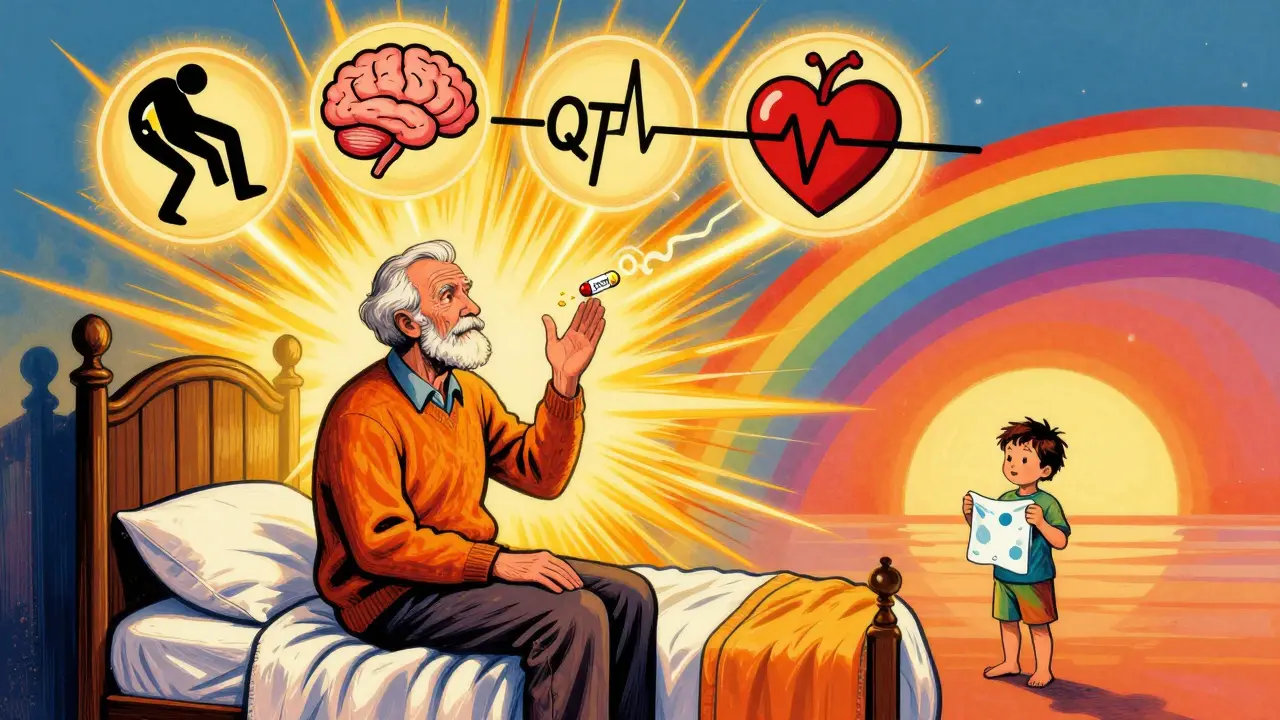
- Dizziness or lightheadedness-caused by orthostatic hypotension. Standing up too fast can make you feel like you’re going to pass out. Many patients learn to rise slowly, but it’s still a fall risk.
- Sedation-amitriptyline knocks out nearly 40% of users. Nortriptyline is milder, around 25%. That’s why doctors prescribe them at bedtime. But daytime drowsiness still creeps in.
Serious Risks: When TCAs Can Be Dangerous
These aren’t just inconveniences. Some side effects can be life-threatening.
Heart problems are the biggest concern. TCAs can lengthen the QT interval on an ECG-a sign of abnormal heart rhythm. Amitriptyline can stretch it by 20-40 milliseconds. That increases the risk of sudden cardiac arrest, especially at higher doses or in people with existing heart disease. The Lancet found TCAs carry a 35% higher risk of heart events than SSRIs.
Overdose is deadly. Unlike SSRIs, TCAs have a very narrow safety margin. Taking just 2-3 times your daily dose can cause seizures, dangerously low blood pressure, wide QRS complexes on ECG, and respiratory failure. Overdose deaths are mostly due to heart rhythm collapse. That’s why doctors monitor heart function before and during treatment.
Cognitive issues are common in older adults. About 25% of people over 65 report confusion or memory problems. Disorientation happens in 15%. The Beers Criteria explicitly says to avoid amitriptyline in seniors because it raises the risk of dementia and falls by 70%.
Amitriptyline vs. Nortriptyline: Which Has Fewer Side Effects?
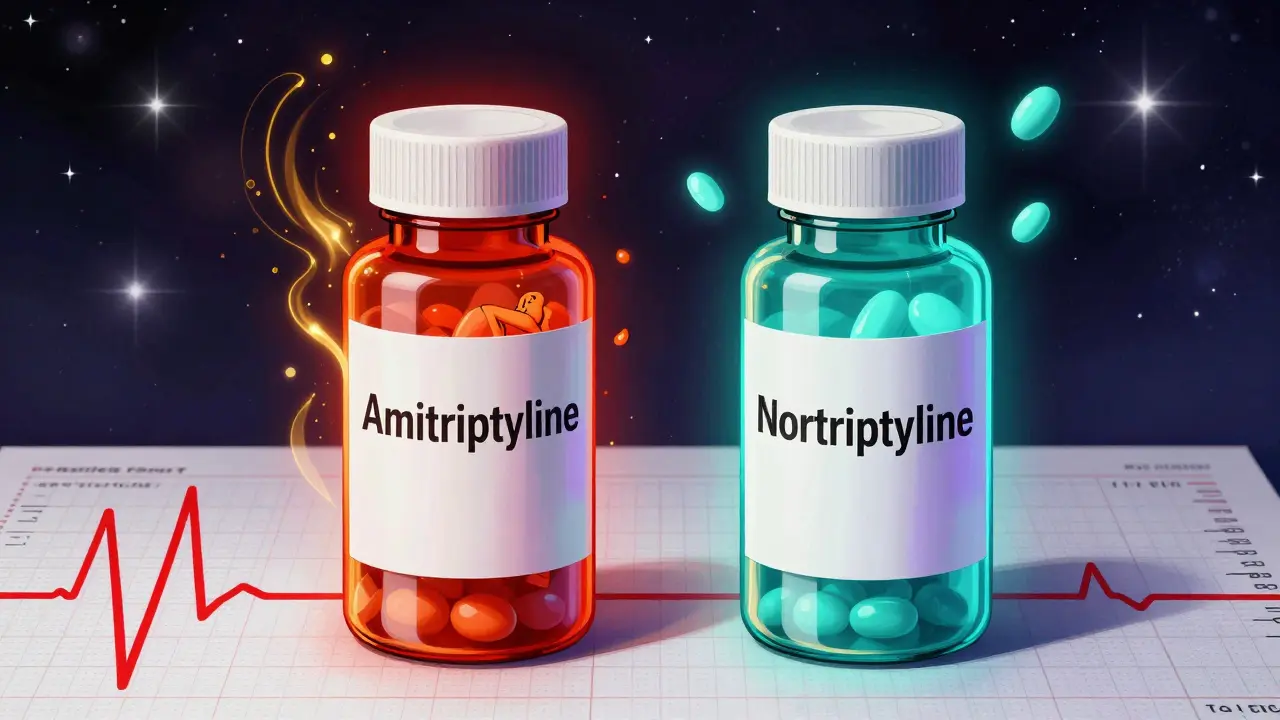
Not all TCAs are the same. Amitriptyline is a tertiary amine-stronger on all receptors. Nortriptyline is its secondary amine metabolite, which means it’s less aggressive on the body.
| Side Effect | Amitriptyline | Nortriptyline |
|---|---|---|
| Dry mouth | Up to 30% | 15-20% |
| Sedation | Up to 40% | 20-25% |
| Orthostatic hypotension | 15-20% | 10-15% |
| Cardiac risk (QT prolongation) | High | Moderate |
| Weight gain | Common (10-15 lbs in 6 months) | Milder |
| Typical starting dose | 25 mg | 25 mg |
| Max daily dose | 150-200 mg | 100-150 mg |
Nortriptyline is often preferred for older patients or those with heart issues. It’s less sedating and has a lower risk of severe side effects. But it’s not side-effect-free. Many users still report fatigue, dry mouth, and occasional dizziness.
Why Doctors Still Prescribe Them
If TCAs are so risky, why do they still exist? Because they work where others don’t.
For treatment-resistant depression, TCAs have a 65-70% response rate-higher than SSRIs’ 50-55%. That’s why they’re often tried after two or more other antidepressants fail.
For nerve pain, amitriptyline is a gold standard. A 2020 Cochrane Review found it reduced diabetic neuropathy pain by at least 50% in 35-40% of patients. That’s better than most newer pain drugs. It’s also used for chronic migraines, irritable bowel syndrome, and even bedwetting in children.
And cost matters. Generic amitriptyline costs $4-$40 a month in the U.S. Most newer antidepressants cost 5-10 times more. For people without good insurance, that’s a big factor.
Real People, Real Experiences
Online forums are full of stories that reflect the reality of taking TCAs.
One Reddit user, ChronicPainWarrior, wrote: “Amitriptyline finally helped my nerve pain after five other meds failed. But the dry mouth was so bad I went through three bottles of Biotene a day-and still got two cavities. I switched to nortriptyline. Better, but still tired all the time.”
On Drugs.com, amitriptyline has a 6.2/10 rating. Negative reviews mention: “Blurred vision made driving impossible,” “I couldn’t pee without a catheter,” and “I gained 18 pounds in four months.” Positive reviews say: “Migraines dropped from 15 a month to 3,” and “After 10 years of depression, this was the first thing that worked.”
Sexual side effects are common too-35-40% of men report reduced libido or erectile dysfunction. Weight gain is reported by nearly half of long-term users.
How to Use TCAs Safely
If you’re on a TCA, here’s what you need to do:
- Start low, go slow. Doctors usually begin with 10-25 mg at night. Don’t rush to increase the dose-it takes 2-4 weeks to work.
- Stand up slowly. Sit on the edge of the bed for 30 seconds before standing. This prevents dizziness and falls.
- Brush and floss daily. Dry mouth increases cavity risk. Use sugar-free gum or saliva substitutes. See your dentist every 6 months.
- Get an ECG before starting. Especially if you have heart disease, high blood pressure, or a family history of arrhythmias.
- Never stop cold turkey. Withdrawal can cause electric shock sensations, nausea, and anxiety. Taper over 4-6 weeks under medical supervision.
- Watch for confusion or memory lapses. If you’re over 65, tell your doctor immediately. These drugs are not safe for seniors without close monitoring.
The Future of TCAs
TCAs are fading from first-line use. In 2022, they made up only 5-7% of antidepressant prescriptions in the U.S.-down from 30% in the 90s.
But they’re not disappearing. New research is finding smarter ways to use them. One 2023 study showed that combining low-dose amitriptyline (10-25 mg) with an SSRI can boost effectiveness while cutting side effects. Another found that genetic testing for CYP2D6 metabolism can predict who’s likely to have bad reactions-poor metabolizers get 30-40% higher drug levels.
Still, the warnings are clear. The FDA says TCAs raise hip fracture risk 2.3 times in older adults. Experts agree: use them only when necessary, with full monitoring, and never as a first try.
As one psychiatrist put it: “When used carefully, TCAs can change lives. But they’re not a casual choice. They demand respect.”
Are tricyclic antidepressants still used today?
Yes, but rarely as a first option. TCAs like amitriptyline and nortriptyline are mostly prescribed today for treatment-resistant depression, nerve pain (like diabetic neuropathy), chronic migraines, or bedwetting in children. They’re used when SSRIs and SNRIs haven’t worked, or when their unique pain-relieving effects are needed.
Which TCA has the fewest side effects?
Nortriptyline and desipramine (both secondary amines) tend to have fewer side effects than amitriptyline or imipramine (tertiary amines). They’re less sedating, cause less dry mouth, and have a lower risk of heart rhythm problems. For older adults or those sensitive to side effects, nortriptyline is often the preferred choice.
Can tricyclic antidepressants cause heart problems?
Yes. TCAs can prolong the QT interval on an ECG, increasing the risk of dangerous heart rhythms like torsades de pointes. They can also cause low blood pressure, fast heart rate, and worsen existing heart disease. People with heart conditions should get an ECG before starting and be monitored regularly, especially if doses exceed 100 mg daily.
Why is amitriptyline used for pain if it’s an antidepressant?
Amitriptyline works on nerve pain by blocking the reuptake of norepinephrine and serotonin in the spinal cord, which reduces pain signals before they reach the brain. It also has direct effects on sodium channels in nerves. These actions help calm overactive pain nerves-especially in conditions like diabetic neuropathy, fibromyalgia, and post-shingles pain-even when depression isn’t present.
Is it safe to take TCAs if I’m over 65?
Generally, no. The Beers Criteria explicitly recommends avoiding amitriptyline and other high-anticholinergic TCAs in older adults. They increase the risk of confusion, memory loss, falls, and dementia. If absolutely necessary, nortriptyline at the lowest possible dose may be considered-but only with close monitoring and after all safer options have failed.
How long does it take for TCAs to work?
It usually takes 2 to 4 weeks before you notice any improvement in mood or pain. Some people feel a little better after 10-14 days, but full effects take time. Don’t stop the medication just because you don’t feel better right away-talk to your doctor first.
Can I drink alcohol while taking TCAs?
Absolutely not. Alcohol increases sedation and dizziness, raises the risk of falls, and can worsen heart rhythm problems. It also increases the chance of overdose. Even one drink can be dangerous when combined with a TCA.
What happens if I miss a dose?
If you miss a dose, take it as soon as you remember-unless it’s close to your next scheduled dose. Don’t double up. Missing doses can cause withdrawal symptoms like nausea, headaches, or electric shock feelings. Consistency matters more with TCAs than with many other antidepressants.

kabir das
January 28, 2026 AT 17:02Kacey Yates
January 30, 2026 AT 09:59ryan Sifontes
January 30, 2026 AT 15:59Laura Arnal
February 1, 2026 AT 06:35Jasneet Minhas
February 1, 2026 AT 20:48Eli In
February 2, 2026 AT 13:55Megan Brooks
February 3, 2026 AT 00:12Pawan Kumar
February 3, 2026 AT 17:16Paul Adler
February 4, 2026 AT 18:54Robin Keith
February 5, 2026 AT 01:27Sheryl Dhlamini
February 6, 2026 AT 00:49Keith Oliver
February 6, 2026 AT 13:25