Think a drug becomes cheap the moment its patent expires? Think again. While the 20-year patent clock is the most famous timeline in medicine, it's rarely the actual end of the line. In the pharmaceutical world, the "patent cliff" is often more of a gentle slope, carefully managed by companies to keep generic competitors at bay for years. By using market exclusivity extensions, manufacturers can build a protective wall around their products that lasts long after the original patent has vanished.
| Mechanism | Primary Purpose | Typical Duration | Region |
|---|---|---|---|
| PTE/SPC | Compensate for regulatory delays | Up to 5-15 years | US & EU |
| NCE Exclusivity | Protect new chemical entities | 5 Years | US |
| Orphan Drug | Incentivize rare disease research | 7-12 Years | US & EU |
| Pediatric Extension | Encourage child-specific studies | 6 Months | US |
The Difference Between Patents and Regulatory Exclusivity
First, we need to clear up a common mistake: patents and regulatory exclusivities are not the same thing. A patent is a legal right granted by a government office (like the USPTO) for an invention. On the other hand, Regulatory Exclusivity is a period of time during which the FDA or EMA refuses to approve a generic version of a drug, regardless of whether a patent exists . This means a company could have no patent at all but still hold a monopoly because the regulator won't let anyone else on the market.
The Hatch-Waxman Act is the 1984 US law that balanced the need for innovation with the need for affordable generics . It set the stage for how companies can recover their R&D costs. In a perfect world, a drug might have nine years of protection after approval, with extensions adding a few more. But in reality, the "stacking" of these protections has turned a simple timeline into a complex web.
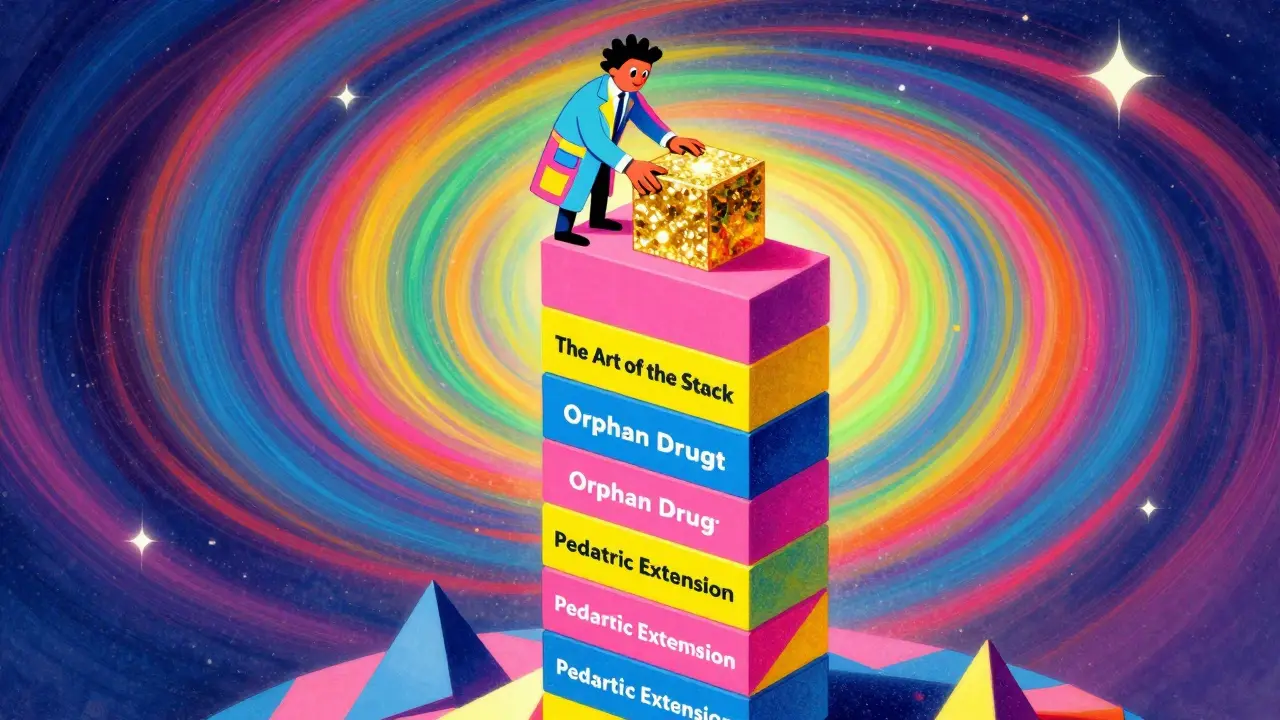
US Mechanisms: The Art of the Stack
In the US, companies don't just rely on one tool. They use a combination of Patent Term Adjustments (PTA) and Patent Term Extensions (PTE). While PTA covers delays at the patent office, PTE covers the long wait for FDA approval. There's a strict cap here: a PTE can't push the total post-approval monopoly beyond 14 years. However, that's just the starting point.
The real magic happens with regulatory exclusivities. For example, if a company develops a New Chemical Entity (NCE), they get 5 years of protection. If that drug is for a rare disease, they might snag Orphan Drug Exclusivity, which grants 7 years of market protection. The most strategic move, however, is the pediatric extension. By completing studies on how a drug affects children, a company can add another 6 months to their existing exclusivity. In a multi-billion dollar market, six months of extra monopoly can be worth an incredible amount of money.
Then there is the "new indication" strategy. If a company finds that a drug approved for blood pressure also helps with hair loss, they can seek a 3-year exclusivity for that new use. The catch? They usually have to change the dose or the formulation to make it commercially viable, otherwise, doctors would just prescribe the old version "off-label."
EU Strategies: SPCs and Data Protection
Across the pond, the European Union handles things differently. Instead of the US-style PTE, they use Supplemental Protection Certificates (SPCs), which can extend protection up to 15 years beyond the standard 20-year patent term. This gives EU companies a potentially longer runway than their US counterparts.
The EU also heavily emphasizes data protection. They use a "8+2+1" year structure for data and market exclusivity. If you're dealing with orphan medicines, the EU is even more generous than the US, offering 10 years of protection, which can stretch to 12 years if you meet all the pediatric data requirements. For drugs that specifically target children and lack a patent, the Pediatric-Use Marketing Authorization (PUMA) provides a vital safety net of 8 to 10 years of protection.
The 'Patent Thicket' and Evergreening
If you're wondering how some drugs stay monopolies for 20+ years, the answer is the "patent thicket." This is where a company files dozens, or even hundreds, of secondary patents. They don't patent the core molecule again; instead, they patent the way the drug is delivered (like a slow-release pill), a specific salt form, or a new way to manufacture it.
Take the drug tazarotene as an example: it had 48 additional patents beyond the core compound. This is what critics call "evergreening." By slightly modifying the product-a tactic known as "product hopping"-companies can move patients to a new version of the drug just as the old patent expires, effectively resetting the clock on competition.
This strategy is highly effective. In 2022, 47 of the top 50 selling drugs used some form of extension. On average, these extensions pushed back generic entry by over 8 years. For the healthcare system, the cost is steep. A study in the JAMA Health Forum showed that extending exclusivity for just four top-selling drugs cost the system $3.5 billion over two years.
The Economic Impact and Ethical Tension
Why is this allowed? The industry argument is simple: developing a new drug costs an average of $2.3 billion. Without these extensions, venture capital would dry up, and high-risk research into rare diseases would stop. Many biotech startups actually rely on these exclusivity windows to secure the funding they need to even start a trial.
But there is a dark side. When companies "game" the system, it delays the arrival of affordable generics. We've seen a shift where the end of a monopoly rarely happens when the core patent expires. Instead, it happens only after every single secondary patent and regulatory exclusivity has been exhausted. This tension is why the Federal Trade Commission (FTC) has started fighting "product hopping" as an antitrust violation.
How Companies Navigate the Complexity
Managing this isn't as simple as filing a form. Big pharma companies employ teams of 15 to 25 specialists just to handle exclusivity for a single blockbuster drug. The strategy starts during Phase II clinical trials. Companies decide whether to push for a new indication or invest in pediatric studies to grab those extra months of protection.
The learning curve is brutal. It usually takes a professional 3 to 5 years of experience in both regulatory affairs and patent law to master the art of "stacking." One common trick is delayed filing-waiting until after early clinical success to file a patent, ensuring the 20-year window covers as much of the actual sales life as possible.
What is the main difference between a patent and market exclusivity?
A patent is a legal right granted for an invention (the molecule or process), while market exclusivity is a regulatory period where the FDA or EMA prevents other companies from getting approval for a generic version, even if no patent is in place.
How long can a drug actually be protected in the US?
While the core patent is 20 years, combined extensions (PTE, NCE, and Orphan exclusivity) can often push total post-approval monopoly time toward 14 years, and strategic secondary patents (evergreening) can extend this even further into the 20+ year range.
What is 'product hopping'?
Product hopping occurs when a company releases a slightly modified version of a drug (like a different dosage or delivery method) just before the original patent expires, then switches patients to the new version to maintain their monopoly.
Do Orphan Drugs have different rules?
Yes. Orphan Drug exclusivity is designed for diseases affecting small populations. In the US, it grants 7 years of protection, and in the EU, it provides 10 years (extendable to 12 with pediatric data), regardless of the patent status.
Can a company get multiple extensions at once?
Yes, this is called "stacking." A company can combine NCE exclusivity, orphan drug protection, and a pediatric extension to prolong the period before generics can enter the market.
Next Steps for Stakeholders
If you're a generics manufacturer, the key is early litigation. Challenging "weak" secondary patents in court is the only way to break through a patent thicket before the official expiry date. For policy makers, the focus is shifting toward revising the SPC system in Europe and tightening FDA requirements for new indication exclusivity to ensure that only real innovation is rewarded, not minor tweaks.
For biotech startups, the priority should be mapping out the exclusivity landscape during the pre-clinical phase. Understanding which regulatory pathways (like PUMA or Orphan designations) offer the best protection can be the difference between getting venture capital funding and failing to launch.


Ethan Davis
April 5, 2026 AT 15:09This is just a cover for the real game. Big Pharma isn't just "managing a slope" they're basically owning the government to make sure we never get cheap meds. Follow the money and you'll see the FDA is just a puppet for these corporations.
Brady Davis
April 7, 2026 AT 02:22Oh wow, imagine being shocked that multi-billion dollar companies actually want to keep making billions of dollars. Truly a groundbreaking revelation here.
Timothy Burroughs
April 7, 2026 AT 20:40who cares about the EU rules they dont even make real medicine like we do here in the states stop worrying about europe and focus on why our own system lets this happen just absolute madness
Kathleen Painter
April 7, 2026 AT 21:11It is quite a complex web when you really dive into it, but I think it is important to remember that some of these rare disease drugs would never even be attempted if there wasn't a guaranteed window of profit, even if it feels unfair to the consumer in the long run. I've always felt that we need a middle ground where innovation is rewarded but not at the expense of human life, though finding that balance is easier said than done in a capitalist framework. It's interesting how the pediatric extensions work because while it adds a tiny bit of time for the company, it actually forces the industry to gather data on children which is a demographic that often gets ignored in clinical trials for decades. If we can find a way to decouple the profit motive from the basic right to health, we might actually see a shift in how these "thickets" are constructed, but for now, we are just seeing the result of a system designed by lawyers for lawyers. I really appreciate how this breakdown explains the difference between a patent and regulatory exclusivity because most people use those terms interchangeably without realizing the FDA has its own set of keys to the kingdom.
jack hunter
April 9, 2026 AT 19:34the whole concept of intellectual property is a joke anyway. why do we act like a molecule belongs to a company just because they found a way to synthesize it in a lab? its all just a social construct to justify greed and the so called "innovation" is just a way to gatekeep nature. plus the pharamceutical indstry is basically just gambling with other peopls money via gov grants then charging us 10x for the result
Windy Phillips
April 11, 2026 AT 12:23One simply cannot overlook the sheer audacity of "product hopping"... It is truly an affront to medical ethics!!! To manipulate patients into switching to a marginally different pill just to preserve a monopoly is, quite frankly, abhorrent...
Jamar Taylor
April 12, 2026 AT 19:32Keep pushing for those policy changes! We can definitely find a better way to reward real innovation while making medicine accessible to everyone.
Stephen Luce
April 14, 2026 AT 07:10I've seen a lot of people struggle with the costs of these drugs, and it's heartbreaking to know there's a generic waiting in the wings but it's blocked by a legal loophole.
dwight koyner
April 14, 2026 AT 08:16From a regulatory standpoint, the distinction between NCE and Orphan Drug exclusivity is critical for biotech valuation. Many small firms leverage these designations to attract Series A funding before they even have a lead candidate in Phase I.
Ruth Swansburg
April 15, 2026 AT 19:47This is such important information! We must all stay informed to advocate for better healthcare access!
Dhriti Chhabra
April 17, 2026 AT 12:54It is my sincere belief that a collaborative approach between international regulatory bodies could harmonize these durations and reduce the disparity in drug pricing across different continents.