Lithium Thyroid Monitoring Calculator
How This Tool Works
This calculator determines your personalized thyroid monitoring schedule based on lithium dose, age, gender, and treatment duration. It estimates your risk of thyroid dysfunction and recommends appropriate testing frequency.
For over 70 years, lithium has been one of the most effective treatments for bipolar disorder. It stabilizes mood, reduces mania, prevents depression, and even lowers suicide risk more than any other medication in its class. But for many people taking it, there’s a hidden cost: their thyroid stops working the way it should.
If you’re on lithium and suddenly feel tired, gain weight, or struggle to stay warm-even when you’re eating well and sleeping enough-your thyroid might be the culprit. About 1 in 5 people on long-term lithium develop hypothyroidism. For some, it’s mild. For others, it’s life-changing. The good news? It’s predictable, manageable, and often reversible. The key is knowing what to watch for-and what to do next.
How Lithium Breaks Your Thyroid (Without Trying To)
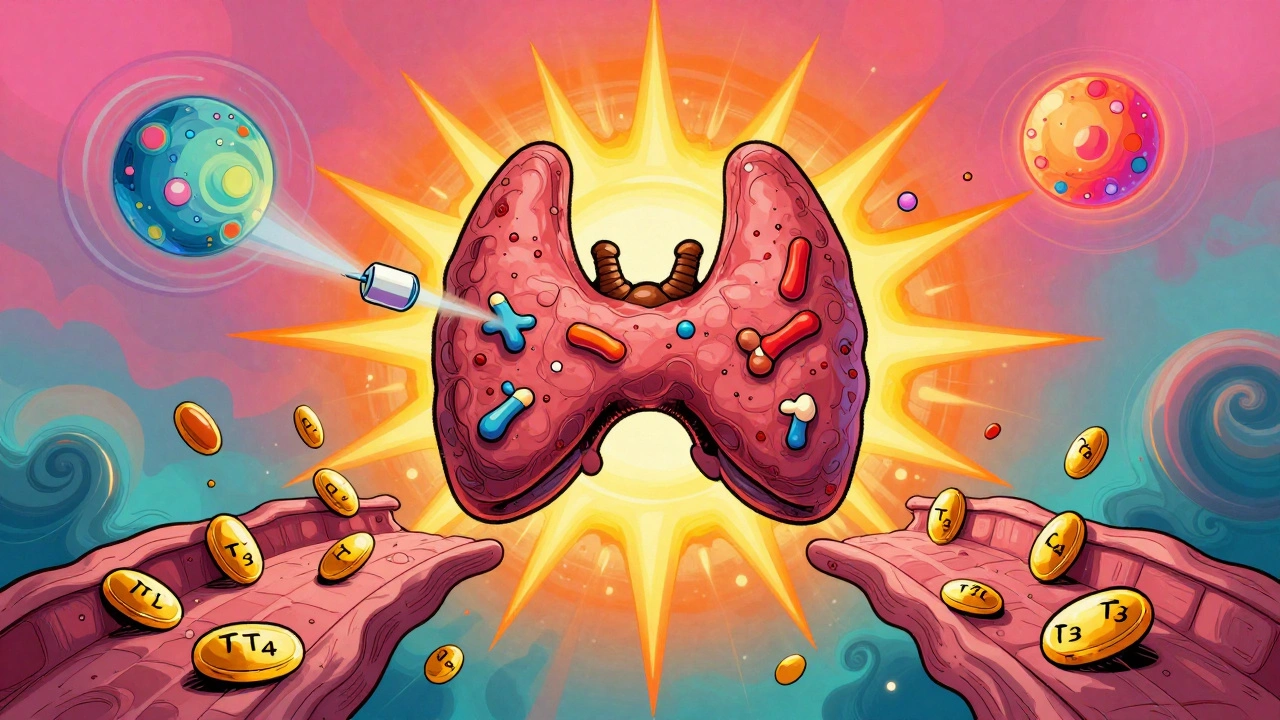
Lithium doesn’t attack your thyroid on purpose. It just doesn’t know how to avoid it. The drug works by changing how brain cells communicate, but it also interferes with the tiny, delicate machinery inside your thyroid gland. Specifically, it blocks three critical steps in hormone production:
- It stops iodine from attaching to the protein thyroglobulin, which is needed to make T3 and T4 hormones.
- It prevents the thyroid from breaking down stored hormone to release it into your blood.
- It reduces how well your body converts T4 (the storage hormone) into T3 (the active one).
Over time, this leads to a backup of thyroid tissue. Your thyroid starts to swell-this is called a goiter-and it happens in 30% to 59% of people taking lithium long-term. In some cases, it’s visible. In others, it’s only detectable on an ultrasound. The bigger the goiter, the more likely your thyroid will eventually underproduce hormones.
What makes this worse is that lithium also increases iodine buildup inside the gland. In countries where people get enough iodine in their diet (like the U.S.), this isn’t as big a problem. But in places like Denmark, where iodine levels are lower, goiter rates jump to nearly 50% after 10 years on lithium. Your environment matters as much as your dose.
Who’s Most at Risk?
Not everyone on lithium develops thyroid problems-but some people are far more likely to. Women under 60 are 3.2 times more likely than men to develop hypothyroidism on lithium, even at the same dose. Age matters too: people who start lithium after age 45 have higher rates of thyroid dysfunction than younger users.
Dose is another major factor. For every extra 100 mg per day you take, your risk of worsening thyroid issues goes up by 27%. That doesn’t mean you should drop your dose on your own-lithium is powerful, and lowering it without medical supervision can trigger a relapse. But it does mean your doctor should be watching your dose closely, especially if your TSH levels start creeping up.
And then there’s time. The longer you’re on lithium, the higher your risk. After 1-5 years, about 44% of users develop thyroid changes. After 10 years, that number hits 50%. But here’s the twist: some people’s thyroids adapt. A 2024 study found that while risk rises at first, it slightly decreases over time-suggesting the thyroid may slowly adjust to lithium’s presence.
Hypothyroidism: The Most Common Problem
Most thyroid issues from lithium are hypothyroidism-your thyroid isn’t making enough hormones. Symptoms are easy to miss because they look like depression or just aging:
- Constant fatigue, even after sleeping
- Unexplained weight gain
- Feeling cold when others are fine
- Dry skin and hair loss
- Brain fog or trouble concentrating
- Depression that doesn’t improve with mood meds
One Reddit user with 12 years on lithium wrote: “My TSH went from 1.8 to 8.7 in 18 months. I’m on levothyroxine now, but my psychiatrist won’t lower my lithium dose-even though I’m still exhausted.” That’s not uncommon. Many doctors assume the fatigue is just part of bipolar disorder. But if your TSH is above 4.0 mIU/L (and especially above 5.0), it’s likely lithium’s doing.
Levothyroxine (Synthroid, Tirosint) is the standard treatment. But here’s something many don’t know: people on lithium often need 20-30% more levothyroxine than someone with the same TSH level who isn’t on lithium. Why? Because lithium interferes with how your body uses the replacement hormone. Your doctor needs to check your free T4 levels-not just TSH-to make sure you’re getting enough.
Hyperthyroidism: Less Common, But Dangerous
Only 3-5% of lithium users develop hyperthyroidism, but it’s trickier to handle. It’s rarely Graves’ disease (an autoimmune condition). More often, it’s painless thyroiditis-a temporary inflammation that causes stored hormones to leak out. Symptoms include:
- Rapid heartbeat
- Weight loss despite eating more
- Shakiness or anxiety
- Heat intolerance
Here’s the catch: you don’t treat this with antithyroid drugs like methimazole. In most cases, it resolves on its own within 3-6 months. Beta-blockers can help with symptoms like a racing heart, but the goal is to wait it out. Stopping lithium at this stage can backfire. In rare cases, removing lithium suddenly-even through dialysis-has triggered thyroid storm, a life-threatening surge of thyroid hormone.
If tests show true Graves’ disease (positive antibodies, enlarged thyroid, eye changes), then carbimazole or radioactive iodine may be needed. But that’s uncommon. Most cases are self-limiting.
What Should You Do? A Practical Checklist
Managing lithium and thyroid health isn’t complicated-but it requires consistency. Here’s what works based on current guidelines:
- Test before you start. Get a full thyroid panel (TSH, free T4, free T3, and thyroid antibodies) before your first lithium dose.
- Test every 6 months for the first year. After that, annual checks are fine if your levels are stable.
- Don’t panic at a slightly high TSH. It can take 6-8 weeks for TSH to rise after starting lithium. Don’t jump to conclusions if your first test is borderline.
- Don’t stop lithium because of thyroid changes. Lithium is more effective than any alternative at preventing suicide and relapse. Managing the thyroid is easier than losing mood control.
- Ask about selenium. A 2023 trial showed 100 mcg of selenium daily cut hypothyroidism rates by 40% in lithium users. It’s safe, cheap, and not widely known.
- Track your symptoms. Keep a simple log: energy, weight, mood, temperature sensitivity. Bring it to every appointment.
And if your doctor dismisses your symptoms? Get a second opinion. Endocrinologists who specialize in psychiatric drug side effects know this well. Primary care doctors often don’t.
Alternatives? Yes-but with Trade-offs
Some people ask: “Can I switch to something else?” Valproate and carbamazepine are options, but they’re not better for your thyroid. Valproate causes thyroid issues in 5-10% of users. Carbamazepine barely affects it. But neither matches lithium’s power in preventing suicide.
A 2013 BMJ study showed lithium reduced suicide attempts by 14% more than other mood stabilizers. That’s not a small difference. It’s life-saving. Newer drugs like lamotrigine are gentler on the thyroid but less effective for mania. Quetiapine helps with depression but doesn’t prevent mania as well.
There’s hope on the horizon. A new compound called RG101, currently in Phase II trials, looks like lithium in how it stabilizes mood-but doesn’t raise TSH levels. If it works, it could replace lithium within the next decade. But for now, lithium is still the gold standard.
Real Stories, Real Choices
On Reddit, one user wrote: “I’ve been on 900 mg daily for 8 years. My thyroid is perfect. Every test normal.” That’s real. Not everyone has problems.
Another said: “I gained 30 pounds. My hair fell out. I cried every day-even though I was on levothyroxine. I thought I was failing at being stable. Turns out, I just needed more hormone.”
And a third: “I’d rather be tired and on pills than in the hospital again. Lithium saved my life. I’ll manage the thyroid.”
These aren’t just stories. They’re decisions. Lithium isn’t perfect. But for many, it’s the only thing that keeps them alive and functioning. The thyroid side effects are a price-but one that can be managed with the right care.
If you’re on lithium and your thyroid is acting up, you’re not alone. You’re not broken. You’re not failing. You’re just one part of a complex system that needs careful tuning. And with the right monitoring, the right dose of levothyroxine, and the right doctor, you can keep both your mood and your thyroid in balance.
Can lithium cause permanent thyroid damage?
In most cases, no. Hypothyroidism caused by lithium is usually reversible if caught early and treated with levothyroxine. Even if you stop lithium, thyroid function often returns to normal within months. However, if hypothyroidism goes untreated for years, the thyroid can become permanently damaged from chronic strain. That’s why regular monitoring is critical.
Should I stop lithium if my TSH is high?
No-not unless your doctor recommends it. A high TSH doesn’t mean you need to quit lithium. It means you need thyroid hormone replacement. Stopping lithium can trigger a relapse into mania or depression, and in rare cases, even thyroid storm. The risk of stopping lithium far outweighs the risk of managing hypothyroidism with medication.
Is levothyroxine safe to take with lithium?
Yes. Levothyroxine and lithium can be taken together safely. In fact, they’re often prescribed as a pair. However, lithium can reduce how well your body uses levothyroxine, so you may need a higher dose than someone not on lithium. Your doctor should check both your TSH and free T4 levels regularly to make sure you’re getting enough.
Can selenium help prevent lithium-induced hypothyroidism?
Yes. A 2023 randomized trial found that taking 100 mcg of selenium daily reduced the risk of developing hypothyroidism by 40% in people on long-term lithium. Selenium helps protect the thyroid from oxidative stress caused by lithium. It’s not a cure, but it’s a simple, low-risk way to lower your chances of needing hormone replacement.
How often should I get my thyroid checked on lithium?
The American Thyroid Association recommends testing TSH and free T4 before starting lithium, then every 6 months during the first year. After that, if your levels are stable, annual checks are sufficient. If your TSH starts rising or you develop symptoms, check every 3 months until it stabilizes. Don’t wait for symptoms to appear-by then, it may already be advanced.
Why do some people on lithium have no thyroid issues?
It varies by genetics, diet, age, gender, and iodine intake. People with no family history of thyroid disease, younger age, male gender, and adequate iodine in their diet are less likely to develop problems. Some people’s thyroid cells simply adapt better to lithium’s effects. It’s not random-it’s biological, and we’re still learning why.
George Graham
December 5, 2025 AT 09:55I’ve been on lithium for 11 years. My TSH was 8.2 last year. Started levothyroxine, doubled the dose after my endo checked my free T4, and now I’m actually sleeping through the night. No more 3pm crashes. This post nailed it - lithium doesn’t make you weak, it just needs a partner in crime.
Ollie Newland
December 6, 2025 AT 14:39Interesting breakdown, but let’s be real - the real issue is that psychiatrists treat TSH like a suggestion. I had a doc tell me ‘your fatigue is just bipolar’ while my TSH was 11. Selenium’s a game-changer. 100mcg daily, no side effects, and my antibodies dropped. Why isn’t this standard?
Benjamin Sedler
December 8, 2025 AT 07:41So let me get this straight - you’re telling me the miracle drug that keeps people from killing themselves also turns their thyroid into a glitchy old laptop? And the solution is… more pills? Cool. I’m just glad I’m not on lithium. I’d rather be manic than feel like a zombie with a thyroid that’s out of warranty.
Alex Piddington
December 8, 2025 AT 22:18Thank you for this comprehensive and clinically accurate overview. It is imperative that patients on long-term lithium therapy receive regular thyroid function monitoring. The data supporting selenium supplementation is promising and should be integrated into clinical practice where available. Consistency in lab tracking and patient education is paramount.
val kendra
December 10, 2025 AT 14:05Isabelle Bujold
December 11, 2025 AT 16:35It’s wild how lithium messes with your thyroid like it’s an afterthought. I’ve been on it for 15 years. My goiter’s visible now - I can feel it when I swallow. I take selenium, I take levothyroxine, I track everything. But here’s the thing nobody says: the real cost isn’t the pills, it’s the guilt. You feel like you’re failing because your body’s betraying you. But you’re not. You’re surviving. And that’s enough.
Chad Handy
December 11, 2025 AT 22:20So you’re telling me the drug that keeps me alive also makes me feel like a 70-year-old woman who just moved to Alaska? And the fix is more hormones? Great. So now I’m a walking pharmacy. And don’t even get me started on how my endo and psych keep blaming each other. I’m just here, trying not to cry in the shower while my thyroid screams for mercy.
Rebecca Braatz
December 13, 2025 AT 07:15You’re not alone. I was on 600mg lithium for 8 years. My TSH hit 9.8. I started 100mcg selenium. My free T4 went up. My energy came back. I’m not ‘fixed’ - I’m managed. And that’s victory. Stop feeling guilty. You’re not failing. You’re adapting. And that’s brave.
Michael Feldstein
December 13, 2025 AT 13:33My mom’s on lithium. She’s 67. Started it at 52. Her TSH went from 2.1 to 6.9 in 5 years. We found out because she kept saying she was ‘too cold’ and ‘too tired’ - and her doctor just said ‘you’re aging’. We switched her to an endo who knew lithium = thyroid trap. Now she’s on levothyroxine + selenium. She’s laughing again. Don’t ignore the signs. Your thyroid isn’t optional.
Heidi Thomas
December 13, 2025 AT 14:12Libby Rees
December 14, 2025 AT 22:24Thank you for writing this. I’ve been on lithium for 10 years. My thyroid is fine. I test every year. I take selenium. I don’t ignore symptoms. It’s not complicated. It’s just consistent. And that’s the secret. Not magic. Just care.
Dematteo Lasonya
December 16, 2025 AT 08:42I didn’t know selenium helped until I read this. I’ve been on lithium for 7 years. My TSH is 3.4. I’ve never had symptoms. But now I’m taking 100mcg daily just in case. It’s cheap. It’s safe. Why wouldn’t you? I’m not trying to fix what’s not broken - I’m trying to keep it from breaking.
Gareth Storer
December 17, 2025 AT 00:21Oh wow, lithium causes thyroid issues? Shocking. Next you’ll tell me breathing causes lung damage. Maybe if people didn’t take a drug that’s basically a mood grenade, they wouldn’t have side effects. Just saying.
Ben Choy
December 18, 2025 AT 09:03My sister’s on lithium. She’s got the goiter. She’s on levothyroxine. She’s still alive. Still working. Still laughing. That’s the win. This post didn’t scare me - it gave me tools. Thank you. I’m printing this for her doctor. She deserves better than ‘it’s just bipolar fatigue’.
Emmanuel Peter
December 19, 2025 AT 02:48Let’s be honest - lithium is a 1940s drug. We’ve got 2024 tech. Why are we still giving people a chemical that turns their thyroid into a cautionary tale? This isn’t management. It’s damage control with a side of guilt. If RG101 works, we should’ve been on it a decade ago.