MedWatch Side Effect Reporter
Is what you're experiencing serious enough to report to the FDA? This tool will help you determine if your symptoms qualify as a reportable side effect and guide you through the reporting process.
Every year, millions of people take prescription drugs, over-the-counter medicines, or use medical devices like glucose monitors or insulin pumps. Most of the time, they work as expected. But sometimes, something goes wrong. A rash appears out of nowhere. A heart palpitation hits after a new pill. A device fails during use. When that happens, you might wonder: Does anyone even know about this? The answer is yes - and you can be the one who tells them.
What Is MedWatch?
MedWatch is the U.S. Food and Drug Administration’s official system for tracking dangerous side effects and product failures. It’s not a hotline or a website you visit once a year. It’s a live safety net. Every report you submit helps the FDA spot patterns - like a new drug causing rare liver damage, or a blood pressure monitor giving wrong readings in elderly patients. These signals can lead to stronger warnings, label changes, or even product recalls. MedWatch covers almost everything regulated by the FDA: prescription and OTC drugs, vaccines (though vaccines have a separate system), medical devices, biologics like gene therapies, CBD products, and even cosmetics. It doesn’t cover tobacco or animal products. But for human medical products? It’s the only official channel. The system works because of two types of reporters: professionals and the public. Doctors, nurses, and pharmacists report using Form FDA 3500. Patients and caregivers use the simpler Form FDA 3500B. Manufacturers? They’re legally required to report - and they do, thousands of times a month. The FDA gets about 1.2 million reports a year. About 80% come from professionals. The rest? From people like you.When Should You Report?
You don’t need to be a doctor to know when something’s wrong. If you or someone you care about had a serious reaction, report it. The FDA defines a serious adverse event as one that:- Caused death
- Was life-threatening
- Required hospitalization
- Resulted in permanent disability
- Caused a birth defect
- Needed medical or surgical intervention to prevent permanent harm
How to Report: The Two Forms
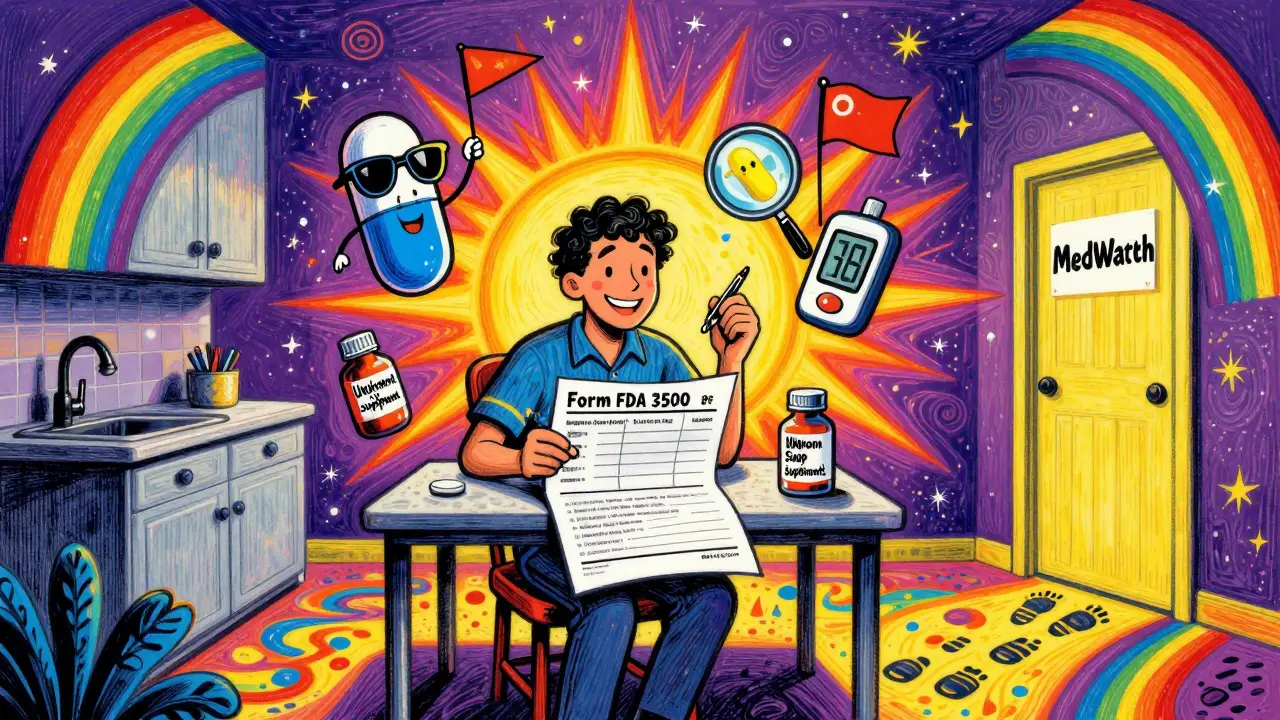
There are two main forms - and you only need one. For patients and caregivers: Form FDA 3500BThis is the easiest one. It’s designed for people without medical training. You’ll need:
- Your name and contact info
- The patient’s name (can be you)
- Product name (drug, device, or supplement)
- When you started using it
- When the problem started
- A description of what happened
- What happened afterward - did you go to the ER? Did it get better?
This one’s more detailed. If you’re a doctor, nurse, pharmacist, or technician, you’ll fill this out. It asks for your license number, specialty, facility, and more clinical details like lab results, timing of symptoms, and whether the event improved after stopping the product. Most professionals complete this in under 15 minutes. Many say it’s faster than writing a chart note. Both forms are available in English and Spanish. The FDA redesigned the online portal in 2021 to work better on phones. Big buttons. Clear fonts. No confusing menus.
What If You Don’t Know the Exact Product?
You’d be surprised how often this happens. People remember “the blue pill” or “that patch I put on my arm.” That’s enough. The FDA can often identify the product from the description. If you’re unsure, write down:- Color, shape, markings on the pill
- Brand name or generic name if you know it
- Where you bought it (pharmacy, online, store)
- Any packaging you still have
Will Your Doctor Report It?
Maybe. But don’t count on it. The FDA says clearly: “Your health care provider is NOT required to report to the FDA.” Many doctors do - especially for serious cases. But many don’t. They’re busy. They assume someone else will report it. Or they don’t know how. If you had a bad reaction, don’t wait for your doctor to act. Take the form to your next appointment. Ask: “Can you help me fill this out?” Most will. They’ve done it before. And if they refuse? Fill it out yourself. You have the right.What Happens After You Submit?
You’ll get an automated email confirmation. That’s it. No follow-up call. No case number. No updates. That doesn’t mean your report disappeared. It went into a database with over 10 million reports. Analysts look for trends. If 50 people report the same issue with the same drug, the FDA investigates. They might:- Update the drug label to warn about the side effect
- Require a boxed warning (the strongest type)
- Ask the manufacturer to study it further
- Issue a safety alert to all doctors and pharmacies
- Remove the product from the market
Why So Few People Report
The FDA estimates only 1% to 10% of serious side effects are reported. Why?- People don’t know they can. Most think reporting is for doctors only.
- It feels too complicated. Terms like “event abated” or “dose frequency” confuse patients. The FDA admits this. That’s why they created the simpler 3500B form.
- They think it won’t make a difference. But every report adds to the pile. One report might not change anything. A hundred? That’s a red flag.
What About Medical Devices?
Devices are a big part of MedWatch. Think insulin pumps, pacemakers, glucose monitors, hearing aids, even home oxygen machines. If a device stops working, gives wrong readings, or causes injury - report it. One real example: A patient reported that her home glucose monitor kept showing “low” readings - even when her blood sugar was normal. She reported it. The FDA checked other reports. Turns out, a batch of test strips had a manufacturing flaw. The company recalled them. That patient’s report helped prevent dozens of dangerous insulin overdoses.
How to Stay Updated
Reporting is important. But staying informed matters too. The FDA sends out MedWatch Safety Alerts for drugs, devices, and supplements that turn out to be risky. You can:- Sign up for email alerts on the MedWatch website
- Follow the FDA’s RSS feed
- Check the “What’s New” section monthly
What’s Next for MedWatch?
The FDA is working on making reporting easier. By 2025, they plan to connect MedWatch with electronic health records. Imagine: your doctor’s system automatically flags a reaction and sends a report - with your permission. That could cut down underreporting dramatically. They’re also testing AI tools that help patients fill out forms by asking simple questions: “Did you feel dizzy?” “When did it start?” “Did you take anything else?” But for now? The system still depends on you.What If You’re Not Sure It Was the Medicine?
That’s okay. You don’t have to be certain. The FDA doesn’t expect you to diagnose. They just need to know:- What you took
- What happened
- When it happened
Final Thought: Your Report Matters
You might think, “I’m just one person. What difference can I make?” A lot. In 2021, a teenager reported that her birth control pill caused extreme anxiety. She didn’t know anyone else had it. She reported it. Within months, the FDA found 40 similar reports. The label was updated to warn about mood changes. You don’t need to be a scientist. You don’t need to be loud. You just need to speak up. The system works because people like you care enough to report.Can I report a side effect if I’m not in the U.S.?
If you’re outside the U.S., you can still report to MedWatch if the product was sold or used in the United States. The FDA accepts reports from anywhere in the world for products regulated by them. If the drug or device was bought in the U.S., shipped here, or prescribed by a U.S. doctor, your report counts. For products sold only outside the U.S., contact your country’s health authority - like the EMA in Europe or Health Canada.
Do I need to give my real name?
No, you don’t have to. You can report anonymously. But if you leave your contact info, the FDA might reach out for more details - which can help them understand your case better. If you’re worried about privacy, you can use a pseudonym or give only your city and state. Your personal details are protected under federal law and won’t be shared publicly.
Can I report a side effect from a supplement or herbal product?
Yes. MedWatch covers dietary supplements, vitamins, herbal remedies, and CBD products. These aren’t as tightly regulated as prescription drugs, so reports are even more important. If a supplement caused liver damage, heart palpitations, or allergic reactions, report it. The FDA uses these reports to investigate unsafe ingredients and take action against companies selling harmful products.
How long does it take for the FDA to act after a report?
There’s no set timeline. Some reports trigger action within weeks if there’s a clear pattern. Others sit in the system for months or years until enough similar reports pile up. The FDA doesn’t respond to individual reports - they look at the big picture. But every report adds weight. A single report might not change anything. Ten from the same drug? That’s a signal.
Is MedWatch the only way to report drug side effects?
For the FDA, yes. MedWatch is the only official channel for reporting adverse events related to FDA-regulated medical products in the U.S. Other systems, like the CDC’s VAERS for vaccines, exist for specific products. But for drugs, devices, and supplements, MedWatch is the only one. Don’t rely on the manufacturer or your pharmacy - they may not report it to the FDA. Only MedWatch goes directly to the agency.




Mandy Kowitz
January 5, 2026 AT 22:46Cassie Tynan
January 7, 2026 AT 00:47bob bob
January 8, 2026 AT 21:00Vicki Yuan
January 9, 2026 AT 22:33Abhishek Mondal
January 11, 2026 AT 12:36Oluwapelumi Yakubu
January 12, 2026 AT 13:43Terri Gladden
January 13, 2026 AT 22:11Jennifer Glass
January 14, 2026 AT 10:58Joseph Snow
January 16, 2026 AT 01:28melissa cucic
January 17, 2026 AT 06:50en Max
January 19, 2026 AT 01:10Angie Rehe
January 20, 2026 AT 18:08Enrique González
January 21, 2026 AT 18:59Aaron Mercado
January 23, 2026 AT 04:25