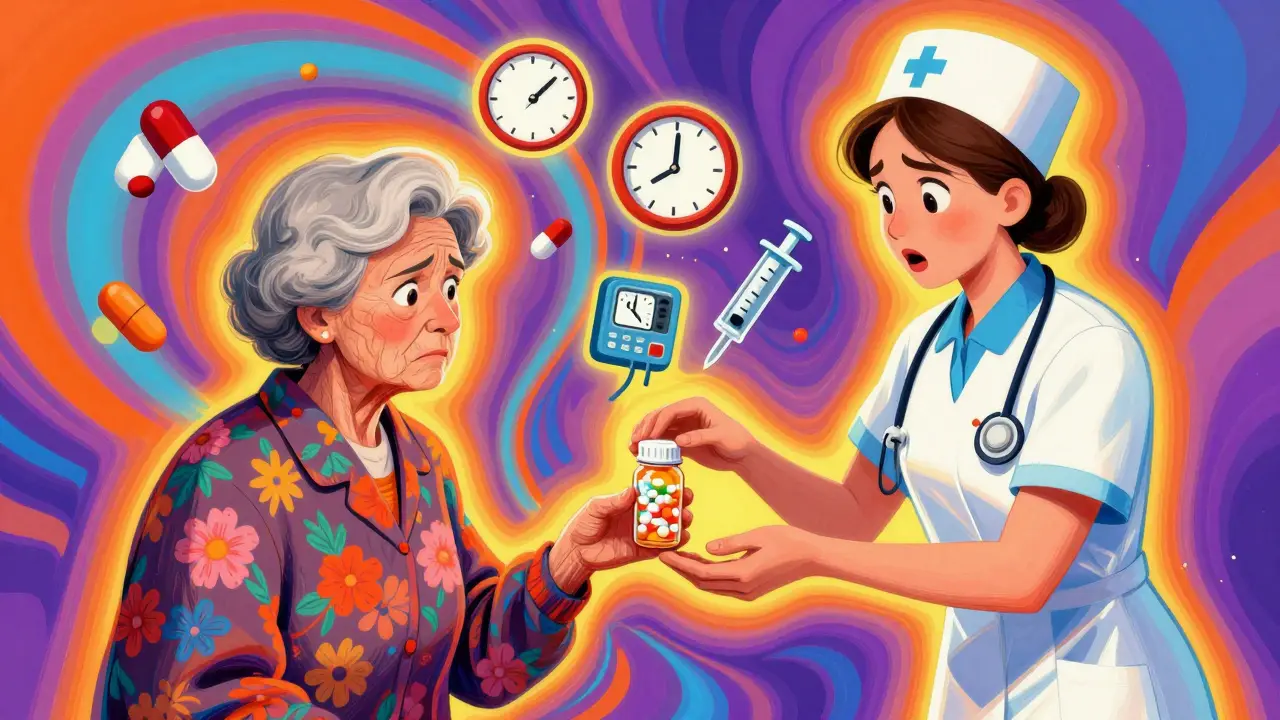
Every year, over 250,000 medication errors happen in U.S. nursing homes - and most go unnoticed. For older adults taking five, ten, or even fifteen different pills a day, a simple mistake - a wrong dose, a missed time, or a duplicate drug - can lead to falls, hospital trips, or worse. The truth is, these errors aren’t accidents. They’re symptoms of a system that’s stretched too thin. But families and caregivers don’t have to sit back. You can learn to spot these mistakes and make sure they’re reported - and that’s how change starts.
What Counts as a Medication Mistake in Seniors?
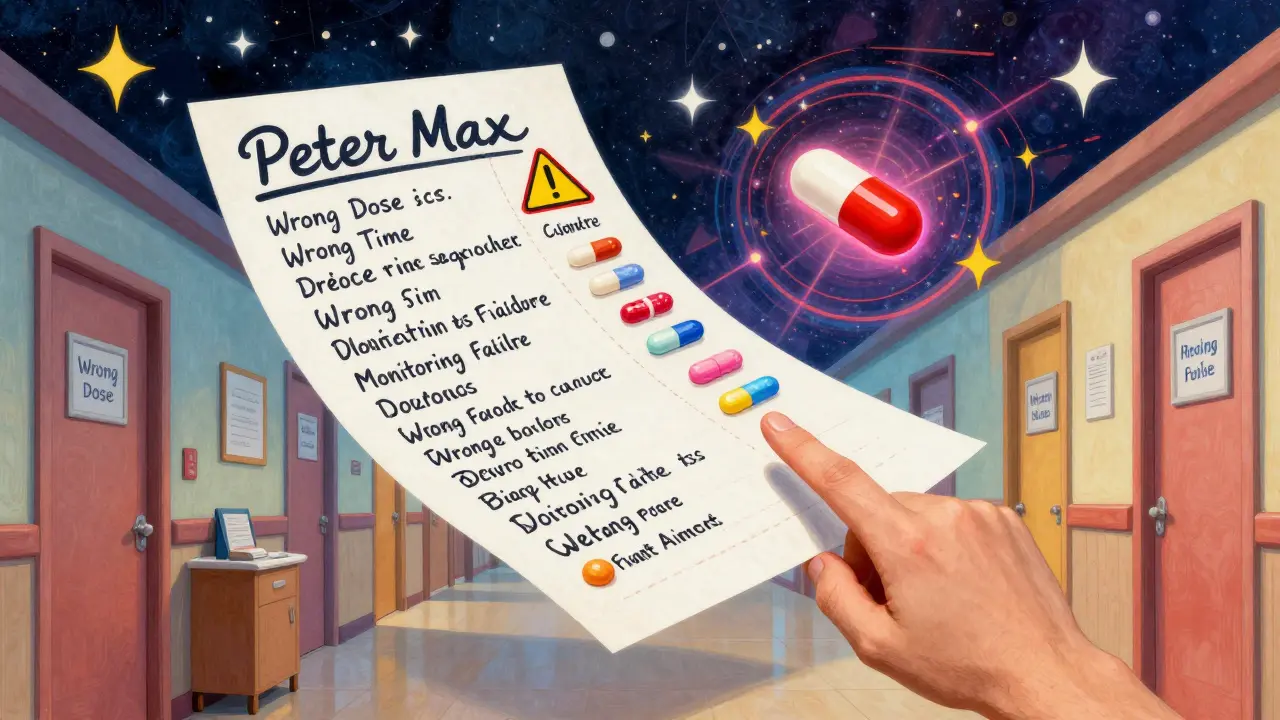
A medication error isn’t just when someone takes the wrong pill. It’s any time the medicine doesn’t match what was supposed to happen. For elderly patients, the most common types are:- Wrong dose - too much or too little. This happens in over 42% of nursing home errors. A blood pressure pill meant for 5mg given as 10mg? That’s a fall waiting to happen.
- Wrong time - giving meds at the wrong hour. Some drugs need to be taken with food. Others must be spaced hours apart. Mixing that up throws the whole system off.
- Wrong medication - giving acetaminophen when they’re already on Tylenol. Brand names fool even trained staff. If a doctor prescribes "acetaminophen" and the pharmacy labels it "Tylenol," confusion follows.
- Wrong route - a pill meant to be swallowed is crushed and put in applesauce. Or worse, an injection is given orally. This can be deadly.
- Monitoring failure - no one checks if the patient is having a reaction. No blood pressure check after a new heart med. No kidney test after starting an NSAID. This is the quietest killer.
The American Geriatrics Society’s Beers Criteria® lists 34 drugs that are risky for seniors - like benzodiazepines, anticholinergics, and certain painkillers. Yet, over 43% of Medicare beneficiaries are still prescribed at least one of them. If your loved one is on one of these, ask why.
How to Spot a Medication Mistake
You don’t need to be a nurse. You just need to pay attention. Start with the Five Rights:- Right patient - Is this the right person? Double-check the name and ID band. Names like "John Smith" are common.
- Right drug - Does the label match the prescription? Compare the name, dose, and color. Don’t trust memory.
- Right dose - Is it the exact amount? A pill split in half? A liquid measured with a spoon? Use the syringe that came with it.
- Right route - Is it supposed to be swallowed, injected, or applied to the skin? Never assume.
- Right time - Is it being given at the scheduled hour? Medications like insulin or diuretics have tight windows.
Use this checklist every time a pill is handed out. If staff resist, that’s a red flag. A 2021 study found that using the Five Rights reduced errors by 63%. That’s not magic - it’s discipline.
Also, keep a written list of every medication - name, dose, purpose, and time. Update it every time the doctor changes something. Bring it to every appointment. If the pharmacy gives you a new bottle and the label says "take twice daily," but your list says "once daily," stop and ask.
What to Do When You Find a Mistake
Don’t wait. Don’t hope it was a one-time thing. Mistakes repeat.Step 1: Stop the error. If you catch a nurse about to give the wrong pill, say it. "I think there’s a mistake here. My mother’s blood pressure med is 5mg, not 10mg." Most staff will listen if you’re calm and clear.
Step 2: Notify the prescriber. If the error could be life-threatening - like an overdose of warfarin or insulin - call the doctor immediately. Don’t wait for a report form. Lives are at stake.
Step 3: Document everything. Write down: date, time, medication, what happened, who was involved, and what you did. Take photos of labels if you can. Save text messages or emails. Paper trails save families.
Step 4: File a formal report. Every nursing home must have a process. Ask for the Medication Error Reporting Form. This isn’t about blame - it’s about fixing the system. The form should capture:
- Type of error (prescribing, administration, monitoring)
- Potential severity (using NCC MERP Index - Categories E to H mean serious harm or death was possible)
- Contributing factors (staff shortage? poor labeling? no barcode scan?)
Most facilities will try to downplay it. They might say, "It was just a one-off," or "The resident was confused." Don’t accept that. The real issue isn’t the resident - it’s the system that let it happen.
Where to Report - And Why It Matters
There are three key places to report:- The facility’s internal system - Every nursing home must have one. Get a copy of the report they file. If they refuse, that’s a violation.
- Your state’s Long-Term Care Ombudsman Program - This is your strongest tool. These are trained advocates who work for residents. Call 1-800-677-1116 or visit ltcombudsman.org. Families who report to ombudsmen see 68% of issues resolved within 72 hours.
- FDA MedWatch - For serious adverse events like hospitalization or death. Report online at www.fda.gov/medwatch. This feeds into national safety data.
Voluntary reporting systems like MEDMARX capture over 80% of errors - far more than mandatory ones. Why? Because they don’t punish staff. They look for system failures. That’s how real change happens.
Why Most Mistakes Go Unreported
Families often don’t report because they’re scared. They fear retaliation. They think, "They’ll treat my parent worse." But here’s the truth: 83% of families who reported errors faced initial denial. Staff blamed the resident. They said, "She’s confused." "He didn’t tell us." "We didn’t know."One Reddit user, u/ElderCareAdvocate, shared: "When I caught the nurse giving my mother double doses of blood pressure medication, the facility refused to file a report until I threatened to contact the state ombudsman." That’s not rare. That’s routine.
Meanwhile, rural homes report 63% fewer errors than urban ones - not because they’re safer, but because they have no one to report to. No ombudsman. No safety officer. No audits.
Reporting isn’t about punishment. It’s about protection. Every report helps fix the next one.
What’s Being Done to Fix This
Technology is helping - but unevenly.- Barcode medication administration (BCMA) - Scanning a patient’s wristband and the pill before giving it cuts errors by 86%. But only 55% of nursing homes have it. Hospitals? 86% do.
- Computerized Prescribing (CPOE) - Electronic orders cut errors by 48%. But many nursing homes still use paper.
- AI tools like MedAware - These flag dangerous drug combinations before they’re prescribed. FDA-approved in 2023. Still rare in nursing homes.
The government is pushing change. By 2025, all nursing homes must use electronic medication records (eMAR). The Biden Administration’s 2022 Patient Safety Plan targets a 50% drop in preventable errors by 2030. And starting in 2024, CMS’s Five-Star Rating System now includes medication error rates. Facilities with high error rates will lose stars - and residents will notice.
But tech alone won’t fix this. The biggest driver of errors? Staff shortages. The average nursing home has 2.1 nurses per 100 residents. That’s one nurse for every 48 people - including those with dementia, diabetes, and heart failure. No system can outsmart exhaustion.
What You Can Do Today
You don’t need to wait for policy changes. You can act now:- Visit daily - Even 15 minutes. Watch how meds are given.
- Ask for the medication list - Every week. Compare it to what’s in the bottle.
- Keep a log - Write down when meds are given. Note if they’re late, skipped, or changed.
- Know your rights - You can request a copy of any incident report. You can demand a meeting with the director of nursing.
- Call the ombudsman - No matter how small the mistake. One report starts a chain.
Medication errors in the elderly aren’t inevitable. They’re preventable. But they won’t stop unless someone speaks up. Your voice - your vigilance - is the most powerful tool we have.
How common are medication errors in nursing homes?
Over 250,000 medication errors occur annually in U.S. nursing homes, according to the National Center for Health Statistics. These errors affect roughly one in three residents at some point during their stay. The most frequent types involve wrong dosage, wrong timing, or giving the wrong drug - often because staff are overwhelmed or systems are outdated.
What should I do if I catch a medication mistake?
First, stop the error if you can - politely but firmly. Then document everything: date, time, medication, who was involved, and what happened. Immediately notify the prescribing doctor if it’s life-threatening. File a formal report using the facility’s Medication Error Reporting Form. If the facility refuses, contact your state’s Long-Term Care Ombudsman at 1-800-677-1116.
Can I report a mistake even if no harm was done?
Yes - and you should. Most serious errors start as near-misses. Reporting even minor mistakes helps identify patterns before someone gets hurt. Voluntary reporting systems like MEDMARX focus on fixing systems, not blaming people. Every report contributes to safer care for everyone.
What’s the difference between reporting to the facility and reporting to the ombudsman?
The facility’s internal report stays within the home - and may be ignored or buried. The state ombudsman is an independent advocate who investigates, pressures the facility to change, and can escalate to state regulators. Families who report to ombudsmen see resolution rates 68% higher than those who only speak to staff.
How can I protect my loved one from future mistakes?
Keep an updated, handwritten list of all medications - including dosages and times. Review it weekly. Ask staff to show you the pill before giving it. Use the Five Rights checklist. Visit daily, even briefly. Call the ombudsman if you notice recurring issues. And never assume everything is fine just because staff say so.



Judith Manzano
March 8, 2026 AT 20:25I’ve been doing this for my mom for two years now, and honestly? The Five Rights checklist changed everything. I started carrying a laminated card in my wallet. Every time they hand her a pill, I check it. No exceptions. Staff at first thought I was overkill - now they hand me the bottle and say, ‘Go ahead, Judith.’ One nurse even started using my checklist for her own training. It’s not about distrust - it’s about partnership.
And yeah, the ombudsman? Life-changing. I called about a missed insulin dose - not even an accident, just ‘forgot.’ Within 48 hours, they implemented a double-check system for high-risk meds. No drama. Just results. You don’t need to be loud. You just need to be consistent.
Don’t wait for a tragedy to act. Start today. One pill. One check. One conversation. That’s how systems change - one stubborn family at a time.
rafeq khlo
March 9, 2026 AT 22:50The entire premise of this article is naive. You think families can fix systemic failures with checklists and polite requests? This is like asking a civilian to fix a nuclear reactor by reading the manual. The real issue is underfunding and deregulation. Nursing homes are profit centers disguised as care centers. Staff are paid minimum wage to manage 50 patients. Of course mistakes happen. The solution isn’t vigilance - it’s nationalization of elder care. Or at least universal wage standards. Your checklist won’t stop a nurse from giving a double dose because she’s working her third shift in 36 hours. You’re blaming the victim while the system burns.
And don’t get me started on the FDA. They approve AI tools but refuse to mandate barcode scanning. That’s not innovation. That’s negligence dressed up as progress.
Morgan Dodgen
March 10, 2026 AT 13:40LMAO so we’re supposed to trust the ‘Five Rights’ like it’s some sacred mantra? Bro. The entire system is a glitchy Windows 95 program running on a potato. Barcode scanning? Only 55% of homes have it? That’s not a gap - that’s a crime scene. And don’t even get me started on the ‘ombudsman’ - they’re just glorified PR interns with a state badge. Meanwhile, the real solution is AI-driven real-time med monitoring. Think: wearable patches that auto-alert if a pill isn’t swallowed. Or facial recognition to confirm patient identity before dosing. We’ve got drones delivering meds to rural homes - but we’re still using paper logs?
Also - ‘handwritten list’? Are you kidding me? That’s like using a rotary phone in 2024. My aunt’s med list was handwritten. The nurse misread ‘5mg’ as ‘50mg’ because cursive ‘5’ looks like ‘S’ in a hurry. We got lucky she didn’t die. I’m not waiting for another near-miss. I’m installing a smart pill dispenser with facial auth and blockchain logging. Yes, it’s $800. But it’s cheaper than a funeral.
Also lol @ ‘don’t trust memory’ - nobody trusts memory anymore. We’ve got apps for everything. Why is elder care stuck in 1997?
PS: If you’re not using MedAware or a similar AI system, you’re not protecting your loved one. You’re just hoping.
Philip Mattawashish
March 11, 2026 AT 20:20You people are delusional. You think reporting a mistake is going to ‘fix the system’? It’s not a system - it’s a slaughterhouse with a bingo night. Every ‘medication error’ is a symptom of a society that views the elderly as disposable. You’re not saving lives with checklists. You’re just buying time before the next one gets quietly ‘accidentally’ overdosed.
And let’s be real - who’s really responsible? The nurse who’s overworked? Or the CEO who cuts staffing to boost Q3 profits? You’re fighting the janitor while the owner laughs in the penthouse.
And don’t even mention the ‘Beers Criteria.’ That’s just a list of drugs the pharmaceutical industry doesn’t want to be sued over. Benzodiazepines? Still prescribed like candy. Why? Because they’re profitable. Not because they’re safe.
You think your ‘one report’ matters? It doesn’t. What matters is shutting down every for-profit nursing home and replacing them with publicly funded, unionized care centers. Until then, you’re just rearranging deck chairs on the Titanic.
And yes - I’ve seen it. My grandmother died in a facility where they gave her 10x her dose of warfarin. The report? ‘Patient non-compliance.’ I’m still waiting for justice. You think your checklist is going to get you there? Keep dreaming.
Tom Sanders
March 13, 2026 AT 18:58Yeah but like… is this even worth the effort? I mean, I’ve been to my dad’s place twice. They’re always saying ‘we’re good.’ And honestly? I’m tired. I work 60 hours a week. I don’t have time to carry a laminated card and photograph every pill bottle. Someone’s gotta do it, sure - but why me? Why am I the one who has to be the detective? Why isn’t the government just… fixing this?
I’m not saying don’t care. I’m just saying… it’s exhausting. And honestly? Most of the time, nothing changes anyway. So what’s the point?
Jazminn Jones
March 15, 2026 AT 03:20The notion that families can meaningfully intervene in clinical medication administration is not only ideologically unsound - it is epistemologically naive. The complexity of polypharmacy in geriatric populations exceeds the cognitive bandwidth of laypersons without formal pharmacological training. The Five Rights framework, while pedagogically convenient, is a heuristic artifact of mid-20th century nursing pedagogy and lacks empirical validity in modern, high-stakes clinical environments.
Furthermore, the reliance on manual documentation and handwritten lists constitutes a violation of HIPAA-compliant data integrity standards. A paper-based system is not merely inefficient - it is a liability vector.
What is required is not individual vigilance but institutional accountability enforced via mandatory integration of CPOE, BCMA, and real-time AI clinical decision support - all audited under ISO 13485 standards. Until then, familial involvement is not protective - it is performative.
And please - stop romanticizing the ombudsman. They are bureaucratic intermediaries with no enforcement power. Their ‘68% resolution rate’ is statistically meaningless without a control group. This article reads like a corporate white paper disguised as advocacy.
Stephen Rudd
March 16, 2026 AT 19:07You all are missing the point. This isn’t about pills or checklists or ombudsmen. It’s about control. The system wants you to think you’re helping by checking a pill bottle - so you don’t ask why your loved one is on five drugs that should’ve been discontinued five years ago. Why is there no mandatory review of all elderly prescriptions every 90 days? Why aren’t pharmacists legally required to call the family when a new high-risk med is added?
You think this is about errors? It’s about erasure. Elderly people are being medicated into silence. Sedated. Confused. Isolated. And you’re out here checking if the dose is 5mg or 10mg? That’s not vigilance - that’s distraction. The real mistake isn’t the wrong pill - it’s that we’ve accepted this as normal.
And don’t even get me started on rural homes. You think they’re ‘safer’? No. They’re invisible. No audits. No cameras. No one to report to. That’s not a feature - it’s a design choice.
Stop checking pills. Start demanding systemic overhaul. Or you’re part of the problem.
Erica Santos
March 16, 2026 AT 20:24Oh wow. A 12-page essay on how to be a better detective for your dying parent. Congrats. You get a participation trophy for not letting your mom die in a nursing home that’s basically a Walmart with IVs.
Let me guess - you’re the one who showed up with a laminated checklist and made the nurse cry? Good job. You’re a hero. Now go cry into your kombucha while your parent’s kidneys fail from another NSAID they shouldn’t have been on.
Here’s the truth: no amount of ‘Five Rights’ or handwritten lists will fix a system where one nurse is responsible for 48 people with dementia, diabetes, and heart failure. You’re not saving lives. You’re just doing damage control while the entire structure collapses.
And yes - I’ve seen it. My grandmother was given a blood thinner she was allergic to. The nurse said, ‘Oh, we didn’t know.’ Turns out, the allergy was in the chart. On page 12. In 6-point font. In Comic Sans. Because someone thought ‘readability’ was optional.
So no. I’m not ‘checking pills.’ I’m canceling the whole damn system. And if you’re still using a paper list in 2024? You’re not a caregiver. You’re a hostage.