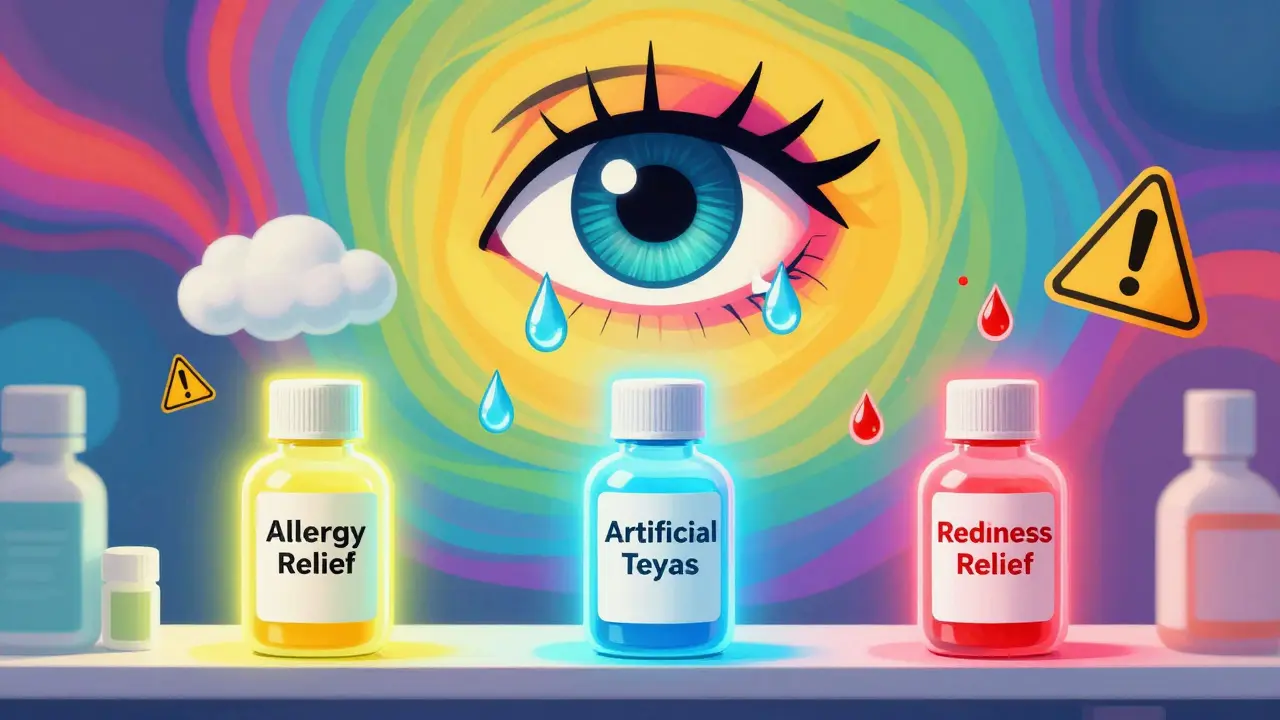
Not all eye drops are the same - and using the wrong one can make things worse
You wake up with itchy, watery eyes. Or maybe your vision feels foggy after staring at a screen all day. Or your eyes are bloodshot and you just want them to look normal again. You reach for the nearest bottle of eye drops in the pharmacy aisle. But here’s the thing: OTC eye drops aren’t one-size-fits-all. Pick the wrong type, and you might feel better for a few hours - then end up with worse symptoms by the end of the week.
Millions of people in the U.S. use OTC eye drops every day. Around 16 million suffer from dry eye alone, according to the American Academy of Ophthalmology. But a 2023 survey from Boulder Medical Center found that 67% of people with dry eye reach for redness-relief drops first - the exact wrong choice. Those drops don’t fix dryness. They mask it. And over time, they make it worse.
Know your problem before you buy
Before you grab a bottle, ask yourself: What’s actually bothering your eyes?
- Allergies? Itchy, watery, swollen eyes - especially during pollen season or around pets.
- Dryness? Gritty, burning, tired eyes that feel worse after screens, wind, or air conditioning.
- Redness? Bloodshot eyes that don’t improve with rest - maybe you think it’s dryness, but it’s just surface irritation.
These are three different problems. And each needs a different kind of solution. Mixing them up is like taking a headache pill for a stomach ache.
Artificial tears: For dry, tired, or gritty eyes
If your eyes feel dry, scratchy, or like there’s sand in them, you need artificial tears. These are lubricants that replace your natural tears. But not all artificial tears are created equal.
Basic versions - like generic saline drops - just add water. They give quick relief but fade fast. Most last only 1 to 2 hours. For people who use screens all day, that’s not enough.
Higher-end options like Systane Ultra is a lubricating eye drop with polyethylene glycol and propylene glycol that provides 8.2 hours of moisture retention in clinical testing or TheraTears is a hypotonic lubricant with balanced electrolytes (80mg sodium, 12mg potassium per mL) that outperforms standard drops by 37% in symptom relief are designed to mimic your natural tear chemistry. TheraTears, for example, has a lower salt concentration (230 mOsm/L) than your tears (300 mOsm/L), which helps draw moisture into your eye instead of pulling it out.
For evaporative dry eye - where your tears evaporate too fast because your oil layer is weak - you need lipid-based formulas. Systane Complete PF contains mineral oil (0.25%) and castor oil (0.5%) to reinforce the tear film’s lipid layer and reduce evaporation is one of the best. It’s preservative-free, so it’s safe for frequent use, and reduces symptoms by 52% more than standard drops.
And if you’re using drops more than 4 times a day, skip anything with preservatives. Preservatives like polyquaternium-1 can irritate your eyes over time. Studies show 22% of chronic users develop punctate keratitis - tiny sores on the cornea - from preserved drops. Go for single-use vials like Refresh Optive Preservative-Free is a preservative-free artificial tear available in 30 single-use vials, ideal for frequent use or sensitive eyes. They cost a bit more ($12-$22 for 30 vials), but your eyes will thank you.
Allergy eye drops: For itchy, watery, seasonal irritation
If your eyes are itchy, red, and watering - especially in spring or fall - you’re likely dealing with allergic conjunctivitis. Don’t reach for regular artificial tears. They won’t touch the allergy.
You need antihistamine eye drops. These block the histamine your body releases when it reacts to pollen, dust, or pet dander. The two most effective OTC options are:
- Pataday contains olopatadine 0.1%, FDA-approved for 24-hour allergy relief with just one daily dose
- Zaditor contains ketotifen 0.035%, effective for allergy relief but typically requires two doses per day
Pataday wins for convenience. One drop in the morning lasts all day. Zaditor works well too, but you’ll need to use it twice. Both are better than old-school allergy drops like Opcon-A, which combine a decongestant (naphazoline) with an antihistamine (pheniramine). Those give fast relief - but 41% of regular users get rebound redness within two weeks.
Use these drops before exposure if you know you’re heading into a high-allergen environment. Prevention beats reaction. And if you wear contacts, make sure the drops are labeled “safe for contact lens wear.” Some antihistamines can stick to lenses and cause irritation.

Redness-relief drops: The trap most people fall into
These are the bright blue bottles with bold claims: “Gets the red out!” “Whitens eyes instantly!” They’re everywhere. But here’s the truth: they’re not for dry eyes. They’re not for allergies. And if you use them daily, they’ll make your eyes redder over time.
These drops contain vasoconstrictors - chemicals like tetrahydrozoline (in Visine) or brimonidine (in Lumify). They shrink the tiny blood vessels on your eye’s surface. That’s why your eyes look white right after you use them.
But here’s what they don’t tell you: your eyes need those blood vessels. They deliver oxygen and nutrients to your cornea. When you shrink them daily, your eyes start relying on the drop to stay white. Once you stop, the blood vessels bounce back bigger than before. This is called rebound hyperemia.
According to Boulder Medical Center’s 2023 data, 68% of people who use Visine-type drops more than once a day for two weeks end up with worse redness than when they started. That’s not a fix. That’s a cycle.
Lumify (brimonidine 0.025%) is a newer option. It causes rebound redness in only 5.2% of users - much safer. But it’s not a cure. It’s a temporary cover-up. And some users report headaches. If your eyes are red because they’re dry or allergic, treat the root cause. Don’t just hide it.
What about gels and ointments?
If your dryness is bad - especially at night - you might need something thicker. Gel drops like Systane Gel Drops contains 0.2% hydroxypropyl guar for extended moisture retention, lasting 4-6 hours but causing temporary blurring or Refresh Relieva GEL is a gel-based lubricant offering 6.5 hours of relief in dry office environments with 40% humidity work better than liquids. They stick around longer - up to 6 hours.
But they blur your vision for 2-3 minutes after you apply them. So don’t use them before driving, working on a computer, or reading. Save them for bedtime. They’re perfect for overnight healing.
How to use eye drops correctly
Even the best drop won’t work if you use it wrong. Most people do it incorrectly.
Here’s how to do it right:
- Wash your hands.
- Tilt your head back and look up.
- With one finger, gently pull down your lower eyelid to make a small pocket.
- Hold the bottle above your eye - don’t let it touch your eye or eyelashes.
- Squeeze one drop into the pocket.
- Closed your eye gently for 30 seconds. Don’t blink hard.
- Press the inner corner of your eye (near your nose) with your finger. This stops the drop from draining into your throat.
Why does this matter? If you blink right after applying the drop, most of it spills out. If you touch the bottle to your eye, you risk contamination. And if the drop drains into your nose, it can cause side effects like a bitter taste or drowsiness.

What to avoid
- Don’t use redness-relief drops for dry eyes. They make dryness worse by reducing blood flow to your eye’s surface.
- Don’t use preserved drops more than 4 times a day. Preservatives irritate your eyes over time.
- Don’t share eye drops. Even with good hygiene, bacteria can transfer between users.
- Don’t use expired drops. OTC eye drops lose effectiveness after 28 days of opening (unless labeled otherwise).
- Don’t store drops in the fridge unless instructed. Thealoz Duo needs refrigeration after opening. Most others should stay at room temperature.
When to see a doctor
OTC drops are great for mild, occasional symptoms. But if you’ve been using them for more than two weeks and your eyes still feel bad, it’s time to see an eye care professional.
Signs you need help:
- Pain or sensitivity to light
- Blurred vision that doesn’t clear up
- Discharge or crusting on your eyelids
- Redness that spreads or gets worse
- Feeling like something’s stuck in your eye
These could be signs of infection, autoimmune disease, or severe dry eye syndrome. Left untreated, they can damage your vision.
Bottom line: Match the drop to your symptom
Here’s your quick cheat sheet:
- Dry, gritty, tired eyes? → Use preservative-free artificial tears like Systane Ultra or TheraTears. For nighttime, try Systane Gel Drops.
- Itchy, watery eyes during allergy season? → Use Pataday or Zaditor. Apply before exposure if possible.
- Red eyes with no other symptoms? → Try Lumify once or twice a day - but only short-term. If redness lasts, see a doctor.
- Using drops more than 4 times a day? → Switch to preservative-free single-use vials.
Eye health isn’t about quick fixes. It’s about understanding what’s really going on - and treating it correctly. The right drop can make your day. The wrong one can turn a small problem into a long-term one.
Can I use allergy eye drops for dry eyes?
No. Allergy eye drops like Pataday or Zaditor are designed to block histamine - the chemical that causes itching and watering during allergic reactions. They don’t add moisture to your eyes. If your eyes are dry because of screen use, aging, or environmental factors, you need artificial tears. Using allergy drops for dryness won’t help - and may delay proper treatment.
Why do some eye drops sting when I put them in?
A mild sting for a second is normal, especially with drops that have a different pH than your tears. But if it burns for more than 10 seconds, the drop may contain irritants like preservatives or incorrect salt levels. Try switching to a preservative-free formula like Refresh Optive PF. If the stinging continues, you might be sensitive to one of the ingredients - talk to your eye doctor.
Are preservative-free eye drops worth the extra cost?
Yes - if you use drops more than 4 times a day, wear contacts, or have sensitive eyes. Preservatives like benzalkonium chloride can damage your eye’s surface over time. A 2023 study from Haas Vision Center found 29% of frequent users developed irritation from preserved drops. Single-use vials cost more, but they’re safer, more effective, and prevent long-term damage. Think of it as investing in your eye health.
Can I use eye drops while wearing contact lenses?
Only if the bottle says “safe for contact lenses.” Many drops contain ingredients that can stick to lenses or change their shape. Blink Contacts, Refresh Contacts, and TheraTears Lubricant are labeled for use with contacts. Always wait 15 minutes after using drops before inserting lenses - unless the label says otherwise.
How long do OTC eye drops last after opening?
Most multi-dose bottles expire 28 days after opening - even if the bottle says “use by” a later date. That’s because once opened, bacteria can grow inside. Single-use vials are discarded after one use. Always check the label. If you’re unsure, throw it out. Your eyes aren’t worth the risk.
Is it safe to use redness-relief drops occasionally?
Occasional use - once or twice a month - is generally safe for most people. But if you’re using them because your eyes are red from dryness, allergies, or fatigue, you’re masking the problem. Redness-relief drops don’t fix the cause. They just shrink blood vessels temporarily. If your eyes are red more than once a week, see an eye doctor instead of reaching for Visine.



Lori Anne Franklin
December 27, 2025 AT 07:23Also, never thought about the inner corner trick-game changer.
Bryan Woods
December 28, 2025 AT 03:59Ryan Cheng
December 28, 2025 AT 14:48wendy parrales fong
December 29, 2025 AT 20:27Sarah Holmes
December 30, 2025 AT 06:12Michael Bond
December 30, 2025 AT 23:16Matthew Ingersoll
December 31, 2025 AT 08:44josue robert figueroa salazar
January 1, 2026 AT 11:23david jackson
January 3, 2026 AT 04:24