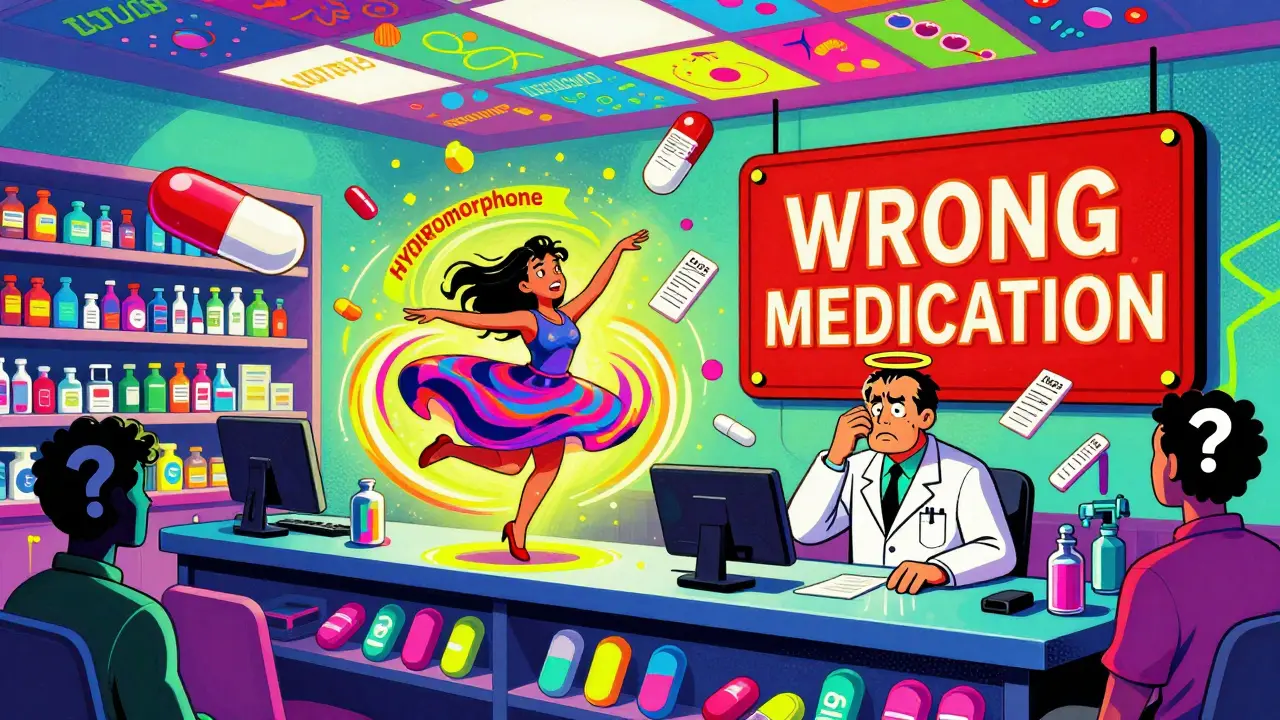
Every year, millions of patients in the U.S. are affected by medication errors - and a large chunk of those come from mistakes made at the pharmacy counter. It’s not about bad pharmacists. It’s about broken systems. A 2023 meta-analysis of 62 global studies found that dispensing errors happen in about 1.6% of all prescriptions filled - but that number hides the real danger: in some settings, error rates climb as high as 33%. That’s one in three prescriptions gone wrong. And the consequences? Hospitalizations, allergic reactions, even deaths.
What Are the Most Common Pharmacy Dispensing Errors?
Not all errors look the same. Some are obvious - like giving someone insulin when they were prescribed metformin. Others are sneaky. Here are the top five mistakes that happen most often:
- Wrong medication - Giving the patient a completely different drug. This happens most often with sound-alike or look-alike names. Think Hydralazine vs. Hydroxyzine, or Clonazepam vs. Clonidine. One letter, one syllable, and a life can change.
- Wrong dose or strength - A 500mg tablet instead of 250mg. A 10mL vial instead of 5mL. These errors spike with high-alert drugs like warfarin, insulin, or opioids. The FDA reports that 27% of all administration errors involve incorrect dosing.
- Wrong dosage form - Giving a tablet when the prescription called for a liquid, or extended-release capsules when immediate-release was needed. Crushing a time-release pill can cause a dangerous overdose.
- Missing allergy check - Failing to verify if the patient is allergic to penicillin, sulfa, or even inactive ingredients like lactose or dyes. In antibiotic-related errors alone, 41% of claims came from not checking allergies.
- Drug interactions ignored - Prescribing an NSAID to someone already on warfarin. Or giving an SSRI with an MAOI. These interactions don’t always show up until it’s too late.
And it’s not just about the drug itself. Wrong duration - giving a 30-day supply when the doctor ordered 7 days - can lead to overuse. Wrong route - an oral pill labeled for IV use - can be fatal. These aren’t rare. They’re routine.
Why Do These Errors Keep Happening?
Blaming the pharmacist won’t fix this. The real culprits are hidden in the workflow:
- Workload pressure - Pharmacies are stretched thin. One study found that 37% of errors occur when pharmacists are handling more than 120 prescriptions per shift. Rushing = mistakes.
- Illegible handwriting - Even in 2025, 43% of errors still start with a paper script that’s hard to read. Is that "5 mg" or "50 mg"? Is it "Lunesta" or "Lisinopril"?
- Sound-alike, look-alike drugs - There are over 1,000 pairs of drugs that sound or look too similar. Without Tall Man lettering (like HYDROmorphone vs. HYDROxyzine), even experienced staff get fooled.
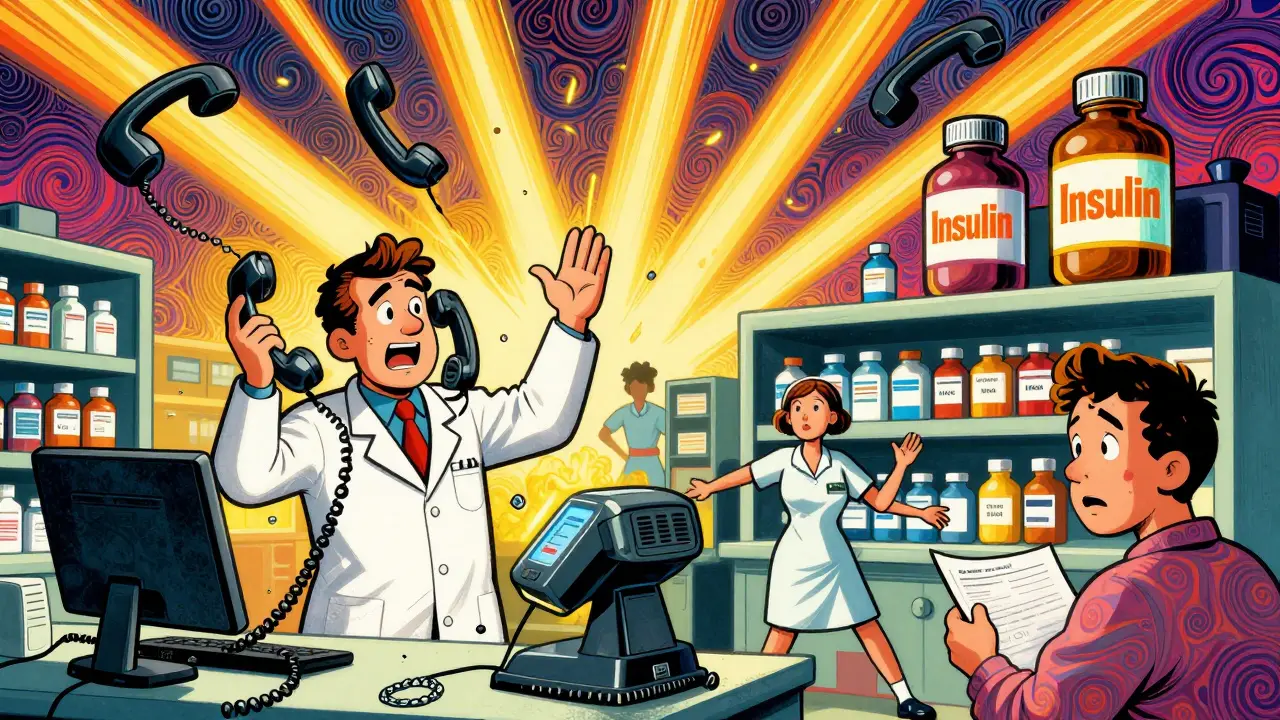
- Interruptions - A phone call, a patient question, a coworker asking for help - each interruption increases error risk by 12.7%. One pharmacist told Reddit: "I was checking a prescription when a nurse walked in. I forgot the dose. The patient got 10x what they needed. I still feel sick about it."
- Lack of information - No allergy history. No kidney function numbers. No list of other meds. Pharmacists can’t prevent errors if they don’t have the full picture.
And let’s not forget technology. Computerized systems help - but they also create new problems. One study found that while CPOE systems cut dispensing errors by 43%, they introduced new errors in 17.8% of cases. Why? Alert fatigue. When your screen flashes 50 warnings per shift, you start clicking "ignore" without reading.
How to Stop These Errors - Proven Solutions
Change isn’t about working harder. It’s about working smarter. Here’s what actually works:
1. Double-Check High-Risk Medications
For drugs like insulin, heparin, warfarin, and opioids, make a rule: two people verify before it leaves the counter. One pharmacist checks, a second pharmacist or technician confirms. In one hospital, this simple step cut insulin errors by 78% in 18 months.
2. Use Barcode Scanning
Barcode systems don’t guess - they confirm. Scan the prescription, scan the bottle, scan the patient’s wristband. If it doesn’t match, the system stops you. A 2021-2023 survey of 127 hospitals showed barcode scanning reduced dispensing errors by 47.3%. Wrong drug? Down 52%. Wrong dose? Down 49%.
3. Implement Tall Man Lettering
It’s simple: make similar drug names visually different. Epinephrine vs. Ephedrine. Prednisone vs. Prednisolone. Writing them as EPINEPHrine and EPHEdrine tricks the brain into seeing the difference. Pharmacies using this saw a 57% drop in sound-alike errors.
4. Build a Culture of Reporting - Not Blaming
When a mistake happens, don’t punish the person. Ask: What broke? Was the system flawed? The ISMP found that pharmacies focusing on system fixes reduced repeat errors by 68%. Those focusing on blame? Only 19% improvement.
Tools like Pharmapod let pharmacists report near-misses anonymously. One community pharmacy reported 12 serious errors caught in their first month of using it - all before a patient got hurt.
5. Use Clinical Decision Support
Modern pharmacy software can flag interactions, allergies, renal dose adjustments, and duplicate therapies in real time. But only if it’s tuned right. Too many alerts? You’ll miss the important ones. Too few? You’ll miss dangerous ones. The sweet spot? Alerts that are specific, actionable, and tied to real patient data - not just generic warnings.
6. Standardize Packaging and Storage
Store look-alike drugs as far apart as possible. Don’t put amoxicillin next to ampicillin. Don’t keep insulin and glucagon in the same drawer. Use color-coded bins. Label everything clearly. One pharmacy reduced wrong-strength errors by 40% just by rearranging their shelves.
What’s Changing in 2025?
The future of pharmacy safety is digital - but not all tech is equal.
Robotic dispensing systems are popping up in hospitals. They can pull, count, and label pills with near-zero error rates. But they cost $150,000 to $500,000 - out of reach for most community pharmacies.
AI tools are getting better. In 34 hospitals, AI systems predicted potential errors before they happened - reducing dispensing mistakes by over 52%. They analyze patterns: which prescribers make the most errors, which drugs are most commonly mispicked, which patients have the highest risk.
And by 2025, the WHO and ISMP will roll out a global classification system for medication errors. Right now, one hospital calls a "wrong dose" error something else than another. Standardizing terms means better data, better learning, better prevention.
But here’s the catch: only 39% of community pharmacies have fully integrated electronic health records. Without access to patient history, labs, or allergy lists, even the smartest tech can’t help.
What You Can Do - Even If You’re Not a Pharmacist
You’re not powerless. If you or a loved one takes medications:
- Always ask: "What is this for?" and "How should I take it?"
- Check the bottle label against the prescription slip.
- Know your allergies - and tell every pharmacist, every time.
- Keep a list of all your meds - including vitamins and supplements - and bring it to every visit.
- If something looks wrong - a pill color, size, or name - speak up. Don’t assume it’s right.
Pharmacists are your last line of defense. But they can’t catch everything if the system is broken - or if you’re silent.
Final Thought
Dispensing errors aren’t inevitable. They’re designed. Bad workflows, poor training, rushed shifts, outdated tech - these are choices. And choices can be changed.
The data is clear: when systems are fixed, errors drop - fast. Double-checks. Barcodes. Tall Man letters. Reporting without fear. These aren’t fancy ideas. They’re basic safety steps. And they work.
The goal isn’t perfection. It’s progress. One less wrong pill. One fewer overdose. One more patient who goes home safe.
What is the most common pharmacy dispensing error?
The most common pharmacy dispensing error is giving the wrong medication, dosage strength, or dosage form - accounting for about 32% of all errors. This includes giving a patient the wrong drug entirely (like hydralazine instead of hydroxyzine), the wrong dose (500mg instead of 250mg), or the wrong form (a tablet instead of a liquid). These errors are often caused by look-alike or sound-alike drug names, poor handwriting, or distractions during the filling process.
How do pharmacists prevent dispensing errors?
Pharmacists prevent errors through layered safety systems: using barcode scanning to verify the right drug and dose, implementing double-checks for high-alert medications like insulin and warfarin, using Tall Man lettering to distinguish similar drug names, and relying on clinical decision support software that flags allergies and interactions. They also reduce interruptions, standardize storage, and encourage anonymous reporting of near-misses to improve systems - not punish individuals.
Can technology really reduce pharmacy errors?
Yes - but not alone. Barcode scanning has reduced dispensing errors by nearly 50% in hospitals. Computerized prescribing with decision support cuts errors by 43%. AI tools are now predicting errors before they happen, reducing them by over 50% in pilot programs. But technology can also create new problems, like alert fatigue. The best results come from combining tech with human checks - not replacing people with machines.
Why do sound-alike drug names cause so many errors?
Sound-alike drug names - like Lunesta and Lisinopril, or Clonazepam and Clonidine - trick the brain because they’re phonetically similar. When a pharmacist hears a prescription over the phone or reads a handwritten note quickly, they mishear or misread the name. Studies show this causes 22% of errors in verbal prescriptions and 19% in handwritten ones. Using Tall Man lettering (e.g., CLONazepam vs. CLONidine) helps the eye catch the difference before the mistake is made.
What should I do if I think I got the wrong medication?
Don’t take it. Call the pharmacy immediately and ask them to verify the prescription against the doctor’s original order. Check the pill’s color, shape, and imprint against a reliable source like Drugs.com or the manufacturer’s website. If you’re unsure, bring the medication back and ask the pharmacist to explain why it was dispensed. It’s better to be safe than sorry - even if you feel embarrassed. Pharmacists expect these questions.
Are dispensing errors more common in hospitals or community pharmacies?
Hospital pharmacies report more total errors simply because they handle more complex prescriptions - IV drugs, chemotherapy, critical care meds. But community pharmacies fill far more prescriptions overall. The global error rate is about 1.6% in both settings, but hospital errors tend to be more severe. Community pharmacies face higher risks from distractions, workload, and lack of access to full patient records.
Sophia Daniels
December 26, 2025 AT 02:26Oh my GOD, I had a pharmacist hand me morphine instead of metformin last year. I didn’t even notice until I was high as a kite at my kid’s soccer game. They said it was a "typo." A TYPO?! My kid saw me drooling in the bleachers. This isn’t a glitch-it’s a national disgrace. We need to jail these people. Or at least make them take the test again. #PharmacistFail
Sumler Luu
December 26, 2025 AT 13:08I appreciate how thorough this breakdown is. The part about Tall Man lettering is something I never knew existed-but it makes perfect sense. My grandmother used to mix up Clonazepam and Clonidine, and I always thought it was her memory. Turns out, it’s the system. Simple fixes like that should be mandatory everywhere.
Brittany Fuhs
December 27, 2025 AT 19:25Let’s be real: if you can’t spell ‘hydroxyzine’ correctly, you shouldn’t be handling prescriptions. I’m sorry, but this isn’t rocket science. It’s basic literacy. And if your pharmacy can’t afford barcode scanners, maybe they shouldn’t be open. We’re not in 1995 anymore. This isn’t negligence-it’s laziness dressed up as ‘resource constraints.’
sakshi nagpal
December 29, 2025 AT 11:18As someone from India, I’ve seen both sides. In urban clinics here, pharmacists often double-check because they know the stakes. But in rural areas? One person handles 200 scripts a day, no tech, no backup. The problem isn’t just American-it’s global. We need global standards. WHO’s new classification system? Long overdue.
Sandeep Jain
December 30, 2025 AT 01:20my uncle died from a wrong dose of warfarin… they gave him 10mg instead of 1mg. the pharmacist said he was "in a rush". i still cry when i think about it. this stuff isn’t abstract. it’s people. real people. with families. please just slow down. please.
roger dalomba
December 30, 2025 AT 23:00Wow. A 52-page essay on how to not kill people. Groundbreaking. Next up: "How to Not Breathe Oxygen Incorrectly."
Nikki Brown
January 1, 2026 AT 07:28It’s not just the pharmacists. It’s YOU. You don’t bring your med list. You don’t ask questions. You just swallow the little pills like good little sheep. If you don’t care enough to read the label, why should they? 😔
Peter sullen
January 1, 2026 AT 09:33It is imperative to acknowledge that the confluence of systemic inefficiencies, cognitive overload, and technological misalignment has precipitated a non-trivial escalation in iatrogenic risk factors within the pharmaceutical dispensing ecosystem. Mitigation requires a multi-tiered, evidence-based intervention architecture that integrates human factors engineering with automated verification protocols.
Steven Destiny
January 2, 2026 AT 18:23Barcodes? Double-checks? That’s it? We’re talking about lives here. We need drones to deliver meds with AI-powered verification. We need mandatory drug safety certification for every pharmacist. And we need to fire the ones who can’t keep up. This isn’t a suggestion-it’s a demand.
Fabio Raphael
January 3, 2026 AT 20:04I’ve worked in a pharmacy for 12 years. The worst part isn’t the mistakes-it’s how no one ever asks, "Why did this happen?" They just blame the person. But if you’re running 150 scripts an hour, with 10 interruptions, and no time to check labs… it’s not your fault. It’s the system. We need more staff, not more shame.
Amy Lesleighter (Wales)
January 4, 2026 AT 00:50just check the pill. if it looks weird, ask. its not hard. people forget that. its not magic. its just paying attention.
Becky Baker
January 4, 2026 AT 08:27USA pharmacy system is a joke. In Germany they have robots that do it all. Here? We got some guy with a coffee stain on his shirt guessing if "Lunesta" is "Lisinopril." Fix it or shut it down.
Rajni Jain
January 4, 2026 AT 12:17my cousin is a pharmacist in Delhi-she takes 5 mins to explain every med to every patient. even if they’re in a hurry. she says, "if i rush, someone might die." i wish more places thought like this. small kindnesses save lives.