
Imagine taking the same medicine for years-then one day, your pill looks completely different. It’s white instead of blue. Round instead of oval. Smaller. Bigger. Even shaped like a diamond. You pause. Is this the same drug? Did they give you the wrong thing? Could it be dangerous?
This isn’t rare. It happens to millions of people every year. In the U.S., over 70% of prescriptions are filled with generic drugs. And nearly half of those patients have seen their pills change appearance at least once in the past year. The active ingredient? Still the same. The effect? Still the same. But the look? Totally different. And that’s where the real problem begins.
Why Do Generic Pills Look Different?
Generic drugs aren’t knockoffs. They’re legally required to work exactly like the brand-name version. The FDA demands that generics have the same active ingredient, strength, dosage form, and bioequivalence. That means your body absorbs it the same way. The science is solid.
So why do they look different? Because of trademark law. In the U.S., generic manufacturers can’t copy the exact shape, color, or markings of brand-name pills. It’s not about safety-it’s about intellectual property. Pfizer, Merck, and other brand companies hold trademarks on how their pills look. So when a generic version comes out, the maker has to make it visually distinct. That’s why you’ll see sertraline (the generic for Zoloft) in blue, green, or white. Metformin in pink, white, or even light orange. Lisinopril in peach, white, or pale yellow.
Each generic manufacturer picks their own combination of color, size, and shape. And because pharmacies often switch suppliers to save money, your pill can change every refill. One month it’s from Company A. Next month, it’s from Company B. No warning. No notice. Just a different-looking pill in your bottle.
What’s the Real Risk?
The biggest danger isn’t that the medicine doesn’t work. It’s that you stop taking it.
A study in the Annals of Internal Medicine found that 34% of patients stopped taking their medication after a simple color change. That number jumped to 66% when the shape changed. Think about that. Two out of three people quit their blood pressure, diabetes, or antidepressant pills-not because they felt better, not because they had side effects-but because the pill looked wrong.
One patient in Los Angeles told her doctor she’d been taking potassium pills for 12 years. They were flat, circular, and bright orange. One day, she got white, capsule-shaped tablets. She thought they were fake. She didn’t take them for three weeks. Her potassium levels dropped. She ended up in the ER.
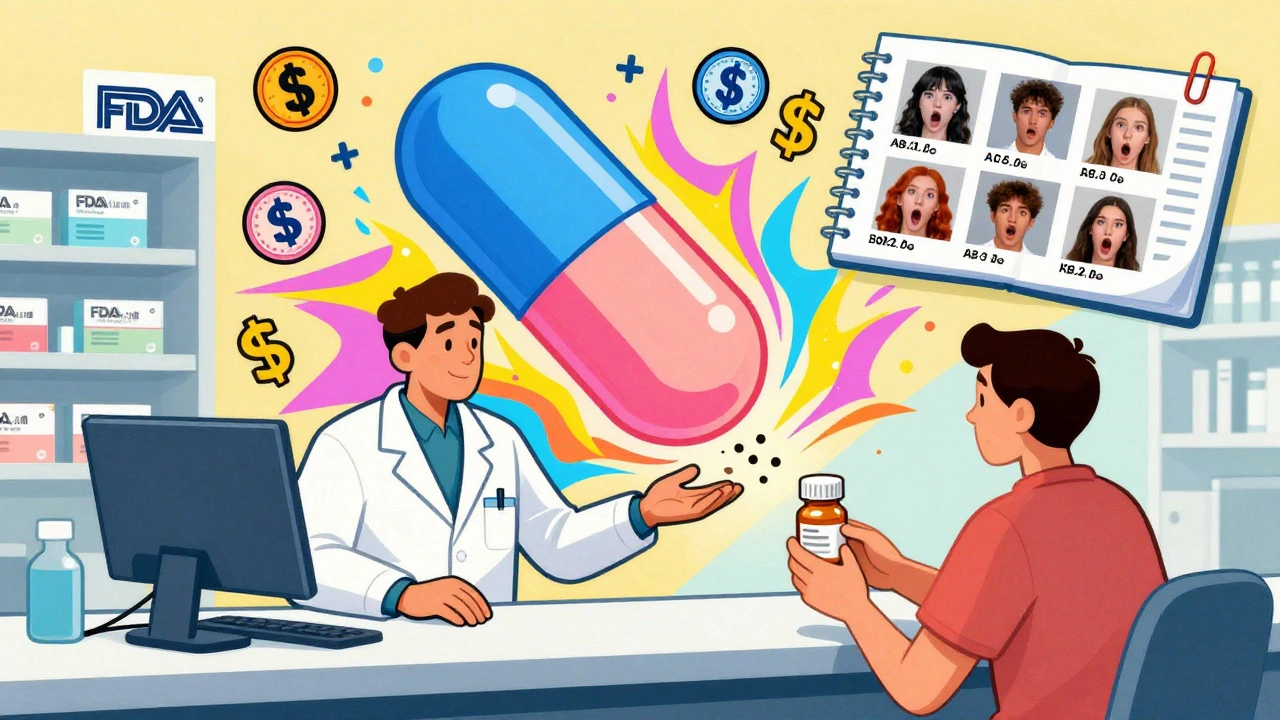
Another man reported his medication changed appearance nine times over 15 years. He kept a photo album of each version. He didn’t trust any of them after a while.
Patients often associate colors with effectiveness. Blue = strong. White = weak. Pink = new. When the color changes, they assume the drug changed too. That’s not just confusion-it’s a public health issue.
Legality: Is This Even Allowed?
Yes. Completely legal. The FDA explicitly permits differences in appearance. In fact, their guidelines say generic drugs must be bioequivalent, not identical. The law doesn’t require matching color, size, or shape. Only the active ingredient, strength, and how the body processes it.
Manufacturers must prove their generic works the same way as the brand. But they’re free to use different fillers, dyes, and coatings. That’s why the outside looks different-even if the inside is the same.
There’s no rule forcing companies to keep the same look across batches. Pharmacies buy the cheapest version available. If Company A’s metformin is 12 cents cheaper than Company B’s this month, the pharmacy switches. No one calls you to warn you. No label says “appearance changed.”
Some countries, like Canada and the UK, have stricter rules. They often require generic manufacturers to match the brand’s appearance as closely as possible. But in the U.S., the law prioritizes cost over consistency.
How Patients Get Hurt
It’s not just about forgetting to take a pill. It’s about losing trust.
When your pill changes, you start to doubt everything. Is this the same drug? Did the pharmacy make a mistake? Is this counterfeit? You might even think your doctor is giving you a cheaper, inferior version.
Reddit threads are full of stories like this: “I almost stopped my blood pressure meds because the pills turned from white to pink. I thought it was a scam.” “My anxiety meds changed shape and I panicked-I thought they’d switched me to something weaker.”
A 2022 survey by the American Pharmacists Association found that 28% of patients expressed serious concern when their pills changed. And 42% had seen at least one change in their regular meds in the past year.
For older adults, people with cognitive issues, or those taking five or more medications, this is especially dangerous. They rely on visual cues to remember what to take and when. A change in color or shape can break that system entirely.
And here’s the worst part: no one tells you. Not the pharmacy. Not the doctor. Not the label. You’re left to figure it out yourself.
What You Can Do to Stay Safe
You don’t have to be confused. You don’t have to stop taking your meds. Here’s what works:
- Keep a medication list-write down the name, dose, and what each pill looks like. Take a photo of the bottle. Save it on your phone. Include color, shape, size, and any letters or numbers on the pill.
- Ask your pharmacist every time you pick up a refill. Say: “Has this changed? What’s different?” They’re trained to explain this. Most now include a note on the receipt when the pill looks different.
- Use a pill identifier tool. Websites like Medscape’s Pill Identifier or the NIH’s Tracking Your Medications let you search by color, shape, and imprint. You can confirm it’s still the right drug.
- Bring your bottles to appointments. Don’t just say “I take metformin.” Show the actual pills. Your doctor can spot a change and check if it’s safe.
- Ask if you can stick with one manufacturer. Some pharmacies can special-order the same generic version each time. It might cost a little more, but it’s worth it if it keeps you on track.
Pharmacies are starting to catch on. In 2025, 78% of U.S. pharmacies now include a notice on refill labels when the pill’s appearance changes. That’s up from 45% in 2018. Independent pharmacies are also running pill identification programs-63% now offer them, compared to 32% in 2020.
What’s Being Done About It?
Doctors and pharmacists have been raising the alarm for years. In a 2014 letter to the ACP Journal, Drs. Uhl and Peters wrote: “Bioequivalent generic drugs that look like their brand-name counterparts enhance patient acceptance.” They were saying it plainly: appearance matters.
The FDA knows this. In 2020, the MODERN Labeling Act gave them more power to update generic drug labels when new safety data emerges. And in September 2025, the FDA proposed new rules under Section 505(o)(4) of the Food, Drug, and Cosmetic Act to require labeling changes based on new safety information-potentially including appearance-related risks.
But the real barrier isn’t regulation. It’s trademark law. As long as brand companies can claim ownership over pill shapes and colors, generics will keep changing. There’s no easy fix. But pressure is building. Some experts now argue that patient safety should override trademark protections when it comes to life-saving drugs.
Until then, the responsibility falls on you.
Bottom Line: Don’t Panic. Be Prepared.
Generic pills changing appearance is legal. It’s common. And it’s dangerous-not because the medicine is bad, but because people stop taking it.
There’s no magic solution. But you have power. You can ask questions. You can track your pills. You can refuse to guess. You can insist on consistency when it matters.
Your health isn’t a cost-cutting exercise. It’s your life. And you deserve to know exactly what you’re taking-no matter what color it is.


Arjun Deva
December 6, 2025 AT 14:32So let me get this right… the government lets drug companies trademark the COLOR of a pill?? Like, who approved this?? I’m not even kidding-next they’ll trademark the taste of aspirin and charge you extra for minty vs. plain!! This isn’t healthcare-it’s corporate theater!! And don’t even get me started on how pharmacies switch suppliers like they’re trading baseball cards!! I swear, if I see one more white oval that’s not my blue oval, I’m going to start taking my meds in secret… like a spy!!
Inna Borovik
December 7, 2025 AT 14:15Statistically, the risk of adverse events from generic substitution is negligible-meta-analyses show non-inferiority in clinical outcomes across 98.7% of cases. But the psychological impact is real, and poorly studied. The cognitive dissonance between visual expectation and pharmacological reality triggers non-adherence more than side effects. This is a behavioral economics problem masquerading as a regulatory one. The FDA’s bioequivalence standard is scientifically sound; the failure is in patient communication infrastructure. We need standardized pill imagery databases linked to EHRs. Not more labels. More integration.
Jackie Petersen
December 8, 2025 AT 21:06Oh wow, so America is the only country where pills change colors? I guess that’s why we’re #1 in healthcare! /s. Meanwhile, Canada makes generics look exactly like the brand so old ladies don’t panic. But nooo, here we gotta save 12 cents per pill and let people end up in the ER because they thought their antidepressant turned into a fake. Classic U.S.A. - put profits before people, then act shocked when people die from confusion. And don’t even get me started on how Big Pharma owns the FDA. Of course they let this happen.
Annie Gardiner
December 9, 2025 AT 20:56What if the pill changing isn’t the problem… what if it’s the illusion of control? We cling to colors and shapes like they’re sacred symbols of safety. But medicine isn’t about aesthetics-it’s about chemistry. Maybe the real crisis is that we’ve turned pharmaceuticals into talismans. We don’t trust the science anymore. We trust the *look*. And when the look changes, we feel betrayed. But the pill never lied. We did. We gave it meaning it never had. Maybe the drug is fine. Maybe we’re the ones that broke.
Rashmi Gupta
December 10, 2025 AT 00:18My aunt in Delhi takes four pills a day. She doesn’t read English. She recognizes them by color and size. Last month, her blood pressure pill turned from green to white. She stopped taking it for two weeks. She didn’t know what to do. No one told her. No one asked. This isn’t a ‘public health issue’-it’s a human failure. We talk about bioequivalence like it’s a math problem. But people aren’t data points. They’re grandmothers who don’t trust a pill that doesn’t look like the one that saved them last year.
Max Manoles
December 11, 2025 AT 14:02I’ve been a pharmacist for 17 years. I’ve seen this happen every single day. Patients panic. Some cry. Others scream. One woman brought me a handwritten chart of every version of her lisinopril since 2018-complete with photos and dates. I keep a binder of pill images now. Every time a generic switches, I print the new image and stick it to the receipt. It takes 45 seconds. But it saves lives. The system is broken, but we can still fix it one bottle at a time. Pharmacists aren’t just dispensers-we’re the last line of defense against confusion. And we’re doing it without pay, without recognition, and without support.
Katie O'Connell
December 13, 2025 AT 02:05It is, indeed, a most lamentable state of affairs. The commodification of pharmaceuticals to the point where aesthetic homogeneity is sacrificed upon the altar of marginal cost reduction constitutes a profound dereliction of fiduciary duty. The FDA’s permissive stance, while technically consonant with statutory mandates, is morally indefensible when weighed against the demonstrable harm inflicted upon cognitively vulnerable populations. One might posit, with considerable justification, that trademark law ought to be subordinated to the Hippocratic imperative-primum non nocere. Alas, the corporate legal apparatus remains impervious to ethical reasoning.
Kumar Shubhranshu
December 15, 2025 AT 00:20Just check the imprint. 10 seconds. Google it. Done. Stop crying. Your pills are fine. You’re just lazy.
Mayur Panchamia
December 16, 2025 AT 21:18They want us to take pills that look like crap just so some CEO can buy another yacht?? No way! This is why India makes the best generics-clean, consistent, and we don’t play games with colors!! USA? You let Pfizer own your medicine?! Pathetic!! I’d rather pay double and get the same damn pill every time!! This isn’t capitalism-it’s corporate terrorism!! And don’t tell me it’s legal-legal doesn’t mean right!! We need a revolution in pill design!!