
Diarrhea isn’t just a quick stomach bug. It’s a symptom with deep roots - and how you handle it depends entirely on whether it’s acute or chronic. If you’ve had three or more loose stools a day for less than two weeks, you’re dealing with acute diarrhea. If it’s been going on longer than 30 days, you’re in the chronic category. These aren’t just labels - they dictate everything from what tests you need to whether you should even take an over-the-counter pill like loperamide.
Acute Diarrhea: The Short, Sharp Shock
Most cases of acute diarrhea come from viruses. Rotavirus used to be the big one, especially in kids, but vaccines have cut those cases by 40-60% in countries with good immunization programs. Now, norovirus and other bugs are more common. Bacteria like Campylobacter or Salmonella show up too, usually after eating undercooked food or drinking contaminated water. Parasites like Giardia are rarer but still happen, especially after hiking or camping.It hits fast. One day you’re fine, the next you’re running to the bathroom every hour. Cramps, nausea, maybe a low fever. But here’s the thing: it usually clears up on its own in 3 to 7 days. That’s why antibiotics are rarely needed. In fact, using them unnecessarily can make things worse by killing off good gut bacteria and increasing the risk of future infections.
The real priority? Hydration. Losing fluids and electrolytes is the danger, not the diarrhea itself. The World Health Organization’s oral rehydration solution (ORS) is the gold standard. It’s not just water with sugar - it’s a precise mix: 75 mmol/L sodium, 75 mmol/L glucose, plus potassium and citrate. This formula cuts death rates from diarrhea by 93% in places with limited medical care. Even in the UK or US, it’s the best way to stay ahead of dehydration. Skip the sports drinks - they have too much sugar and not enough salt.
Forget the BRAT diet. Bananas, rice, applesauce, toast - that’s old advice. Current guidelines say eat normally as soon as you can tolerate it. Your gut needs nutrients to heal. Chicken soup, plain pasta, yogurt - these are fine. Avoid heavy, greasy, or super sugary foods for a day or two, but don’t starve yourself.
Chronic Diarrhea: When It Won’t Go Away
If diarrhea lasts more than 30 days, it’s not a bug. It’s a signal. About 5% of adults in developed countries have chronic diarrhea, and most cases aren’t infectious. The big culprits are things like:- Irritable Bowel Syndrome with diarrhea (IBS-D) - affects 10-15% of people globally. No inflammation, no damage - just a miscommunication between gut and brain.
- Inflammatory Bowel Disease (IBD) - Crohn’s or ulcerative colitis. This is serious. You’ll often lose weight, have bloody stools, and feel tired all the time.
- Bile acid malabsorption - happens after gallbladder removal. Up to 30% of those patients develop chronic diarrhea because bile isn’t being reabsorbed properly.
- Celiac disease - an autoimmune reaction to gluten. Often mistaken for IBS. Around 40% of celiac cases are misdiagnosed that way.
- Medication side effects - antibiotics, metformin, laxatives, even some antidepressants can cause ongoing loose stools.
Chronic diarrhea doesn’t just come with loose stools. Watch for red flags: weight loss, nighttime diarrhea, blood in stool, or fever. These aren’t IBS signs - they point to something structural or inflammatory. That’s why doctors order blood tests (CBC, CRP), stool tests (calprotectin to check for inflammation), thyroid panels, and sometimes a colonoscopy.
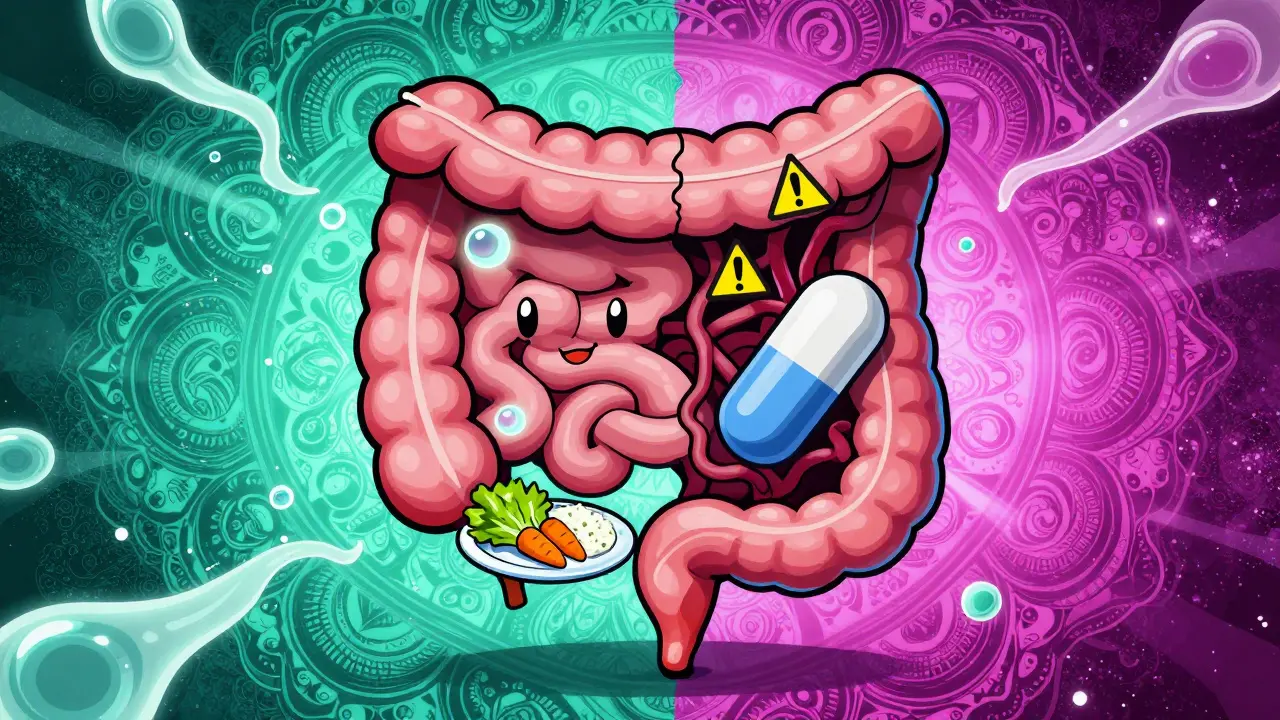
Antimotility Agents: Loperamide and Beyond
When it comes to slowing things down, loperamide (Imodium) is the go-to. It works by slowing the movement of the gut, letting more water get reabsorbed. For acute diarrhea, it’s fine - start with 4mg after the first loose stool, then 2mg after each one after that. Don’t go over 16mg a day.For chronic diarrhea, especially IBS-D or bile acid issues, loperamide can be a game-changer. Patients report going from 10 bathroom trips a day to 2 or 3. But there’s a catch: it’s not a cure. It just masks the symptom. And if you use it long-term, your body can get used to it. Some people end up taking 8mg or more daily just to feel normal - which is dangerous.
Here’s the critical warning: never use loperamide if you have bloody stools, high fever, or suspect an infection like C. diff or Shiga-toxin E. coli. Slowing your gut down in those cases traps the toxin inside, increasing the risk of severe complications like hemolytic uremic syndrome - especially in kids. The FDA has seen 57 deaths linked to loperamide misuse since 2011, mostly from people taking massive doses to get high or self-treat opioid withdrawal.
Bismuth subsalicylate (Pepto-Bismol) is another option. It has mild antimicrobial effects and can help with both diarrhea and nausea. But don’t use it long-term - it can cause ringing in the ears or interact with blood thinners.

What Works Better Than Pills?
For chronic diarrhea, especially IBS-D, the real fix often isn’t a pill - it’s a diet. The low-FODMAP diet, developed by researchers at Monash University, has helped 50-75% of patients. It cuts out fermentable carbs found in onions, garlic, wheat, dairy, and artificial sweeteners. But it’s not a quick fix. You need 6-8 weeks under a dietitian’s guidance to do it right.For bile acid malabsorption, bile acid sequestrants like cholestyramine work better than loperamide. They bind the excess bile in the gut and flush it out. For celiac disease, going gluten-free is the only treatment - and it works. For IBD, you need real medications like anti-inflammatories or biologics.
Probiotics? Some help - especially strains like Saccharomyces boulardii for antibiotic-related diarrhea. But don’t expect miracles. Align, a popular brand, made $287 million in the US in 2022, but evidence for its effect on chronic diarrhea is mixed.
The Hidden Cost of Chronic Diarrhea
It’s not just physical. A 2022 survey by the IBS Patient Network found that 82% of people with chronic diarrhea avoid social events because they’re scared of sudden accidents. People delay seeing doctors for months. One Reddit user shared that it took her 11 months and five doctors before someone finally tested her for celiac disease. She’d been told she had IBS all along.And then there’s the financial toll. In the US alone, diarrhea costs $1.6 billion in medical bills and another $1.2 billion in lost work time each year. Globally, it’s the second biggest killer of children under five - over 500,000 deaths a year. Vaccines like RotaTeq and Rotarix have slashed rotavirus deaths by 80-94% where they’re used - proof that prevention works.
What’s next? Scientists are moving toward personalized treatment. Blood or stool biomarkers might soon tell you whether your diarrhea is from bile acids, food intolerance, or inflammation - so you get the right drug, not just a guess. The FDA approved a new extended-release loperamide in May 2023 to cut abuse risk. WHO updated its ORS formula in 2022 to be even more effective.
But the bottom line hasn’t changed: know the difference. Acute? Hydrate, eat normally, rest. Chronic? Don’t just pop pills - get tested. Your gut is trying to tell you something.
Can I take loperamide for acute diarrhea?
Yes, loperamide is safe for short-term use in acute diarrhea if you don’t have a fever, bloody stools, or signs of a serious infection. Start with 4mg after the first loose stool, then 2mg after each subsequent loose stool. Don’t exceed 16mg in 24 hours. It helps reduce frequency but doesn’t cure the infection.
Is chronic diarrhea always serious?
Not always, but it should never be ignored. While IBS-D is common and not life-threatening, chronic diarrhea can also signal Crohn’s disease, celiac disease, bile acid malabsorption, or even cancer. If it lasts more than 30 days, you need medical evaluation - especially if you’re losing weight, have night-time symptoms, or notice blood in your stool.
Why shouldn’t I use loperamide if I have bloody diarrhea?
Bloody diarrhea often means inflammation or infection - like C. diff, Shiga-toxin E. coli, or ulcerative colitis. Loperamide slows gut movement, which traps toxins and bacteria inside. This can lead to severe complications like toxic megacolon or hemolytic uremic syndrome, especially in children. Always avoid antimotility drugs if you have fever, blood, or severe pain.
What’s the best thing to drink for diarrhea?
The best option is WHO-formula oral rehydration solution (ORS), which has the right balance of salt, sugar, and electrolytes. You can buy pre-made packets or make your own: 1 liter of clean water, 6 level teaspoons of sugar, and half a teaspoon of salt. Avoid soda, juice, or sports drinks - too much sugar makes diarrhea worse.
Can probiotics cure chronic diarrhea?
No, probiotics won’t cure chronic diarrhea, but some may help manage it. Saccharomyces boulardii is proven to reduce antibiotic-associated diarrhea. For IBS-D, certain strains like Bifidobacterium infantis 35624 (found in Align) may reduce bloating and urgency. But they’re not a replacement for diagnosing and treating the root cause.
How long should I wait before seeing a doctor for diarrhea?
For acute diarrhea, wait 3-5 days if you’re otherwise healthy. But see a doctor sooner if you have high fever, bloody stools, signs of dehydration (dizziness, dry mouth, little urine), or if you’re over 65, pregnant, or immunocompromised. For chronic diarrhea - anything lasting more than 30 days - don’t wait. Get evaluated.


Carolyn Whitehead
January 31, 2026 AT 08:06Just had a bout of this last month after that weird street food trip in Mexico
Took loperamide for a day and it saved my sanity
But honestly the ORS was the real MVP
Water with salt and sugar works better than anything fancy
Diksha Srivastava
February 2, 2026 AT 02:55Same! In India we call it 'jholi' and everyone swears by coconut water
But now I know why it's not enough
WHO formula is science magic
Thanks for this post, finally someone explained why IBS feels like a betrayal from your own body
Sarah Blevins
February 4, 2026 AT 00:37There are multiple methodological flaws in this post's epidemiological claims. The 93% mortality reduction statistic from WHO ORS is misattributed to the current formulation when it was derived from the older 90 mmol/L sodium solution. Additionally, the assertion that probiotics have mixed evidence for IBS-D ignores at least five meta-analyses published between 2020 and 2023 that show statistically significant symptom reduction with specific strains. The claim that bile acid malabsorption affects 30% of post-cholecystectomy patients is also inflated - recent endoscopic studies suggest 12-18%.
Furthermore, the post conflates symptom management with diagnosis, which could lead to dangerous self-treatment patterns in vulnerable populations.
Jason Xin
February 5, 2026 AT 17:30Wow, Sarah just dropped a whole textbook chapter in one comment
Meanwhile I’m over here Googling ‘how to make ORS without measuring spoons’
But seriously - this is the kind of post that makes you realize your gut isn’t broken, it’s just screaming for attention
And yeah, loperamide is not a personality trait
Also, why does everyone think yogurt fixes everything? It doesn’t. Unless it’s probiotic. And even then… maybe
Yanaton Whittaker
February 7, 2026 AT 03:05AMERICA NEEDS TO STOP TREATING DIARRHEA LIKE A LUXURY PROBLEM
Back in my day we drank boiled water and prayed
Now people are on low-FODMAP diets and paying $20 for ‘gut health’ gummies
Get off your phone and eat real food
Also WHO? More like WHO CARES, we got our own science here
🇺🇸💪
Kathleen Riley
February 8, 2026 AT 05:54One is compelled to contemplate the ontological implications of gastrointestinal distress as a metaphysical signal - a corporeal semaphore broadcasting the dissonance between biological imperative and modern environmental dissonance.
Indeed, the gut-brain axis, as elucidated by neurogastroenterology, represents not merely a physiological pathway but an existential interface wherein the somatic self negotiates its relationship with an increasingly dysbiotic world.
One must therefore ask: Is chronic diarrhea a disease… or a dignified refusal to participate in a system that refuses to nourish?
Perhaps the true remedy is not loperamide, but a reorientation of one’s entire ethos toward ancestral dietary rhythms - and the quietude of unprocessed sustenance.
Donna Fleetwood
February 9, 2026 AT 23:41I used to think I had IBS for years
Turned out I had celiac
It took me five doctors and three years
One of them told me I was ‘just stressed’
Now I eat gluten-free and my life is different
Don’t let anyone tell you it’s ‘just in your head’
Your body knows
And if it’s been more than 30 days - get tested
You deserve to feel normal
Sazzy De
February 11, 2026 AT 00:06My mom used to say ‘eat rice and stop crying’
Now I know she was half right
Don’t starve yourself but don’t eat pizza either
ORS is cheap and works
And loperamide? Only if you’re stuck on a plane
Otherwise let your gut do its thing
It’s not broken, it’s just mad
Gaurav Meena
February 12, 2026 AT 08:57Bro I took 12mg of loperamide for 3 weeks because I thought I was ‘over it’
Then I started feeling dizzy and my heart skipped
Went to ER
Turns out I was almost overdosing
They said I was lucky
Now I’m on bile acid meds and I finally sleep through the night
Don’t be like me
Stop masking, start diagnosing
And if you’re from India - try cholestyramine, it’s cheaper than you think
❤️