
Choosing Between Gastric Bypass and Sleeve Gastrectomy
When you’re considering bariatric surgery, two names come up again and again: gastric bypass and sleeve gastrectomy. Both are proven to help people lose weight and reverse obesity-related diseases like type 2 diabetes and high blood pressure. But they’re not the same. One changes how your body absorbs food. The other just makes your stomach smaller. And that small difference changes everything - from recovery time to lifelong supplements, from weight loss speed to long-term risks.
How Each Procedure Works
Gastric bypass, also called Roux-en-Y gastric bypass, does two things at once. First, it cuts your stomach into a tiny pouch - about the size of a golf ball. Then, it reroutes your small intestine so food skips most of your stomach and the first part of your intestine. This isn’t just about feeling full faster. It changes your hormones, reduces hunger, and cuts how many calories your body can pull from food. The average Roux limb length in modern surgeries is 119 cm, meaning food travels farther before being absorbed.
Sleeve gastrectomy is simpler. Surgeons remove about 80% of your stomach, leaving a long, banana-shaped tube. That’s it. No rerouting. No intestinal bypass. The new stomach holds only 2 to 5 ounces - enough for a small meal, not a big one. It’s purely restrictive. You eat less because you physically can’t fit more in. The surgery takes about 47 minutes on average, compared to 68 minutes for bypass. That’s a big deal when you’re dealing with anesthesia and recovery.
Weight Loss: Speed and Total Amount
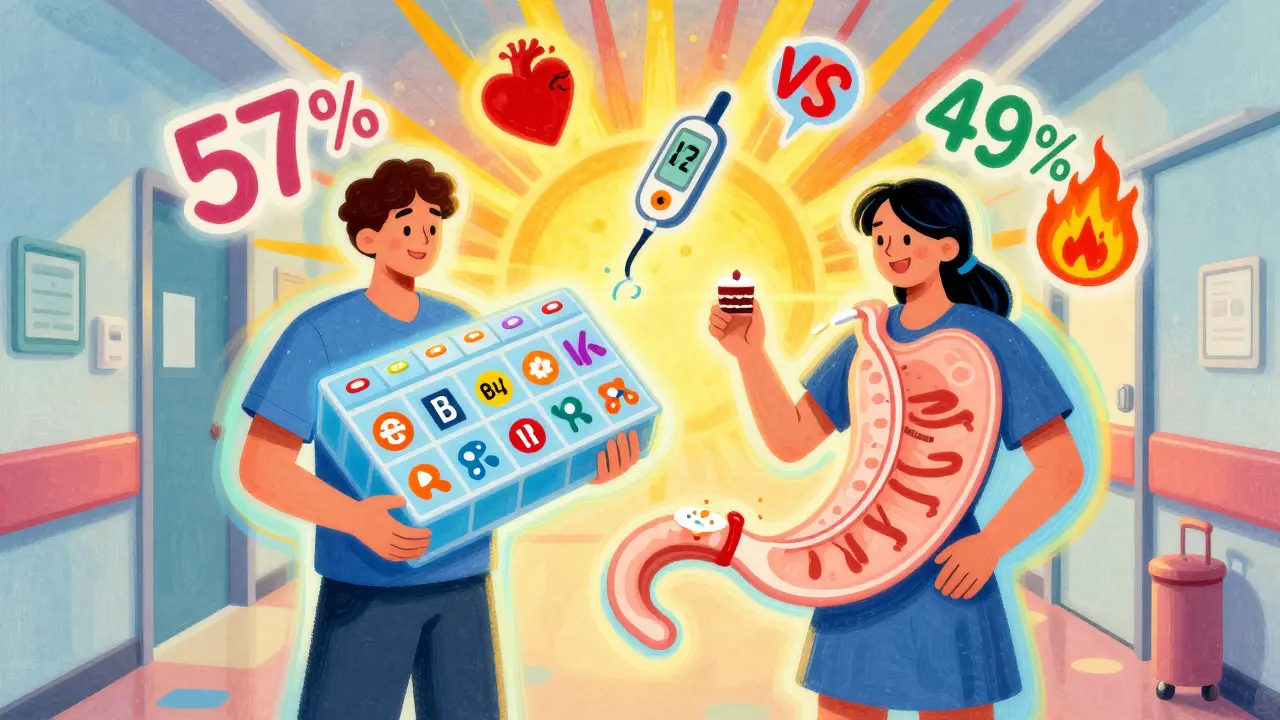
If your main goal is to lose weight fast, gastric bypass usually wins. Studies show patients lose 57% of their excess weight at the five-year mark with bypass, versus 49% with sleeve. At one year, bypass patients often drop 60-80% of excess weight. Sleeve patients lose 60-70% - still impressive - but it tends to happen more slowly. Some people notice the difference early. One patient on Reddit said, “After three months, I was already down 50 pounds with bypass. My friend with the sleeve was still at 20.”
But speed isn’t everything. Sleeve patients often report steadier, more predictable loss. Bypass patients sometimes hit plateaus or even regain weight if they don’t stick to strict eating habits. The metabolic changes from bypass can be powerful, but they’re not magic. You still have to eat right.
Complications and Risks
Here’s where things get tricky. Gastric bypass has higher short-term risks. A 2022 study of over 95,000 Medicare patients found that 5.67% of bypass patients died within five years, compared to 4.27% of sleeve patients. That’s a 32.8% lower risk of death with the sleeve. It’s not a small difference. It’s the kind of number that changes how doctors talk to patients.
Why? Bypass is more complex. More connections inside your belly mean more places things can go wrong - leaks, internal hernias, bowel obstructions. Even though modern techniques have cut hernia rates to under 1%, the risk is still higher than with sleeve. And then there’s dumping syndrome. About half to 70% of bypass patients get it. One moment you’re eating a slice of cake, the next you’re sweating, dizzy, and racing to the bathroom. It’s not dangerous, but it’s awful. And it teaches you quickly: no sugar. No fried food. No sweets.
Sleeve patients don’t get dumping syndrome. But they do get reflux. About 20-30% of sleeve patients develop new or worse GERD after surgery. That’s because the lower part of the stomach, which helps keep acid down, is removed. Bypass, oddly enough, often improves reflux. For people with severe acid reflux before surgery, bypass might be the better choice.
Long-Term Follow-Up and Revisions
Here’s something most people don’t talk about: revision surgery. A 2022 study found that sleeve patients were 3.2 percentage points more likely to need another operation within five years than bypass patients. Why? Weight regain. The stomach can stretch over time. The hormone changes aren’t as strong as with bypass. Some patients start eating more, and the sleeve doesn’t stop them like bypass does.
That’s why some surgeons now offer “sleeve to bypass” conversions. If you’ve had a sleeve and regained 30 pounds, you can go back in and add the bypass part. It’s not simple, but it’s possible. Bypass patients rarely need revisions. Their anatomy doesn’t change much. The rerouting stays put.
Nutrition and Lifelong Supplements
If you hate taking pills, sleeve gastrectomy is easier. You still need a daily multivitamin, calcium, and vitamin D. But because your intestines aren’t bypassed, you absorb most nutrients normally. Most sleeve patients only need annual blood tests.
Gastric bypass? You’re on a lifelong supplement schedule. B12, iron, calcium, folate - all need checking every six months. Deficiencies can lead to anemia, nerve damage, or osteoporosis if ignored. Many bypass patients carry a small pill organizer like a second wallet. One patient said, “I take 12 pills a day. If I forget one, I feel it.”
And here’s a hidden cost: protein. Both procedures require 60-80 grams of protein daily. But bypass patients often struggle more. Their stomach is smaller, and they can’t tolerate large meals. Many end up relying on protein shakes. If you don’t hit your protein goal, you lose muscle, not just fat.
Cost and Insurance
Out-of-pocket costs matter. As of late 2024, sleeve gastrectomy averages $14,500 after insurance pays its 80%. Gastric bypass? Around $19,300. That’s a $4,800 difference. For some, that’s a deciding factor.
Insurance rules haven’t changed much. Most still follow NIH guidelines: BMI 40 or higher, or BMI 35 with conditions like diabetes or sleep apnea. But UnitedHealthcare raised its bar to BMI 45 in January 2024. That’s a big deal for people on the edge. If you’re at BMI 42 with diabetes, you might get approved for sleeve but denied for bypass.

What Patients Really Say
On RealSelf, gastric bypass has a 91% “Worth It” rating. Sleeve is at 89%. Close. But the comments tell a different story.
Bypass patients say: “I lost 120 pounds in a year. My diabetes is gone.” But also: “I can’t eat dessert anymore - ever. And I’m always tired because I forget my iron.”
Sleeve patients say: “I didn’t have to change my life overnight.” But also: “I’m hungry all the time. I thought the surgery would fix that. It didn’t.”
There’s no perfect choice. Only the right one for your body, your habits, and your long-term goals.
Who Gets Which Surgery?
If you have type 2 diabetes, high blood pressure, or severe GERD - and you want the best chance at reversing them - gastric bypass is often the stronger option. The metabolic changes are deeper. Studies show better diabetes resolution with bypass.
If you’re scared of lifelong supplements, hate the idea of dumping syndrome, or just want a simpler surgery with a faster recovery - sleeve might be your fit. It’s the most common procedure now for a reason. It’s safer, cheaper, and still very effective.
And if you’re unsure? Talk to a surgeon who does both. Ask to see their complication rates. Ask how many revision surgeries they’ve done. Don’t let someone push you into one just because it’s popular.
The Bottom Line
Gastric bypass gives you more weight loss and better metabolic results - but it comes with more risks, more pills, and more restrictions. Sleeve gastrectomy is safer, cheaper, and easier to live with - but you might need another surgery later if weight creeps back.
There’s no right answer. Only the answer that fits your life. Choose based on your health goals, your tolerance for risk, and your willingness to stick with lifelong habits - not just the surgery.
Which surgery leads to more weight loss: gastric bypass or sleeve gastrectomy?
Gastric bypass typically leads to more weight loss. At the five-year mark, patients lose about 57% of their excess weight with bypass compared to 49% with sleeve. In the first year, bypass patients often lose 60-80% of excess weight, while sleeve patients lose 60-70% - but at a slower pace. The metabolic changes from bypass help burn more calories and reduce hunger more effectively.
Is sleeve gastrectomy safer than gastric bypass?
Yes, sleeve gastrectomy is generally safer. A 2022 study of over 95,000 patients found a 32.8% lower risk of death within five years for sleeve patients compared to bypass patients. Sleeve also has fewer complications like internal hernias and bowel obstructions. However, sleeve patients are more likely to need a second surgery later due to weight regain or worsening reflux.
Do I have to take vitamins forever after bariatric surgery?
Yes, but the requirements differ. After gastric bypass, you need lifelong supplements for B12, iron, calcium, and folate, with blood tests every six months. After sleeve gastrectomy, you still need a daily multivitamin, calcium, and vitamin D, but annual blood tests are usually enough. The bypass procedure interferes with nutrient absorption, while the sleeve mostly just limits how much you can eat.
Can I get pregnant after bariatric surgery?
Yes, and it’s often safer. Many women see their fertility improve after weight loss surgery. But doctors recommend waiting 12 to 18 months after surgery to get pregnant. This gives your body time to stabilize weight and nutrient levels. Women who’ve had gastric bypass need extra monitoring during pregnancy because of nutrient absorption issues.
What’s dumping syndrome, and does it happen with sleeve gastrectomy?
Dumping syndrome happens when sugary or fatty foods move too quickly from the stomach into the small intestine. It causes nausea, sweating, dizziness, cramps, and diarrhea. It affects 50-70% of gastric bypass patients but is rare with sleeve gastrectomy. That’s because bypass reroutes food past the stomach’s natural control point. Sleeve patients rarely experience this because their stomach structure remains mostly intact.
Why is sleeve gastrectomy more popular than gastric bypass?
Sleeve gastrectomy became the most popular bariatric surgery in the U.S. because it’s simpler, faster, cheaper, and safer. In 2022, it made up 63.2% of all bariatric procedures, while bypass dropped to 27.4%. Patients prefer it because recovery is easier, there’s no dumping syndrome, and it doesn’t require as many supplements. Surgeons also favor it because it’s technically less complex and has lower complication rates.
Can I reverse bariatric surgery if I’m unhappy?
Gastric bypass is rarely reversed because it’s complex and risky. Sleeve gastrectomy cannot be reversed - part of the stomach is permanently removed. However, you can have a revision surgery. For example, a sleeve patient who regains weight can have a bypass added on. This is called a “sleeve-to-bypass revision.” About 15% of sleeve patients need some form of revision within five years.
How long is recovery after each surgery?
Recovery is similar for both: most people go home after one day and return to work in 2-4 weeks. Sleeve patients often feel better faster because the surgery is less invasive. Bypass patients may have more discomfort early on due to internal changes and stricter dietary rules. Both require a liquid diet for the first week, then soft foods for several weeks before moving to regular meals.


Elen Pihlap
January 7, 2026 AT 09:50Emma Addison Thomas
January 8, 2026 AT 19:11Anastasia Novak
January 9, 2026 AT 18:47Jonathan Larson
January 10, 2026 AT 03:29Alex Danner
January 10, 2026 AT 21:56Sai Ganesh
January 12, 2026 AT 20:44Paul Mason
January 12, 2026 AT 22:22Katrina Morris
January 14, 2026 AT 13:05Anthony Capunong
January 15, 2026 AT 13:44