Every year, the U.S. health system saves tens of billions of dollars simply because generic drugs hit the market. These aren’t hypothetical numbers. They’re real dollars taken out of patients’ pockets, insurance bills, and government programs-thanks to FDA approvals of generic versions of brand-name drugs. But how much do those savings actually add up to? And why do some years jump while others dip? The answer isn’t just about how many generics get approved-it’s about which drugs they replace.
What the FDA Actually Measures
The FDA doesn’t track all generic drug savings. It tracks something more specific: the savings generated in the first 12 months after a new generic drug is approved. This is called the "first-year savings from new generic approvals." It’s not the total savings from all generics in use. It’s the immediate drop in price when a brand-name drug loses its monopoly. For example, when a blockbuster drug like Humira or Lipitor loses patent protection, the first generic version can slash the price by 70% or more. The FDA calculates savings by comparing what patients and insurers paid for the brand before the generic arrived, versus what they paid after. They factor in how much the brand price dropped even before the generic fully took over (because manufacturers often lower prices to compete), and how many units of the generic were sold. Here’s what that looked like in recent years:- 2018: $2.7 billion in savings from new generic approvals
- 2019: $7.1 billion - the highest year on record
- 2020: $1.1 billion
- 2021: $1.37 billion
- 2022: $5.2 billion
Total Generic Savings: The Bigger Picture
If you want to see the full impact of generics on the U.S. health system, you need to look beyond the FDA’s first-year numbers. That’s where the Association for Accessible Medicines (AAM) comes in. They track total savings from all generic drugs sold in a calendar year - no matter when they were approved. In 2023, generics saved the U.S. health system $445 billion. That’s not a typo. $445 billion. For context, that’s more than the entire annual budget of the Department of Defense. And it’s up from $408 billion in 2022 and $338 billion in 2020. These savings are spread across every part of the system:- Medicare: $137 billion saved - that’s an average of $2,672 per beneficiary
- Commercial insurers: $206 billion saved - nearly half of all generic savings
- Medicaid: $102 billion saved
- Heart disease: $118.1 billion saved
- Mental health: $76.4 billion saved
- Cancer: $25.5 billion saved
Why the Numbers Don’t Always Match
You might notice something strange: the FDA’s $5.2 billion in 2022 savings doesn’t come close to the AAM’s $408 billion total for the same year. That’s because they’re measuring different things. The FDA looks at the impact of new approvals - the moment a drug goes generic for the first time. The AAM looks at the total savings from every generic drug sold that year, even if it’s been on the market for 10 years. Think of it like this: the FDA is counting the opening of a new grocery store that lowers prices on milk. The AAM is counting how much money everyone saved on milk, bread, eggs, and cereal all year long - because of all the stores, old and new. The FDA’s data tells you when the biggest price drops happen. The AAM’s data tells you how much those drops add up over time. Both matter.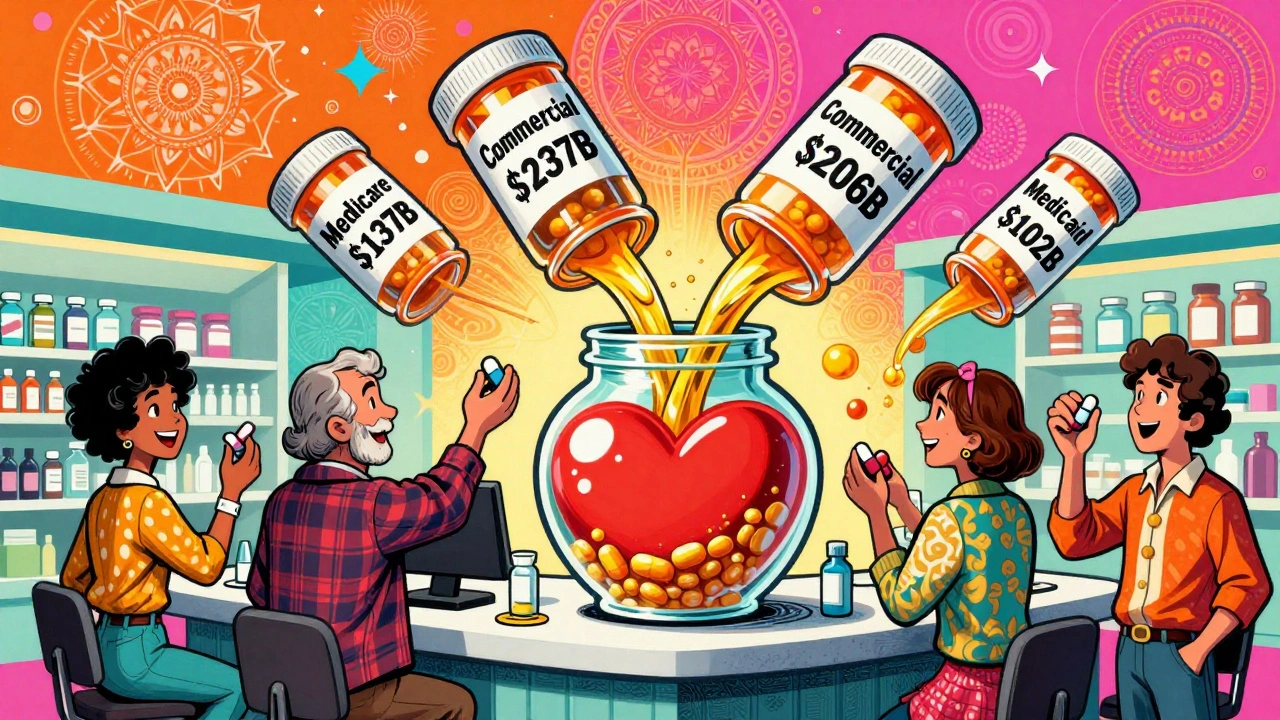
Who Benefits the Most?
Patients pay less. But do they get to keep all the savings? Not always. Pharmacists report that 92% of generic prescriptions are filled for under $20. The average copay is just $6.97. That’s a massive drop from the $300+ some brand-name drugs cost before generics. But here’s the catch: a 2023 Senate Finance Committee investigation found that only 50% to 70% of the savings from generics actually reach the patient. The rest gets absorbed by pharmacy benefit managers (PBMs), insurers, and middlemen through rebate systems. State Medicaid programs see the clearest benefits. California’s Medi-Cal program saved $23.4 billion in a single year from generics. Alaska saved $354 million. The savings scale with population size, but even small states see millions in relief. The biggest winners? People with chronic conditions who need drugs every day. A patient on a generic statin for cholesterol might save $2,000 a year. That’s not just a copay cut - it’s money for groceries, rent, or a child’s school trip.What’s Driving the Growth?
Generics now make up 90% of all prescriptions filled in the U.S. - but only 13.1% of total drug spending. That’s the power of competition. The FDA approved 742 generic drug applications in 2022 alone. That’s up from 633 in 2021. Why? Two big reasons: First, more big drugs are losing patents. Drugs like Humira, Enbrel, and others are hitting their expiration dates, opening the door for generics. Second, the FDA’s Generic Drug User Fee Amendments (GDUFA) have cut approval times. In 2022, 95% of standard applications were reviewed within 10 months - down from years in the early 2000s. The pipeline is full. By 2033, U.S. generic drug revenue is projected to hit $131.8 billion. That means more savings on the horizon.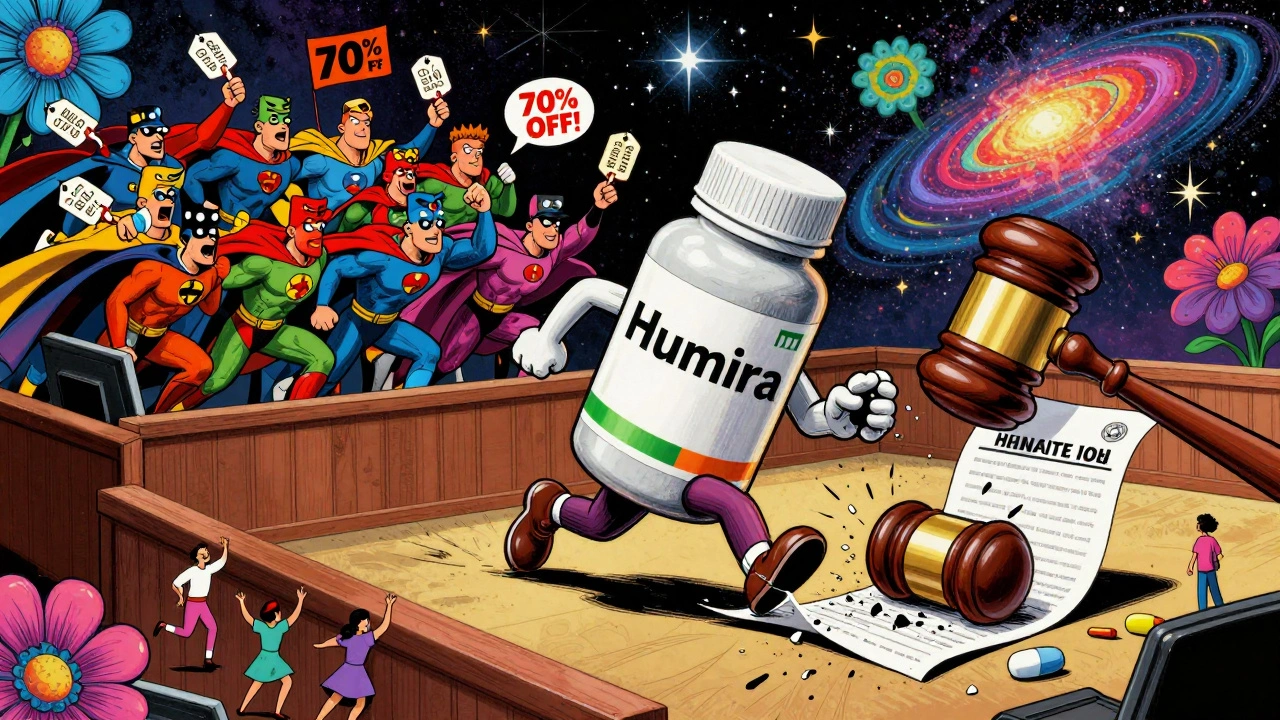
The Challenges Ahead
Not everything is smooth sailing. Some brand-name companies use legal tricks to delay generics - like filing endless patents, or using risk evaluation and mitigation strategies (REMS) to block generic manufacturers from getting samples of the drug. These tactics have slowed down generic entry for drugs like insulin and biologics. Biosimilars - the generic version of complex biologic drugs - are growing, but slowly. As of August 2024, the FDA had approved 59 biosimilars. They’re promising, but they’re still expensive to make and hard to approve. Their savings so far are small compared to traditional generics. And while generics are cheaper, they’re not always cheaper for the patient. If your insurance plan doesn’t cover generics at a low copay, or if your PBM negotiates rebates that don’t get passed on, you might still pay too much.The Bottom Line
The FDA’s annual savings numbers are volatile. Some years, they’re in the billions. Others, they’re barely over a billion. But the AAM’s total savings tell a clearer story: generics are the single biggest driver of cost control in U.S. health care. In 2023, they saved $445 billion. That’s $445 billion that didn’t go to drug companies, PBMs, or insurers - it went back to families, to hospitals, to state budgets. That’s not just policy. That’s people living healthier lives because they could afford their meds. The next time you hear about a new drug being approved, ask: Is it a brand-name drug? Or is it a generic? Because the answer could save someone thousands of dollars - and maybe even their life.How are savings from generic drug approvals calculated?
The FDA calculates savings for each new generic approval by comparing the brand-name drug’s price before the generic entered the market to the price after. They multiply the price difference by the volume of generic sales and add any price reductions the brand manufacturer made to compete. This gives the total savings generated in the first 12 months after approval.
Why was 2019 the highest year for generic savings?
2019 saw the highest savings because multiple high-revenue brand drugs lost patent protection at once. The biggest contributors were Repatha and Eliquis, two blockbuster drugs with annual sales over $5 billion each. When generics entered, prices dropped by 70-80%, generating $1.8 billion and $1.6 billion in savings respectively - nearly half of the year’s total $7.1 billion.
Do generic drugs always lower patient out-of-pocket costs?
Not always. While generics are significantly cheaper than brand drugs, pharmacy benefit managers (PBMs) often negotiate rebates with manufacturers that don’t get passed to patients. A 2023 Senate investigation found only 50-70% of generic savings reach consumers directly. Patients may still pay high copays if their insurance plan doesn’t prioritize generics or if rebates are kept by middlemen.
What’s the difference between FDA and AAM savings data?
The FDA tracks savings from new generic approvals in their first 12 months on the market. The AAM tracks total savings from all generic drugs sold in a calendar year, regardless of when they were approved. The FDA shows the impact of new competition; the AAM shows the full, cumulative effect of generics in the system.
How much do generics save Medicare beneficiaries?
In 2023, generics saved Medicare beneficiaries $137 billion, or an average of $2,672 per beneficiary. This includes savings from common drugs for diabetes, heart disease, high blood pressure, and depression - conditions that require daily medication. Without generics, many seniors would face unaffordable costs.
Are biosimilars making a big impact on savings yet?
Not yet. While the FDA has approved 59 biosimilars as of August 2024, their adoption has been slow due to high development costs, complex manufacturing, and patent challenges from brand manufacturers. Their total savings so far are still small compared to traditional small-molecule generics, which have been saving billions annually for decades.
What’s projected for future generic savings?
The Association for Accessible Medicines projects cumulative savings from generics and biosimilars will reach $3.9 trillion between 2014 and 2028. That means annual savings could hit $450-500 billion by the late 2020s. This growth is driven by more blockbuster drugs losing patents, an aging population, and continued pressure on payers to cut costs - as long as barriers to generic entry are addressed.



Ben Greening
December 9, 2025 AT 13:52The FDA's first-year savings metric is fascinating, but it's like judging a marathon by the first 100 meters. The real story is in the cumulative effect - $445 billion in 2023 alone is staggering. That’s not policy noise; that’s systemic relief.
It’s easy to overlook how many people can afford insulin or statins now because of generics. The numbers don’t lie - they just need context.
And yes, PBMs are still sucking up a chunk of those savings, but the fact that copays are under $7 for 92% of prescriptions? That’s a win.
More transparency on rebate structures would help, but we’re clearly moving in the right direction.
Generics aren’t perfect, but they’re the closest thing we have to healthcare equity in this system.
Neelam Kumari
December 10, 2025 AT 02:36Oh wow. Another love letter to Big Pharma’s cheap knockoffs. Let me guess - you also think generic aspirin is ‘revolutionary’?
Meanwhile, India exports 40% of the world’s generics and you’re acting like the FDA invented medicine. You people act like generics are some miracle, not the result of decades of global manufacturing infrastructure built by people who don’t get credit.
And don’t get me started on how U.S. patients still pay more than Europeans for the same pills. This isn’t a victory lap - it’s a cover-up.
David Palmer
December 11, 2025 AT 02:59Bro, I just paid $4 for my blood pressure med. Like, four bucks. Last year it was $180. That’s not savings, that’s magic.
Also, why do PBMs get to keep the rest? That’s wild. My grandma’s copay’s low but her insurance company’s profit’s higher than my rent. Something’s off.
And yeah, I don’t care if it’s ‘biosimilar’ or ‘generic’ - as long as it doesn’t make me cry at the pharmacy counter, I’m good.
Doris Lee
December 11, 2025 AT 16:25This is the kind of post that reminds me why I still believe in systems that work.
Generics aren’t just cheaper - they’re life-changing. I’ve seen friends choose between meds and groceries. Now? They take their pills. They sleep. They show up for their kids.
Let’s not get lost in the numbers. The real win is the quiet moments: a diabetic checking their levels without panic, a mom filling a prescription without a second thought.
Keep pushing for transparency. Keep pushing for access. This matters.
Michaux Hyatt
December 12, 2025 AT 22:28Great breakdown. A lot of folks don’t realize the FDA’s numbers are just the tip of the iceberg.
The AAM’s $445B figure is what actually keeps the system from collapsing. Medicare alone saved $137B - that’s enough to fund every rural clinic in Texas for two years.
And the fact that 90% of prescriptions are generics? That’s market competition at its best. No subsidies, no handouts - just price pressure forcing innovation.
One thing to watch: biosimilars. They’re slow, but if we crack the cost barrier, we could see even bigger drops for cancer and autoimmune drugs.
Raj Rsvpraj
December 14, 2025 AT 19:36HAHAHAHAHAHAHA! You Americans think you’re so smart with your ‘FDA approvals’?!
India makes 70% of the world’s generics - and we do it cheaper, faster, and without your bureaucratic red tape!
And you think $445 billion is impressive? Try looking at our drug exports - $25 billion in 2023 alone - and you’ll see what real healthcare innovation looks like.
Your PBMs? Your insurance middlemen? Your patent trolling? Pathetic.
We don’t need your ‘first-year savings’ metrics - we just make medicine and ship it.
Stop acting like you invented affordability.
And yes, I’m proud. We’re the pharmacy of the world. You’re just the customer.
Frank Nouwens
December 15, 2025 AT 10:07It is of considerable interest to note that the variance in annual savings, as documented by the FDA, is directly attributable to the temporal clustering of patent expirations.
One must distinguish between the marginal impact of new generic entrants and the aggregate, sustained effect of market saturation.
Furthermore, the role of Pharmacy Benefit Managers in capturing a non-trivial proportion of cost reductions remains a structural inefficiency of the pharmaceutical supply chain.
It is also noteworthy that the AAM’s aggregate figures, while substantially larger, do not reflect the same temporal granularity - a critical distinction for policy evaluation.
One might reasonably conclude that both datasets are necessary, but insufficient in isolation.
Transparency in rebate structures would significantly enhance patient equity.
Moreover, the regulatory efficiency gains under GDUFA are laudable and merit continued investment.
One must not overlook the geopolitical dimension: the global supply chain for active pharmaceutical ingredients remains vulnerable.
These are not merely economic metrics - they are public health indicators.
Aileen Ferris
December 16, 2025 AT 08:22ok but what if the generic is made in a factory that uses child labor? like… did anyone check? i mean the price is low but like… what’s the cost?
also why does my insurance still make me pay $15 for a pill that costs 2 cents to make? conspiracy?
also i read somewhere that the fda approves generics without testing them? is that true? or am i just paranoid?
also why are all the big savings from 2019? did they just save up all the drugs and release them at once? like a cartel?
Rebecca Dong
December 17, 2025 AT 17:34THEY’RE LYING TO YOU.
Do you know what happens to the ‘savings’? They don’t go to patients.
They go to the same people who made the brand-name drugs in the first place - through shell companies, patent evergreening, and PBM kickbacks.
And the FDA? They’re in bed with Big Pharma.
That $445 billion? It’s a smoke screen. The real cost? Your data. Your privacy. Your future.
They’re turning your medicine into a financial instrument.
And the biosimilars? They’re not slow - they’re being BLOCKED.
Why? Because the same companies that own Humira also own the biosimilar patents.
It’s not a system.
It’s a pyramid scheme with pills.
Nikki Smellie
December 19, 2025 AT 04:02Have you ever wondered why the FDA approves generics so fast now?
Because they’re being pressured by foreign governments to open the floodgates - and those countries are using the data to build their own bioweapons.
Think about it: generic drugs are made with the same chemical formulas as the originals.
What if someone reverse-engineers the manufacturing process to create a targeted toxin?
And the $445 billion in savings? That’s not saving lives - it’s weakening the U.S. pharmaceutical defense infrastructure.
Who benefits? China. Russia. Maybe even Iran.
They get the formulas. We get the bills.
And your $4 statin? It might be contaminated with unapproved compounds.
Ask yourself - is affordability worth national security?
They’re not lowering prices.
They’re lowering standards.
Queenie Chan
December 20, 2025 AT 12:10I love how this post doesn’t mention the elephant in the room: the fact that generics are often made from the same raw materials as the brand drugs - just in a different country, with different quality controls.
And yet we treat them like they’re magic beans.
What if the ‘savings’ come at the cost of inconsistent bioavailability? What if a patient gets a batch from India one month and a batch from China the next, and their body reacts differently?
It’s not just about price - it’s about predictability.
And don’t get me started on the fact that 80% of the active ingredients in U.S. generics come from just two countries.
That’s not a supply chain.
That’s a vulnerability.
Generics are brilliant - but they’re also a house of cards built on global instability.
And we’re all just hoping the wind doesn’t pick up.
Jack Appleby
December 22, 2025 AT 10:12Let’s be precise: the FDA’s methodology for calculating first-year savings is statistically robust, utilizing a difference-in-differences estimator with propensity score matching to account for pre-generic price trends.
However, the AAM’s aggregate figures are fundamentally flawed - they conflate savings from price reductions due to market saturation with those attributable to new generic entry.
Furthermore, the assertion that ‘copays are $6.97’ is misleading - it ignores the fact that many patients are subject to coinsurance or deductible structures where the nominal copay is irrelevant.
And the Senate Finance Committee’s 50–70% patient benefit range? That’s based on a 2022 GAO report that excluded rebates tied to formulary placement - a critical omission.
Moreover, the claim that generics saved $118B for heart disease is tautological - it’s merely the difference between brand and generic prices multiplied by volume, without adjusting for utilization changes.
One must also consider the opportunity cost: the billions spent on litigation to delay generics could have funded R&D for next-generation therapies.
And finally - the ‘$445B’ figure is inflated by including OTC generics, which are not part of the prescription drug system.
Context matters. Precision matters. Otherwise, you’re not informing - you’re performing.
Ben Greening
December 24, 2025 AT 09:19Re: the biosimilar bottleneck - it’s not just about cost. It’s about trust.
Doctors are hesitant to switch patients from a biologic they’ve been on for years, even if the biosimilar is FDA-approved.
It’s not irrational. It’s risk-averse.
And until we have real-world data showing biosimilars perform identically over 5+ years, that hesitation won’t fade.
Meanwhile, the real hero here is the generic statin - $4 a month, 30 years of proven safety, and a million lives saved.
Let’s not forget the quiet giants.