Older adults aren’t just getting older-they’re getting more complex health needs. By 2026, nearly one in five Americans will be 65 or older. That means doctors, nurses, and caregivers are seeing more people managing diabetes, heart disease, arthritis, and multiple medications. But here’s the problem: senior patient education often fails them. Too much jargon. Too small print. Too fast. And too little testing with real people.
It’s not that older adults don’t want to understand. It’s that most health materials were written for someone who reads at a 7th or 8th grade level. But 71% of adults over 60 struggle with basic print materials, according to CDC data. That’s not laziness. That’s poor design.
What Makes Good Senior Patient Education Materials?
Effective materials don’t just simplify words-they rethink how information is delivered. The National Institute on Aging says the gold standard is writing at a 3rd to 5th grade reading level. That means short sentences. No medical terms like “hypertension” or “polypharmacy.” Say “high blood pressure” and “taking too many pills.”
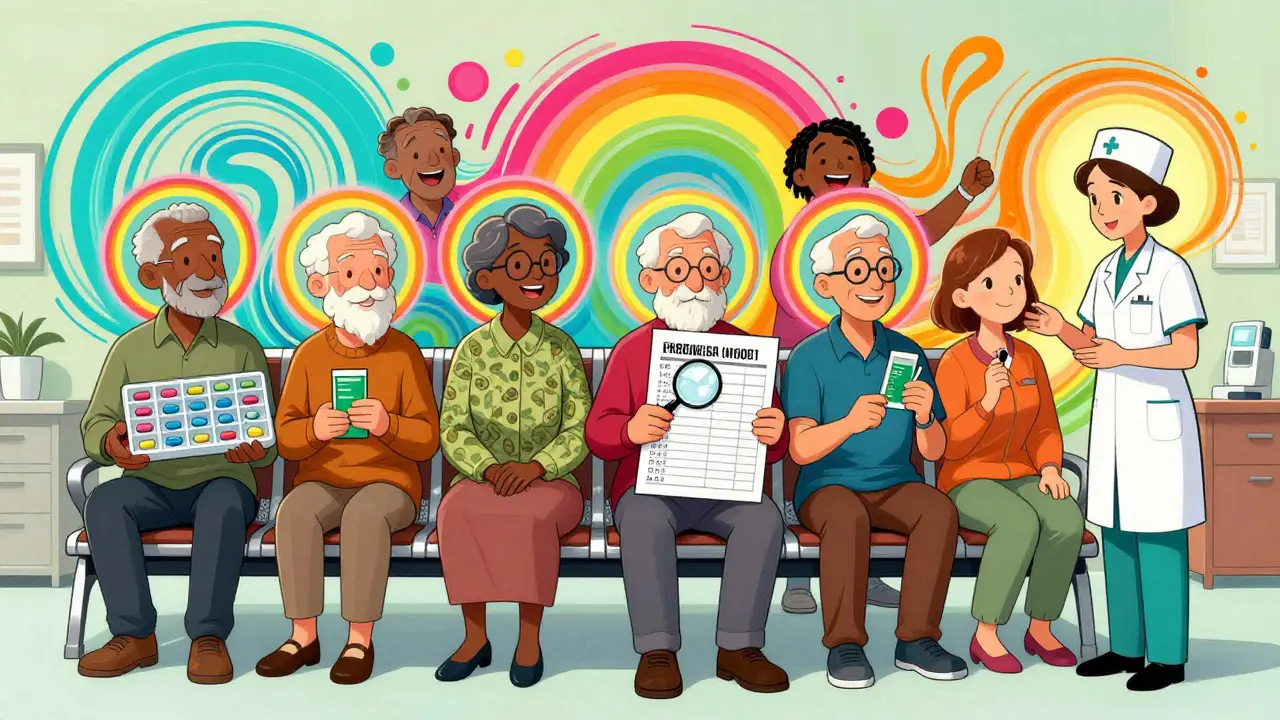
Font size matters. At least 14-point. No smaller. And use easy-to-read fonts like Arial or Verdana-not Times New Roman or fancy script. Letters like “1,” “l,” and “I” can look the same to someone with fading vision. That’s why materials should say “1 as in one,” “l as in lion,” “I as in ice.”
Color contrast is just as important. Black text on white paper works best. Avoid pastel backgrounds or light gray text. People with macular degeneration or cataracts need high contrast to see clearly.
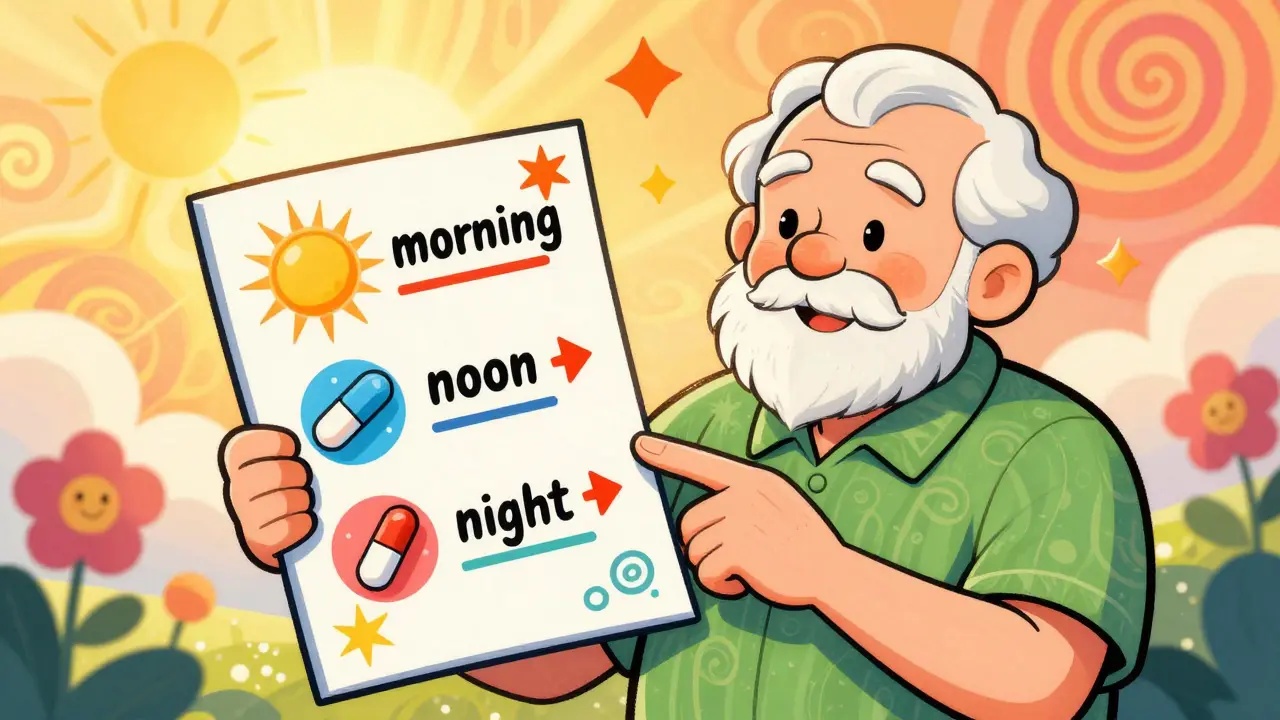
And pictures? Not just decoration. A drawing of a pill organizer with arrows showing morning, noon, and night helps more than a paragraph of instructions. A 2023 study in the Journal of the American Geriatrics Society found that illustrated step-by-step guides improved medication adherence by 37% compared to text-only sheets.
How Materials Are Tested-Before They’re Used
Too many health centers print brochures and hand them out without ever asking an older adult what they think. That’s a mistake. The HealthPartners Institute and CDC both say: test every piece with at least 15 people from the target group.
Here’s how it works: Give a senior a handout about managing blood sugar. Ask them to explain back what they learned. If they say, “Take the white pill with breakfast,” but the sheet says “take metformin 500mg with morning meal,” then the material failed. It’s not about memory-it’s about clarity.
This process is called “teach-back.” It’s simple. You say it. They say it back. If they get it wrong, you fix the material-not the patient. The American Geriatrics Society says every educational tool should include a teach-back step. And it works. A 2022 study in Patient Education and Counseling found that doctors who used teach-back spent just 2.7 extra minutes per visit but saw 31% better understanding.
Where to Find Trusted Senior Health Materials
You don’t have to build everything from scratch. Several trusted sources offer free, ready-to-use resources designed specifically for older adults.
- HealthinAging.org - Run by the American Geriatrics Society, this site has over 1,300 free materials. Topics range from “How to Take Your Pills Safely” to “Dealing with Memory Changes.” All are written at a 3rd-5th grade level and reviewed by older adults.
- MedlinePlus Easy-to-Read - The National Library of Medicine labels materials with the Health Education Materials Assessment Tool (HEMAT). Their collection includes 217 resources, from “Understanding Your Blood Pressure” to “Staying Active After 65.”
- National Institute on Aging (NIA) - Their “Talking With Your Older Patients” guide is used by clinics nationwide. It includes sample conversations, visual aids, and tips for explaining complex topics like advance directives or fall prevention.
- CDC Healthy Aging - Their “Developing Materials for Older Adults” toolkit gives step-by-step design rules: font size, color, layout, and testing protocols.
These aren’t just websites. They’re toolkits. You can download PDFs, print them in large font, or even share them via tablet. Many include audio versions now too.
Why Digital Isn’t Always the Answer
Telehealth usage among seniors jumped from 17% in 2019 to 68% in 2023. That sounds good-until you realize many older adults don’t know how to use video apps, click links, or find their prescription refill portal.
Just because something is digital doesn’t mean it’s accessible. A 2023 CDC report found that 58% of adults over 70 don’t feel confident using health apps or websites. That’s why the best programs still use paper. Printed materials are reliable. They don’t need Wi-Fi. They don’t crash. And they can be taped to the fridge.
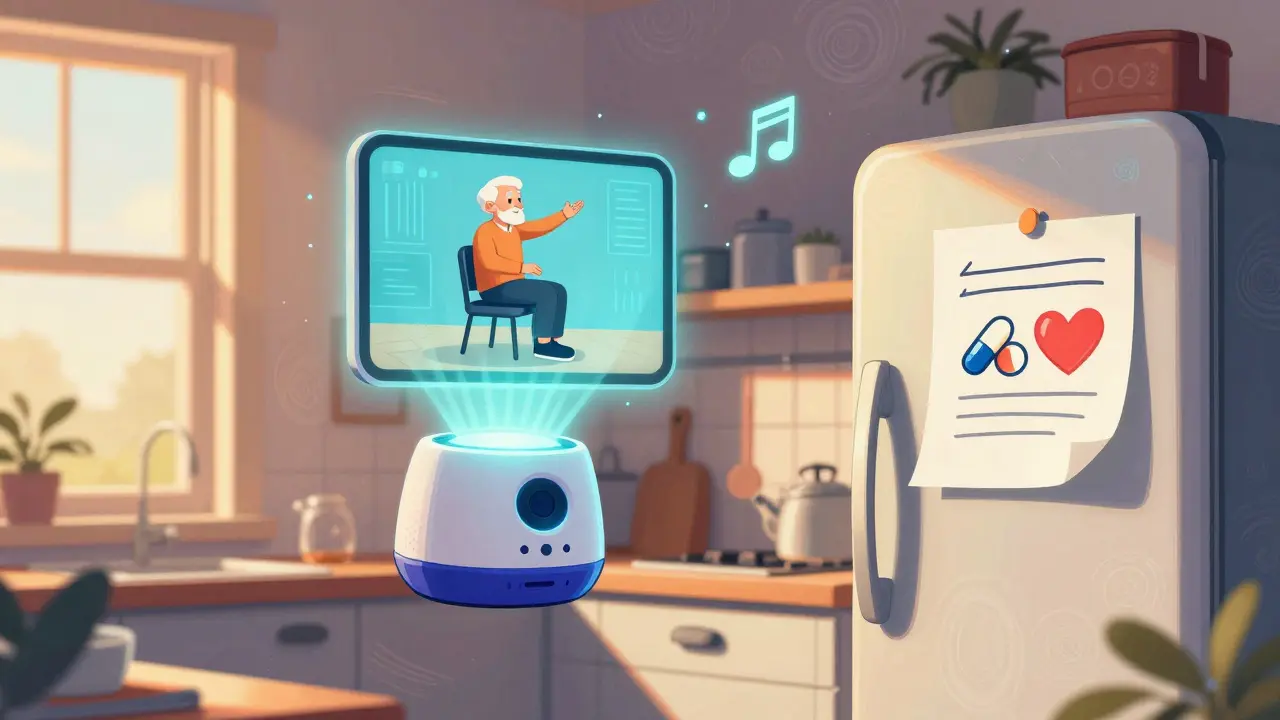
But digital tools can help-when designed right. The NIA’s updated Go4Life program now includes voice-activated exercise guides. You say, “Show me the chair stand,” and it plays a video. No buttons to press. No menus to navigate.
The key? Offer choices. Some seniors prefer paper. Others want a video on their tablet. Give both. And never assume they know how to use technology.
What Happens When You Get It Right
Good senior patient education doesn’t just make people feel better-it saves money and lives.
Hospitals that use universal health literacy practices (clear language, teach-back, large print, visuals) see 22% fewer emergency visits from older patients, according to the Agency for Healthcare Research and Quality. Medicare patients in these programs have 14.3% fewer readmissions. That’s about $1,842 saved per person.
And it’s not just numbers. Amanda C., a caregiver from San Diego, wrote on HealthinAging.org: “I couldn’t believe how much information they made easy to understand. I finally felt like I could help my dad.”
When materials are clear, older adults ask more questions. They take their pills. They show up for appointments. They avoid falls. They live longer.
Why So Many Clinics Still Get It Wrong
Here’s the hard truth: only 28% of U.S. healthcare systems have fully adopted health literacy best practices, even though the evidence is strong. Why?
Staff are stretched thin. A 2023 AMA survey found 78% of providers say they don’t have time to redesign materials or train staff. And 65% of community health centers say they can’t afford to hire specialists to create custom resources.
But you don’t need a big budget. Start small. Pick one common condition-like high blood pressure-and rewrite one handout. Use HealthinAging.org as a template. Test it with three seniors. Fix what’s confusing. Print it. Use it. Then do it again.
The National Quality Forum now includes health literacy in three of its 12 top healthcare quality measures. That means insurers and regulators are watching. Clinics that ignore this aren’t just being careless-they’re risking compliance.
What’s Next: Personalized Education
The future of senior patient education isn’t just big fonts and pictures. It’s smart tools that adjust to each person.
The NIH is funding a $4.2 million project to build AI-driven materials that change based on how someone learns. If a patient struggles with memory, the system repeats key points. If they have trouble hearing, it adds captions. If they read slowly, it breaks text into smaller chunks.
But here’s the catch: even the smartest AI can’t replace a human voice. A nurse saying, “Let me show you again,” or a family member reading aloud, makes all the difference.
The goal isn’t to replace people with technology. It’s to give people better tools to help each other.
By 2027, Medicare spending on health literacy programs is expected to jump from $187 million to $312 million. That’s because we finally know: clear communication isn’t a luxury. It’s care.


Colin Pierce
January 29, 2026 AT 12:02I’ve been working in geriatric care for 12 years, and this post nails it. I used to hand out tiny-print brochures until I saw a 78-year-old man squinting at his diabetes sheet like it was a secret code. We switched to 14-point Arial, added simple icons for morning/afternoon/evening pills, and boom - his A1C dropped. No magic, just respect for how people actually experience info.
Also, teach-back isn’t just a buzzword - it’s the difference between someone saying ‘I got it’ and actually knowing what to do. I always ask, ‘Can you show me how you’d set up your pill box?’ If they hesitate, we rewrite.
Timothy Davis
January 30, 2026 AT 04:40Let’s be real - most of this is common sense wrapped in a 20-page CDC report. You think older adults can’t read? No, they just don’t care enough to decode corporate health jargon. The real issue? Providers don’t want to spend 3 minutes explaining. So they slap on a 12-point Times New Roman PDF and call it ‘accessible.’
And don’t get me started on ‘audio versions.’ Half the seniors I know can’t figure out how to turn on their TV. You think they’ll tap a button to hear ‘take metformin’? Please. Paper on the fridge works. Always has. Always will.
Rose Palmer
January 31, 2026 AT 18:44While I appreciate the empirical grounding of this piece, I must emphasize the systemic inertia that continues to impede implementation. The evidence base is unequivocal: health literacy interventions reduce readmissions, improve adherence, and mitigate adverse events. Yet, structural barriers - including reimbursement models that penalize time-intensive patient education - remain unaddressed.
Moreover, the reliance on pre-existing templates, while pragmatic, risks homogenization. Individual cognitive profiles, cultural contexts, and linguistic preferences are not adequately accounted for in standardized materials. A one-size-fits-all approach, even if simplified, remains fundamentally inadequate.
Future initiatives must integrate dynamic, person-centered design protocols, validated through longitudinal, community-based participatory research. Only then can we move beyond compliance to true equity in health communication.
Kathy Scaman
February 1, 2026 AT 20:35My grandma used to keep all her meds in a cereal box because the original bottle labels were too tiny. She’d call me every week asking what the blue pill was for. I printed out big pictures from HealthinAging.org, taped them to the box, and now she doesn’t even need me anymore. It’s wild how such a simple fix changes everything.
Also, she loves the voice-guided exercise videos. Says it’s like having a yoga teacher in her living room. No buttons. Just say ‘show me the chair stand’ and boom - there it is. Tech can be nice when it doesn’t make you feel dumb.
Rhiannon Bosse
February 3, 2026 AT 10:33So let me get this straight - we’re spending millions on ‘accessible’ materials while Medicare is secretly tracking seniors’ pill intake through smart bottles and AI? And no one’s talking about this?
Who’s really behind these ‘free’ resources? Big Pharma? The CDC? Are we being trained to trust paper over people? I’ve seen the forms - they all have tiny QR codes in the corner. Scan it, log in, give your Social Security, and bam - now you’re in their database.
Meanwhile, my aunt got her blood pressure sheet with a ‘teach-back’ form that had a 12-question survey at the bottom. ‘Do you feel empowered?’ Yeah, I feel like a lab rat. This isn’t care. It’s surveillance with a smiley face.
fiona vaz
February 5, 2026 AT 04:43This is the kind of post that reminds me why I got into this field. I work in a rural clinic where most patients are over 70 and on fixed incomes. We started using the NIA templates last year - no cost, no training needed. One woman told me, ‘I didn’t know I could ask for bigger print.’ I almost cried.
Small changes matter. A bigger font. A picture of a pill organizer. Saying ‘high blood pressure’ instead of ‘hypertension.’ These aren’t just ‘accommodations’ - they’re basic dignity. Thank you for saying this so clearly.
Sue Latham
February 6, 2026 AT 03:19Ugh, another ‘senior-friendly’ guide. I swear, every healthcare org thinks they’re the first to figure out ‘use big fonts.’ Newsflash: my 82-year-old uncle reads War and Peace on his Kindle. He just doesn’t care about your brochures.
Stop infantilizing older adults. They’re not toddlers. They’ve lived through the Cold War, the internet boom, and three recessions. If they can’t figure out a PDF, maybe they just don’t want to. Not every old person needs a cartoon of a pill.
John Rose
February 7, 2026 AT 18:57One thing this post doesn’t address is the role of family caregivers in reinforcing material. Many seniors rely on adult children to interpret health information. But caregivers are often overwhelmed, underinformed, or geographically distant.
What if we designed materials not just for patients, but for the people who help them? A one-page summary with bullet points, a QR code to a 90-second video, and a phone number to call with questions - that’s the real win.
I’ve seen clinics do this. They print the caregiver version on the back of the patient sheet. Simple. Effective. And it doesn’t cost a dime.