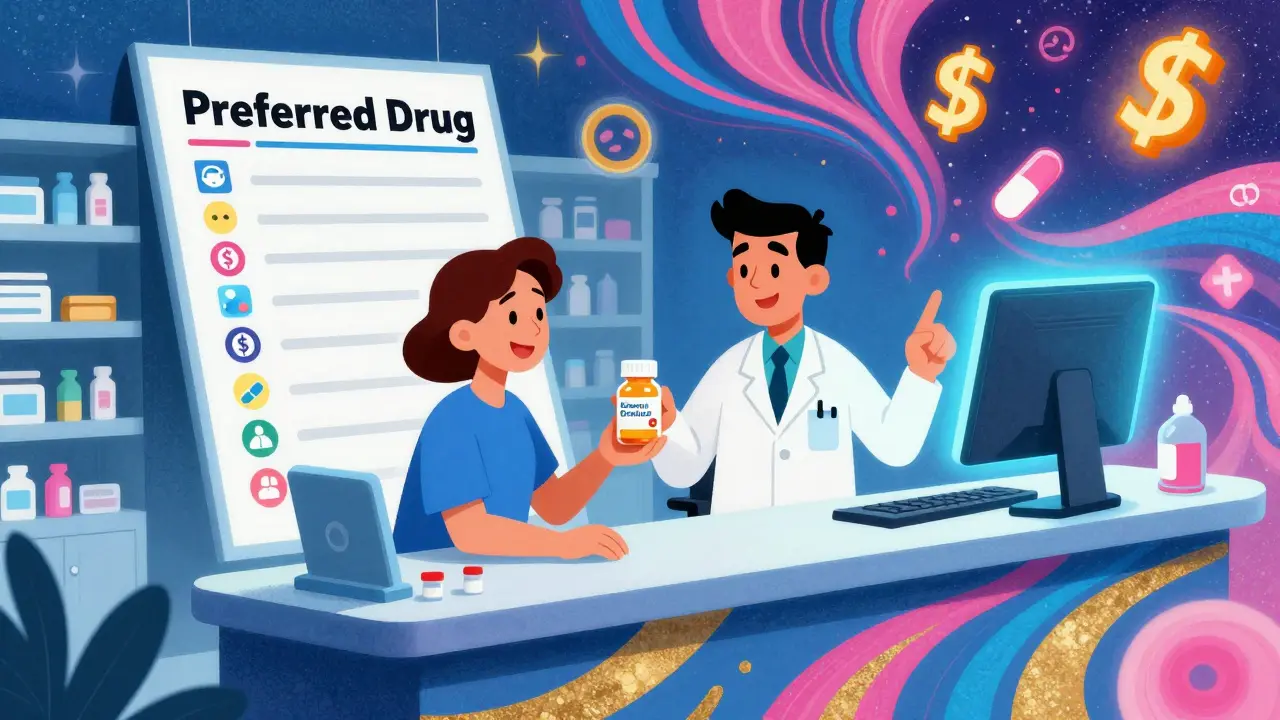
When you pick up a prescription, you might not think about whether it’s brand name or generic. But behind the counter, state policies are quietly pushing pharmacists and doctors to choose the cheaper option. In 2026, generic prescribing incentives are one of the most effective tools states have to lower drug spending - without sacrificing care. These aren’t just suggestions. They’re rules, financial nudges, and legal frameworks designed to make generics the default choice.
How States Push Doctors and Pharmacies Toward Generics
Most states don’t force doctors to write only for generics. Instead, they make it easier - and cheaper - to choose them. The main tool? Preferred Drug Lists (PDLs). As of 2019, 46 out of 50 states used these lists in their Medicaid programs. A PDL is basically a ranked catalog of drugs that the state prefers. If your doctor prescribes a drug not on the list, you might have to pay more, or the pharmacy might need special approval before filling it. This puts pressure on doctors to pick from the approved list - and most of the time, that’s the generic version. States don’t just set these lists and forget them. Twenty states review their lists every year. Ten do it quarterly. That means if a new brand-name drug hits the market with a fancy ad campaign, but a cheaper generic already exists, the state can quickly block it from being covered without extra cost. It’s not about banning drugs. It’s about steering care toward what works and costs less.Why Copay Differences Matter More Than You Think
Here’s something most people don’t realize: the difference in price between a brand-name drug and its generic isn’t always the biggest factor. What really changes behavior is what you pay out of pocket. States have learned that if your copay for a generic is $5 and your copay for the brand is $30, you’re far more likely to choose the generic - even if your insurance covers both. In 2000, the Kaiser Family Foundation found that while pharmacies were making only 8 cents more per generic prescription than a brand-name one, patients were paying much higher copays for brands. That gap - not the pharmacy’s profit - was what drove switching. Today, that gap is wider. Many states set generic copays at $5 or less, while brand-name copays can be $20, $40, or even higher. The message is clear: choose the generic, save money. This isn’t just about Medicaid. Employers and private insurers follow the same model. In 1998, 29% of employers required generic use through their pharmacy benefit managers. That number has only grown. The real win? Patients who switch to generics save an average of 80% on their monthly drug costs.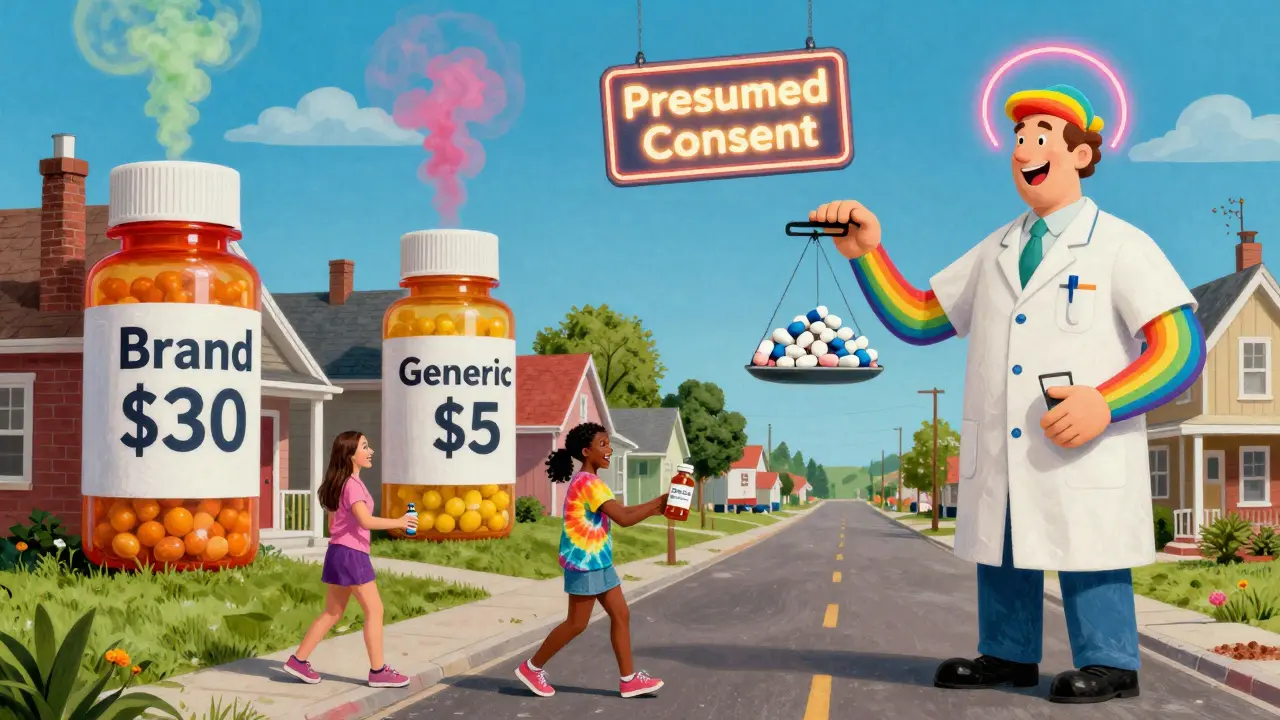
The Secret Weapon: Presumed Consent Substitution Laws
Here’s where things get interesting. Some states let pharmacists swap a brand-name drug for a generic without asking you first. That’s called presumed consent. Other states require the pharmacist to ask you - explicit consent. The difference? Huge. A 2018 NIH study found that states with presumed consent laws saw a 3.2 percentage point increase in generic dispensing compared to those with explicit consent. That might sound small, but multiply that across millions of prescriptions, and you’re talking about billions in savings. The study estimated that if all 39 explicit consent states switched to presumed consent, they’d save $51 billion a year. Why does this work? Because patients rarely say no. Most don’t know the difference. They trust their pharmacist. And if the pharmacist hands them a generic without asking, they take it. No hassle. No paperwork. Just a cheaper pill. Mandatory substitution laws - where pharmacists are forced to switch regardless of patient preference - didn’t have the same effect. Why? Because pharmacists were already incentivized to substitute. The real driver isn’t the law. It’s the patient’s out-of-pocket cost and the ease of the process.The Hidden Cost: When Generics Disappear
There’s a dark side to all these savings. States rely on the Medicaid Drug Rebate Program, which forces drugmakers to pay rebates to get their drugs covered. For generics, that’s a minimum 13% rebate of the average price. But here’s the catch: if a generic drug’s cost goes up due to supply issues, ingredient shortages, or inflation - but the manufacturer can’t raise the price because of rebate rules - they might just stop selling it in Medicaid. Avalere Health found five scenarios where this happens. A generic might be profitable everywhere except Medicaid. And when that happens, the drug vanishes. Patients are left with fewer options. Doctors have to prescribe something else - often more expensive. The state ends up paying more anyway. This isn’t theoretical. In 2022, several common generic antibiotics and blood pressure meds disappeared from Medicaid formularies in multiple states. The reason? The rebate structure made them unprofitable. States thought they were saving money. They were actually making the market less stable.
What’s Next? The Drug List and the Federal Push
The federal government is watching. CMS - the agency that runs Medicare - is testing a new model called the $2 Drug List. It’s simple: for a handful of low-cost generics, Medicare Part D beneficiaries pay just $2 per prescription, no matter what. The goal? Make it so easy and cheap to use generics that patients never even consider the brand. It’s still voluntary and only applies to Medicare. But states are watching closely. If it works, expect them to copy it for Medicaid. The idea is powerful: remove all friction. Make the generic the obvious, effortless choice. Meanwhile, states are still refining their own systems. Some are tying pharmacist bonuses to generic dispensing rates. Others are using real-time alerts in electronic health records to nudge doctors toward generics when they’re writing prescriptions. The tools are getting smarter. The goal hasn’t changed: save money without hurting care.Why This Isn’t Just About Saving Money
It’s easy to think this is just a cost-cutting move. But it’s more than that. It’s about fairness. A person on Medicaid shouldn’t have to choose between food and their blood pressure pill. A working parent shouldn’t skip doses because their copay is too high. Generics make treatment possible for millions who otherwise couldn’t afford it. The real success isn’t in the number of prescriptions filled. It’s in the number of people who stayed on their meds because they could actually pay for them. Studies show that when copays are low, adherence goes up. That means fewer hospital visits, fewer ER trips, fewer complications. And that’s the quiet win. States didn’t just cut costs. They improved health outcomes.Do generic drugs work as well as brand-name drugs?
Yes. The FDA requires generics to have the same active ingredients, strength, dosage form, and route of administration as the brand-name version. They must also meet the same strict standards for purity and performance. The only differences are in inactive ingredients - like fillers or dyes - which don’t affect how the drug works. Generics are tested to be bioequivalent, meaning they work the same way in your body.
Why do some states require patient consent before switching to a generic?
States with explicit consent laws assume patients should have control over their medication choices. But research shows most patients don’t object to generics - they just don’t know they’re being offered one. These laws were originally meant to protect patient autonomy, but they often create unnecessary delays and reduce generic use. Presumed consent laws, which allow substitution without asking, have been shown to increase generic dispensing without reducing patient satisfaction.
Can a pharmacist refuse to substitute a brand-name drug with a generic?
Yes - but only under specific conditions. Even in presumed consent states, pharmacists can refuse if the prescriber writes "dispense as written" or "no substitution" on the prescription. They can also refuse if the patient objects, if the generic isn’t available, or if the drug is on a state’s list of exceptions (like certain controlled substances or narrow-therapeutic-index drugs). The rules vary by state, but the default is always substitution unless blocked.
Why do some generic drugs disappear from pharmacy shelves?
It’s often due to the Medicaid rebate system. Generic manufacturers must pay rebates to states based on drug prices. If production costs rise - due to ingredient shortages, labor issues, or inflation - but the manufacturer can’t raise the price because of rebate caps, the drug becomes unprofitable to sell in Medicaid. When that happens, companies stop supplying it. This leads to shortages, even when the drug is still available elsewhere. It’s a systemic flaw in how cost controls are designed.
How do Preferred Drug Lists affect my doctor’s choices?
They shape prescribing behavior without banning anything. If your doctor wants to prescribe a drug not on the state’s Preferred Drug List, they may need to get prior authorization - which takes time and paperwork. Many doctors just pick from the list to avoid delays. Most drugs on these lists are generics because they’re cheaper and equally effective. So while your doctor still has the freedom to choose, the system makes the generic the easiest, fastest option.

Marlon Mentolaroc
January 23, 2026 AT 20:32So let me get this straight - states are basically playing behavioral economics on us? I love it. Lower copays, automatic substitution, PDLs - it’s like they built a nudging machine for generic drugs. And the best part? People don’t even notice they’re being guided. I’ve switched to generics for years and never thought twice. Now I know why.
Gina Beard
January 25, 2026 AT 17:14Efficiency is compassion in disguise.
Don Foster
January 27, 2026 AT 06:41People think generics are cheap because they're inferior but the FDA requires bioequivalence so if you're still paranoid about generics you're either lying to yourself or you've been sold a brand name marketing scam for 20 years and now you're emotionally attached to your $40 pill that does the exact same thing as the $3 one
Phil Maxwell
January 27, 2026 AT 20:37Had a friend on Medicaid who stopped taking her blood pressure med because the brand was $50 and the generic was $5. She didn't know they were the same. When she found out she was mad not because she was tricked but because she'd been paying too much for years. This system helps people who don't even know they need help.
Patrick Gornik
January 29, 2026 AT 15:21Ah yes the noble quest to optimize pharmaceutical equity through bureaucratic choreography - a symphony of rebate structures, presumed consent, and formulary gatekeeping. The irony? We’ve engineered a system where cost containment becomes a proxy for moral superiority, yet the very mechanism designed to empower patients - the rebate - is the same one that causes drug shortages. Capitalism doesn’t fail here. It succeeds too well. And the patients? They’re just the collateral in a beautifully rationalized tragedy
Luke Davidson
January 30, 2026 AT 06:12Man I used to think generics were sketchy until my dad switched to one for his cholesterol med and saved $80 a month. He said he felt like a genius. And yeah it worked just as good. Now my whole family uses generics. Why pay more if it’s the same? The system ain’t perfect but it’s helping real people
Karen Conlin
January 31, 2026 AT 08:04Let me tell you something - this isn’t just policy. This is survival. I’ve seen single moms skip doses because the copay was $40. Generics aren’t a cost-cutting gimmick - they’re a lifeline. And when pharmacists can swap without asking? That’s not invasion of autonomy. That’s removing a barrier. People don’t want paperwork. They want to live. This system lets them.
Sushrita Chakraborty
February 2, 2026 AT 05:40While the implementation of presumed consent laws has demonstrably increased generic dispensing rates, it is imperative to acknowledge the ethical dimensions of patient autonomy. In jurisdictions where explicit consent is mandated, the preservation of individual agency is prioritized, even at the expense of marginal efficiency gains. A balanced approach, informed by empirical data and humanistic values, is thus warranted.
Josh McEvoy
February 4, 2026 AT 05:12bro the fact that i didn't know generics were the same as brand names until i was 25 is wild 😳 like i thought they were like knockoff sneakers but nooo they're literally the same pill just without the fancy packaging. also why is my copay $30 for a brand and $2 for generic?? i feel like i got scammed for a decade
Heather McCubbin
February 4, 2026 AT 20:16So now we're treating people like children? 'Oh don't worry honey we'll just swap your pill without asking you' - what happened to informed consent? This isn't efficiency. It's paternalism wrapped in a savings report. And don't even get me started on how these 'formularies' are just corporate lobbying in disguise. Who really benefits here? Not you. Not me. The drug companies.
Shanta Blank
February 6, 2026 AT 03:46They call it 'savings' but when the generic disappears because the rebate structure makes it unprofitable? That’s not a win. That’s a trap. States think they’re being smart - but they’re just playing Jenga with people’s lives. One wrong move and the whole tower collapses. And then suddenly your blood pressure med is gone and you’re scrambling for something $200 a month. Congrats. You saved $50 billion. Now someone’s in the ER.
Tiffany Wagner
February 8, 2026 AT 02:09My pharmacist just swaps my meds without asking and I’m fine with it. I don’t care what it’s called as long as it works. And honestly? I’d rather save $30 than argue about a label. If it’s FDA-approved, I’m good.
Jenna Allison
February 8, 2026 AT 12:53For anyone confused: generics have the same active ingredient, same dose, same way your body absorbs it. The only differences are fillers - like the stuff holding the pill together. Think of it like two identical cars, one with a nicer paint job. The brand is the fancy paint. The generic? Same engine. Same safety rating. Just cheaper. No magic. No scam.
Vatsal Patel
February 9, 2026 AT 05:59Oh so now we’re proud of tricking people into taking cheaper pills? Brilliant. Let’s just assume everyone’s too dumb to know what they’re taking. That’s not healthcare. That’s condescension with a spreadsheet. And don’t even mention the 'savings' - those are just accounting illusions while the real cost is paid in disrupted care when the generics vanish. You’re not fixing the system. You’re just hiding the cracks.
Himanshu Singh
February 10, 2026 AT 06:58There’s something beautiful here - when a system helps someone afford their medicine without them even realizing they’re being helped. It’s quiet. It’s practical. It doesn’t shout. It just works. That’s the kind of change we need. Not grand speeches. Just better design. And yeah - if a pharmacist swaps your pill and you don’t notice? That’s not a flaw. That’s a feature.