Every month, millions of Americans fill prescriptions for generic medications-metformin for diabetes, lisinopril for blood pressure, levothyroxine for thyroid issues. These drugs are cheaper than brand names, sure. But for many, even $5 or $10 a month adds up. And if you’re on a fixed income, working two jobs, or just barely making ends meet, that $30 for three generics can mean skipping a meal or delaying a doctor’s visit. The truth? Generic copay assistance isn’t as obvious as brand-name programs, but it’s real-and you can get it.
Why Generics Still Cost Too Much
Generic drugs cost 80-85% less than brand names. That’s not a guess-it’s from the Association for Accessible Medicines. In 2023, generics made up 92% of all prescriptions in the U.S. But they only accounted for 23% of total drug spending. Sounds fair, right? Not for everyone. Here’s the problem: insurance plans still charge copays. Even if your drug is a generic, your plan might make you pay $10 per fill. That’s $120 a year. For someone on Social Security, that’s a third of a monthly check. And if you take five generics? That’s $600 a year-money that could go to rent, groceries, or heat. Worse, many people assume generics don’t need help. A 2023 study in the Annals of Internal Medicine found that 38% of patients skipped their generic meds because they thought they couldn’t afford them-even though the price was low. They didn’t know help existed.Who Actually Gets Help?
The biggest source of generic drug help isn’t a drug company. It’s the government. If you’re on Medicare and have a low income, you might qualify for Extra Help (also called the Low-Income Subsidy). In 2025, this program caps your generic copay at exactly $4.90 per prescription. That’s it. No more, no less. You also won’t pay a deductible. If you’re getting Medicaid, SSI, or a Medicare Savings Program, you’re automatically enrolled. But here’s the gap: if you earn just above the limit-say, $37,150 a year for one person-you don’t qualify for Extra Help. And you’re not rich enough to afford $30/month in copays. That’s the “assistance cliff.” About 2.3 million seniors could hit this by 2026. Commercial insurance patients face their own hurdles. Most plans put generics in Tier 1 with $5-$10 copays. But unlike brand-name drugs, there are no manufacturer copay cards. Generic makers don’t offer them. Their margins are too thin.Where to Find Real Help-No Ads, No Scams
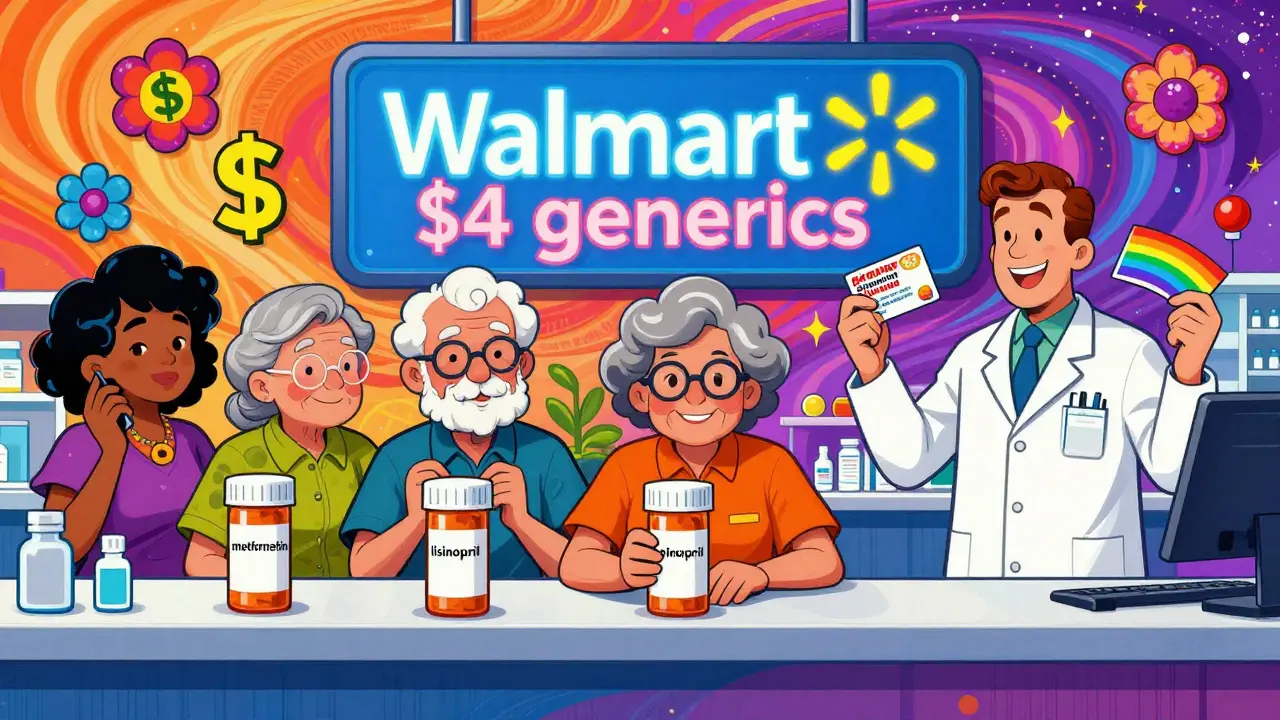
You don’t need to sign up for 10 websites or give out your credit card. Here are five proven, free ways to cut your generic drug costs right now:- Walmart’s $4 Generics List - Covers over 150 common generics. No insurance needed. Just ask for the list at the pharmacy counter. Drugs like metformin, levothyroxine, and atorvastatin are on it. Price: $4 for a 30-day supply, $10 for 90 days.
- Kroger’s $15 Generics Program - Similar to Walmart. Available at Kroger, Fred Meyer, and Ralphs. Includes 90-day supplies of blood pressure, cholesterol, and thyroid meds.
- SingleCare, GoodRx, or RxSaver - These are pharmacy discount cards. They’re not insurance. You use them instead of insurance. They work with Walmart, CVS, Walgreens, and more. In 2023, SingleCare had over 14 million users. Search your drug + “discount card” to find the best price.
- Medicare Savings Programs (MSP) - Even if you don’t qualify for Extra Help, you might qualify for MSP. These state-run programs pay your Medicare Part B premiums and sometimes reduce copays. Apply through your State Health Insurance Assistance Program (SHIP). They’ll help you fill out the forms. No fee.
- PAN Foundation - A nonprofit that helps with copays for specific conditions. As of 2024, 17 of its 72 programs cover generic-only treatments like hypertension, diabetes, and hypothyroidism. You need to be under 400% of the federal poverty level ($62,600 for a family of four). Approval takes about 3 weeks.
What Doesn’t Work (And Why)
Not all help is real help. Here’s what to avoid:- Manufacturer copay cards for generics - They don’t exist. If someone says they do, it’s a scam.
- Combining discount cards with insurance - You can’t use both. If you use a GoodRx card, your insurance won’t pay. But if you’re paying $40 with insurance and $10 with GoodRx, use GoodRx. Simple.
- Assuming your plan covers everything - Even with insurance, your copay might be high. Check your formulary. Ask your pharmacist to run a price check before you pay.
- Waiting until you can’t afford it - The average person waits 4 months before skipping meds. By then, their condition worsens. That leads to ER visits. That costs more.
The Big Change Coming in 2025
Starting January 1, 2025, the Inflation Reduction Act changes everything for Medicare beneficiaries.- Your out-of-pocket drug costs will be capped at $2,000 per year (down from $8,300).
- Extra Help recipients will pay $0 deductible and $2/month for insulin (even generic).
- During the coverage gap, no one pays more than $100 per quarter for generics.

How to Apply: Step-by-Step
If you think you qualify for help, here’s how to move fast:- Make a list - Write down every generic you take, the dose, and how often you refill.
- Check prices - Go to GoodRx or SingleCare. Type in each drug. Note the cash price vs. your insurance copay.
- Call your pharmacy - Ask: “Do you accept Walmart’s $4 list?” or “Can I use a discount card here?” Most pharmacists will help.
- Apply for Extra Help - Go to medicare.gov and search “Extra Help.” Fill out the online form. It takes 15 minutes. You’ll get a decision in 2-4 weeks.
- Apply for MSP - Call your local SHIP counselor. Find them at shiphelp.org. They’ll walk you through it. No cost.
- Apply to PAN Foundation - If your condition is covered (diabetes, hypertension, etc.), go to panfoundation.org. You’ll need your doctor’s signature and proof of income.
Real Stories: What It Looks Like
One woman in Ohio, 72, on Social Security, takes five generics. Before Extra Help, she paid $45 a month. After? $24.50 total. “I used to skip my blood pressure pill every other week,” she said. “Now I take them every day. I sleep better.” A man in Texas, 58, works two jobs. He makes $2,100 a month. His three generics cost $32 a month after insurance. He doesn’t qualify for Medicaid because he makes $300 too much. He uses GoodRx. Now he pays $12 a month. “It’s not perfect,” he said. “But it’s enough.”What You Can Do Today
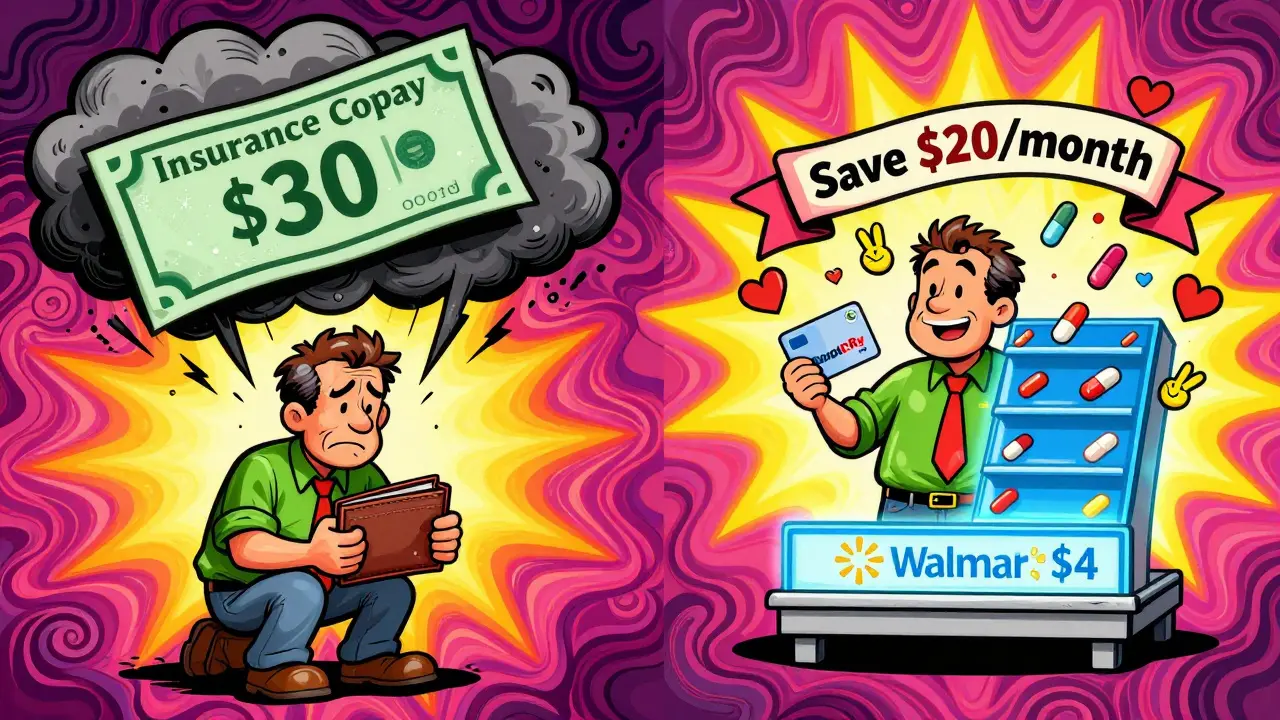
Don’t wait for a bill to arrive. Don’t assume you’re not eligible. Don’t think generics don’t need help. Start with one step: Go to GoodRx or SingleCare. Search your most expensive generic. See what the cash price is. Compare it to your insurance copay. If the cash price is lower, use it. Keep the receipt. You might be saving $20 a month right now. Then, call your local SHIP counselor. Ask: “Can I qualify for Extra Help or a Medicare Savings Program?” They’re there to help. No judgment. No pressure. The system isn’t perfect. But the tools are there. And if you use them, you can cut your generic drug costs by 50%, 70%, even 90%. You don’t need to be poor to deserve affordable medicine. You just need to know where to look.Can I use a discount card like GoodRx with my Medicare Part D?
No, you cannot combine a discount card with Medicare Part D. But you can choose which one to use at the pharmacy. If the cash price on GoodRx is lower than your Medicare copay, pay cash. Medicare won’t cover it, but you’ll save money. Always ask the pharmacist to compare both prices before you pay.
Do generic drug manufacturers offer copay cards?
No. Generic manufacturers operate on very thin profit margins and do not offer copay assistance cards. If someone claims to have one, it’s likely a scam or a mislabeled brand-name card. Always verify the drug’s manufacturer before trusting a copay card.
What if I make too much for Medicaid but still can’t afford my generics?
You’re not alone. Many people fall into the “assistance gap”-earning too much for Medicaid but too little to afford out-of-pocket costs. Your best options are pharmacy discount programs (Walmart, Kroger, SingleCare), applying to the PAN Foundation if your condition is covered, and checking if you qualify for a Medicare Savings Program-even if you’re not on Medicare yet.
Will the $2,000 cap in 2025 help people on private insurance?
No. The $2,000 annual out-of-pocket cap only applies to Medicare Part D beneficiaries. People with private insurance are not covered by this change. You’ll still need to use discount cards, pharmacy programs, or nonprofit aid to lower your costs.
How do I know if my generic is on Walmart’s $4 list?
Visit walmart.com/pharmacy and click on “$4 Prescriptions.” You’ll see a searchable list of over 150 generics. Common ones include metformin, levothyroxine, lisinopril, atorvastatin, and amlodipine. You can also ask your pharmacist for a printed copy-they keep them at the counter.
Can I apply for multiple assistance programs at once?
Yes. In fact, people who use two or more programs save the most. For example, use GoodRx for one drug, Walmart’s $4 list for another, and PAN Foundation for a third. There’s no rule against combining help. The key is to apply for everything you might qualify for-even if you’re not sure.
What if my pharmacy won’t honor a discount card?
Most major chains like CVS, Walgreens, and Walmart accept discount cards. If a small independent pharmacy refuses, ask them to call the card provider’s customer service line. Many discount programs have a 24/7 support line that can verify the price. If they still refuse, try another pharmacy. Prices vary by location-even within the same chain.
Adewumi Gbotemi
January 10, 2026 AT 17:44Wow, this is so helpful. I didn’t know Walmart had $4 generics. My dad takes metformin and he’s always complaining about the cost. I’m printing this out for him tonight.
Alfred Schmidt
January 10, 2026 AT 20:46Stop pretending this is a solution!!! The system is BROKEN. $4 for metformin? That’s a band-aid on a gunshot wound. Drug companies are ROBBING us blind, and you’re telling people to go to Walmart like it’s a grocery store? This isn’t charity-it’s systemic failure. And don’t get me started on PAN Foundation’s 3-week wait-people DIE waiting!!!
Priscilla Kraft
January 12, 2026 AT 05:59Thank you for this!! 🙏 I’ve been using GoodRx for my levothyroxine and saved $28/month-life-changing. Also, SHIP counselors are angels on earth. I called mine last week and they helped me get into MSP. No judgment, just help. You’re not alone. 💛
Vincent Clarizio
January 12, 2026 AT 17:25Let’s be real here-this whole thing is a tragic farce wrapped in a bureaucratic nightmare. We live in a country where a 72-year-old woman has to choose between her blood pressure meds and her heating bill, and the ‘solution’ is a discount card? The pharmaceutical-industrial complex has turned healthcare into a game of Russian roulette with your life. And we’re patting ourselves on the back for finding $4 pills? This isn’t innovation-it’s surrender. The fact that we’ve normalized this as ‘acceptable’ says more about us than it does about the system. We’re not fixing medicine-we’re just learning how to survive it.
Roshan Joy
January 14, 2026 AT 13:59This is gold! I’m from India and we have similar issues here-people skip meds because of cost. But I never knew about Walmart’s $4 list. Will share with my cousin in Texas. Also, PAN Foundation is new to me-thanks for the link!
Michael Patterson
January 15, 2026 AT 22:32Everyone’s acting like this is some revolutionary guide but let me tell you something-most of these programs are a waste of time. I applied to PAN last year. Took 5 weeks. They asked for 17 documents. My doctor had to fax 3 forms. And then they denied me because my ‘income was too high’ even though I work 70 hours a week. Don’t waste your time. Just pay cash or don’t take it. Simple.
Matthew Miller
January 17, 2026 AT 21:41Why are you even writing this? People who need this are too stressed to read 10 paragraphs. You think they’re sitting around Googling ‘Walmart $4 list’ while their kidneys are failing? This is performative activism. Real help would be price controls. Not discount cards. Not apps. Not ‘checking your formulary.’ Stop pretending this is helpful. It’s not.
Madhav Malhotra
January 19, 2026 AT 14:16Love how you included real stories. My uncle in Mumbai takes insulin and pays $2 a month because of a local NGO. It’s not perfect, but it works. Maybe we need more community-based solutions like this, not just corporate or government fixes.
Priya Patel
January 21, 2026 AT 13:44OMG I just used GoodRx for my lisinopril and paid $8 instead of $35. I cried. Like, actually cried. Thank you for making this so clear. I feel less alone now. 🥹❤️
Jennifer Littler
January 22, 2026 AT 22:07While the resource list is accurate, the structural critique is absent. The real issue is the fragmentation of U.S. pharmaceutical reimbursement models-Tiered formularies, PBMs, and the absence of reference pricing create artificial scarcity. Discount cards are symptom management, not systemic intervention. The Inflation Reduction Act’s $2K cap is a start, but only for Medicare. Private payers remain unregulated. We need national price negotiation. Period.
Jason Shriner
January 23, 2026 AT 09:10so… you’re telling me i have to go to walmart and ask for a list… instead of just… getting my meds? wow. what a breakthrough. next you’ll tell me to breathe.
Sean Feng
January 24, 2026 AT 18:44Sam Davies
January 24, 2026 AT 19:13How quaint. A $4 generic. How very… American. In the UK, we just get it for free. But hey, at least you’ve got a coupon. Bravo. I’m sure your pharmacist appreciates the effort.